Saint Gregory the Great
c. 540 - March 12, 604
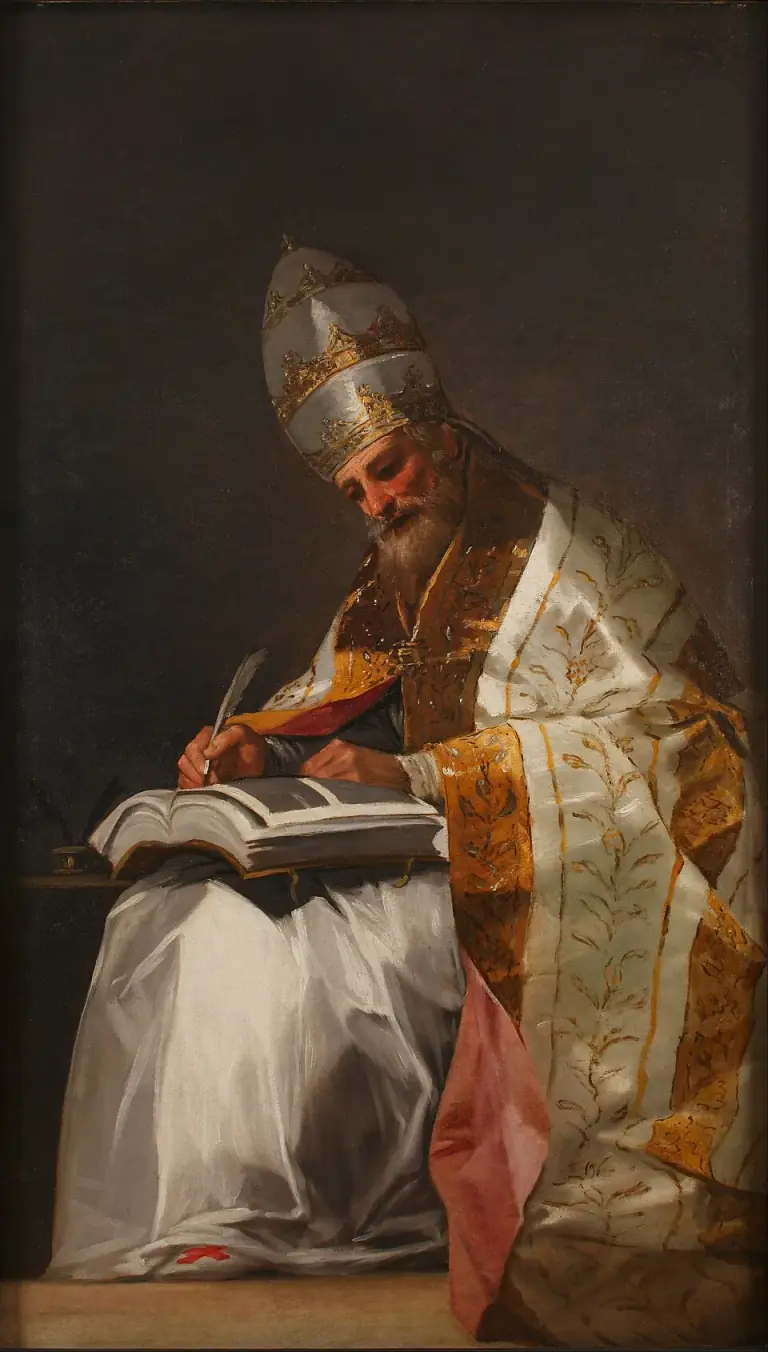
- Patron saint of
- England, epilepsy, musicians, and teachers 3
- Died
- March 12, 604, and buried the same day at St Peter's 2
- Pope
- Bishop of Rome from 590 to 604 1
Saint Gregory the Great ran the city of Rome before he was thirty, gave it up to turn his family house into a monastery, and was then elected pope in the middle of a plague against his own strenuous objections. 123 He held the office for fourteen years while in almost constant pain, and an Anglican historian quoted by Franciscan Media called him the real father of the medieval papacy. 3 He died on March 12. His feast is September 3, and the difference between those two dates is not an accident.
Prefect of Rome, and then a monk
Gregory was born at Rome about the year 540 into the gens Anicia, a rich patrician family that had already given the Church two popes - Felix III, his great-great-grandfather, and Agapetus. 1 His parents, Gordian and Silvia, are both venerated as saints, and two of his father's sisters lived as consecrated virgins in their own home. 1 The house stood on the Clivus Scauri among the surviving monuments of ancient Rome. 1
He went into public administration like his father and reached the top of it in 572, when he became Prefect of the city. 1 Franciscan Media puts his age at the time bluntly: prefect of Rome before he was thirty. 3 Benedict XVI notes what he took from the work - "a deep sense of order and discipline," to the point that as pope he would tell bishops to manage the Church's affairs with the diligence and respect for law of good civil servants. 1
It did not hold him. After about five years he resigned, gave up every civil office, founded six monasteries on the family estates in Sicily, and turned his own house on the Coelian Hill into the monastery of St Andrew, where he became a monk. 13 Benedict describes those years as "a perennial nostalgia which he referred to ever anew and ever more in his homilies" - a happy time of recollection, prayer and study that he kept looking back at from under the weight of everything that came later. 1
Constantinople
The retirement lasted a few years. Pope Pelagius made him a deacon and sent him to Constantinople as apocrisarius - "today one would say 'Apostolic Nuncio'," Benedict glosses - to help settle the last of the Monophysite controversy and, more urgently, to get imperial support against the Lombards. 1 He took a group of monks with him and went on living monastically in the imperial capital. 1
It was the education that made the rest possible. He came home knowing the Byzantine world from the inside and having had to think hard about the Lombard problem, which would occupy most of his pontificate. 1 Recalled to Rome, he was made the pope's secretary. 1
Elected in a plague, against his will
The years that followed were miserable in Rome: continual rain, rivers overflowing, famine across much of Italy, and finally plague. Pope Pelagius II died of it. 1 The clergy, the people and the senate settled unanimously on Gregory. 1
He did not want it. Benedict says he tried to resist and even attempted to flee. 1 The encyclopedia is more specific - "The saint was terrified at the news and even meditated flight. He was seized, however, carried to the Basilica of St. Peter, and there consecrated pope on 3 September, 590." 2 It also refuses the more dramatic version: the story that he actually fled the city, hid in a forest for three days and was found by a supernatural light "seems to be pure invention," appearing first in a life written at Whitby. 2
Recognizing the will of God in what had happened, Benedict writes, "the new Pontiff immediately and enthusiastically set to work." 1 He was fifty. 3
What he actually did with it
About eight hundred of his letters survive in the Register, and Benedict uses them to show the range of what landed on his desk daily from bishops, abbots, clergy and civil authorities of every rank. 1 Franciscan Media summarizes the housekeeping: he removed unworthy priests, forbade taking money for many services, and emptied the papal treasury to ransom prisoners taken by the Lombards and to care for persecuted Jews and for victims of plague and famine. 3
The Lombard question was the political one, and his approach to it separated him from the emperor. Constantinople assumed the Lombards were predators to be exterminated; Gregory, Benedict writes, "saw this people with the eyes of a good pastor," worked for peace founded on mutual respect and coexistence, and negotiated directly with their king, Agilulf. That produced a truce of about three years from 598 and a firmer armistice in 603. 1 Much of it ran through Queen Theodolinda, a Catholic Bavarian princess whose letters from Gregory survive and who drew her husband toward the Church; Benedict calls the whole episode "a beautiful testimony to the importance of women in the history of the Church." 1
With the revenues of the Roman see's estates, especially in Sicily, he bought and distributed grain, supported priests, monks and nuns living in poverty, and paid for ransoms and truces. 1 He demanded that tenants on Church land be protected from dishonest agents and compensated quickly when they were cheated, "so that the face of the Bride of Christ was not soiled with dishonest profits." 1 The people of Rome called him consul Dei. 1
And he sent forty monks from his own monastery to England under Augustine of Canterbury, which is the single decision of his that changed the most. 13
Ill the entire time
None of this was done from a position of strength. Gregory was often confined to bed for days on end. The fasts of his monastic years had left him with serious digestive problems that never resolved, and his voice was so weak that he frequently had to hand his homilies to a deacon to read aloud so the congregation could hear them. 1
The encyclopedia records how it ended. His mind, "naturally serious, was filled with despondent forebodings," his bodily pain increased, and his "sole consolation was the hope that death would come quickly." He died on 12 March 604 and was buried the same day in the portico of St Peter's. 2
Benedict's reading of him is worth setting against that: "He was a man immersed in God... Indeed, during a desperate period of havoc, he was able to create peace and give hope." 1 Both things are true at once, and the profile of a competent, generous administrator who spent much of his pontificate wishing to die is more useful than either half alone.
Pastoral Care, and the chant
His book on the duties and qualities of a bishop, Pastoral Care, was read for centuries after his death. In it he describes bishops mainly as physicians whose work is preaching and the enforcement of discipline. 3 Franciscan Media notes that his own preaching was down-to-earth and skilled at applying the day's Gospel to what his listeners actually needed, and that "Called 'the Great,' Gregory has been given a place with Augustine, Ambrose, and Jerome, as one of the four key doctors of the Western Church." 13
On the music that carries his name, the honest position is the one Franciscan Media takes: "Whether he was largely responsible for the revision of 'Gregorian' chant is disputed." 3 He is nonetheless listed by the same source as a patron of musicians, and both facts are printed here rather than one.
Franciscan Media also quotes an Anglican historian on his long effect: "It is impossible to conceive what would have been the confusion, the lawlessness, the chaotic state of the Middle Ages without the medieval papacy; and of the medieval papacy, the real father is Gregory the Great." 3
What is Saint Gregory the Great the patron saint of?
Saint Gregory the Great is the patron saint of England, epilepsy, musicians, and teachers. 3 England follows from the mission he sent under Augustine of Canterbury. 13 Teachers follows from Pastoral Care and from a pontificate spent explaining things. 3 The other two are stated by the source without an explanation, and none is supplied here.
Saint Gregory the Great's feast day
The feast of Saint Gregory the Great is September 3. 3 He died on March 12, 604. 12 The feast is not the anniversary of his death, then - September 3, 590 is the date the encyclopedia gives for his consecration as Bishop of Rome. 2 Neither source states why the day was chosen, so this page does not claim to know.
This is worth stating plainly because the mistake is easy and common. The 1909 encyclopedia article does not give a feast day for Gregory anywhere - it gives his death, his consecration, and, in a line about his family, the November 3 feast of his mother Silvia. 2 A reader in a hurry could take any of the three for his own. Franciscan Media is the source cited here for September 3, and it is the one that actually states it. 3
Praying with Saint Gregory
Gregory got what he wanted for a few years and then lost it for the rest of his life. The monastery was the thing he had chosen freely, and he was pulled out of it first to be a diplomat and then to be pope, and he never stopped missing it. 1 He did the second job extremely well while grieving the first, which is a more common shape of vocation than the version where the calling and the wish coincide.
He was consecrated in a city with plague in it, having tried to run away. 12 The account of a man being seized and carried to St Peter's is not usually how we picture accepting God's will. 2 What followed was fourteen years of grain shipments, ransom payments, letters and negotiations with an invading king.
The detail about his voice is the one to keep. He was too weak to be heard, so the homilies he had written were read out by somebody else while he sat there. 1 Anyone whose capacity has dropped below what their responsibilities require has a saint who governed the Western Church from bed and handed his words to a deacon.
He wrote that his only consolation was the hope that death would come quickly. 2 That sentence sits in the same article as the mission to England and the eight hundred letters. 12 The work was not the fruit of feeling well, and he did not wait to feel better before doing it.
Saint Gregory the Great, pray for us.
Sources
Saints to turn to next
Others in this collection who are turned to for some of the same things.
- Saint Angela MericiMarch 21, 1474 - January 27, 1540Study and teachingWork and vocationDiscernment
- Saint Jadwiga of Poland1373 - July 17, 1399Study and teachingDiscernmentWork and vocation
- Saint John BerchmansMarch 13, 1599 - August 13, 1621Study and teachingDiscernmentWork and vocation
- Saint Ephremc. 306 - June 9, 373Study and teachingWork and vocation