Saint Jadwiga of Poland
1373 - July 17, 1399
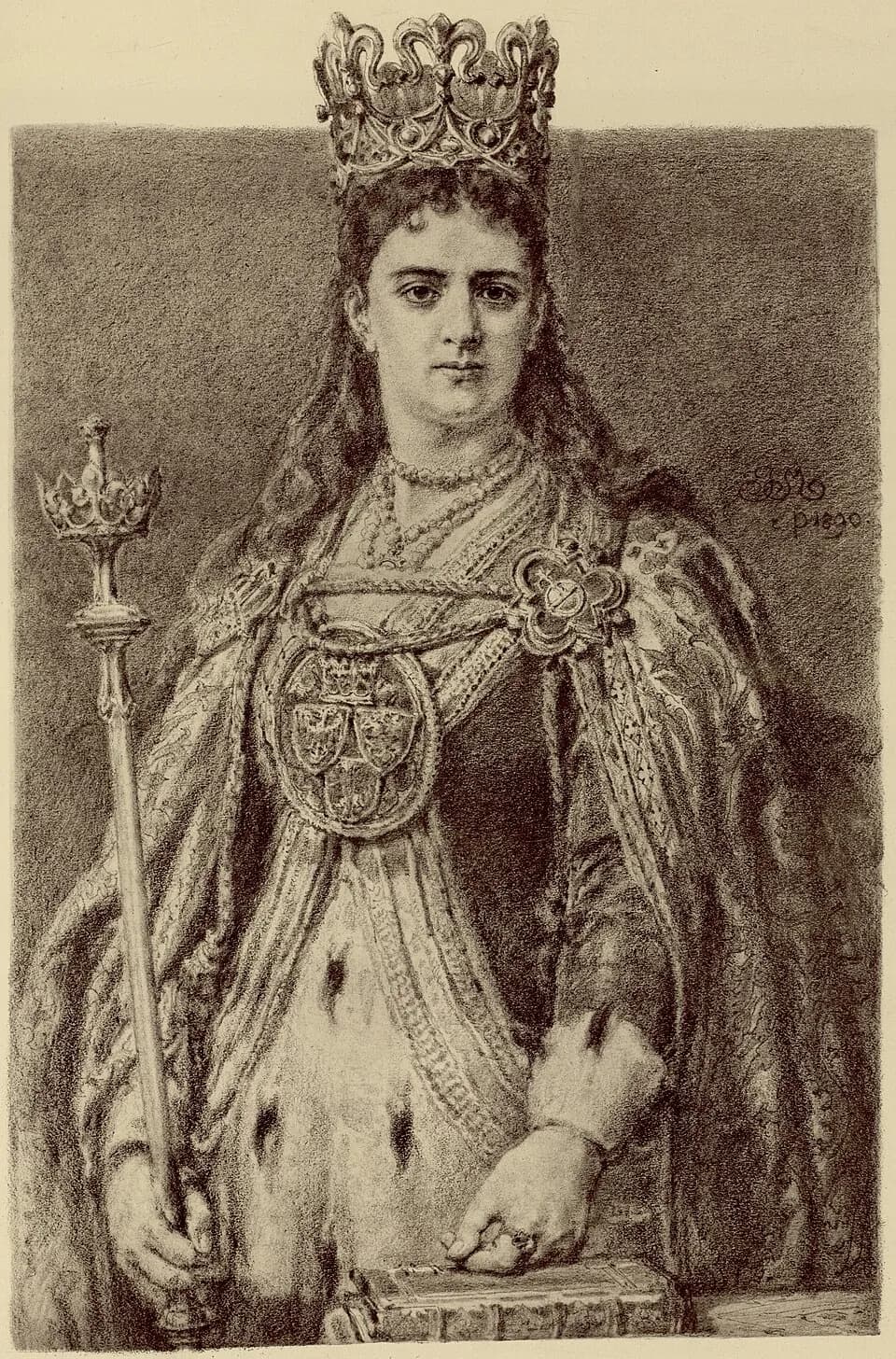
- Not to be confused with
- Saint Hedwig of Silesia, an earlier princess of the same name, whom Saint Kinga took as her patroness 6
Saint Jadwiga was crowned "king" of Poland as a child in 1384, married the pagan Grand Duke of Lithuania on condition that he and his people be baptized, and won a theology faculty for the University of Krakow before she died after childbirth in 1399. 2578 She is the Hedwig whom John Paul II called the Lady of Wawel, and not Saint Hedwig of Silesia, an earlier princess whom Saint Kinga took as her patroness. 16 John Paul II canonized her in Krakow on June 8, 1997, almost six hundred years after her death, and her feast is kept on July 17. 178
A king's daughter with no brothers
Jadwiga was born in 1373, the youngest of three daughters of Louis the Great, King of Hungary and of Poland, and Elizabeth of Bosnia. 78 The Dialog gives her birthplace as Budapest, which in her day meant Buda, the Hungarian royal seat. 8 Louis had no son. 78 According to Galway Cathedral, the eldest daughter, Catherine, died in 1378 and the second, Mary, was crowned in Hungary; the Polish nobles would not accept a ruler who lived outside the country, and so Poland fell to the youngest. 7
The 1911 Catholic Encyclopedia says she succeeded her father "after much hesitation on her part" in 1384. 5 She was crowned king of Poland, not queen. 78 Galway Cathedral offers two reasons for the title, to stress that she reigned in her own right or to keep a future husband from claiming it, and The Dialog adds that it meant the nobles could recognize any husband of hers as king only with their consent. 78
The marriage to Jagiello
She had been betrothed as a child to William of Habsburg and had lived in Austria for two years; Galway Cathedral says the two "seemed to have been fond of one another." 7 Some of the Polish lords judged William too weak, and proposed instead Jagiello, Grand Duke of Lithuania. 7 He was a pagan. 78 The 1911 encyclopedia puts the Polish condition plainly: he could marry the queen only if "he and all his people should embrace Christianity." 5 Poland and Lithuania also shared an enemy in the Teutonic Knights, once a crusading order and by then a power on the Baltic. 7
Galway Cathedral says she prayed long before the crucifix in Wawel Cathedral, and repeats, with an "it is said", the tradition that Christ spoke to her from it: "Do what you see." 7 She consented. 7 Jagiello was baptized on February 4, 1386, taking the name Wladyslaw, and they married three days later. 7 Galway Cathedral gives his age as thirty-five and hers as twelve. 7 He was crowned king on the strength of being her consort, and soon after, the encyclopedia says, a large body of clergy crossed into Lithuania and the people "were baptized in vast multitudes." 5
John Paul II made the baptism of Lithuania the center of his canonization homily. "Hedwig knew that her mission was to bring the Gospel to her Lithuanian brothers and sisters," he said, and she accomplished it "with the help of her consort." 1 Through her, he said, the Poles, baptized in the tenth century, "four centuries later undertook the apostolic mission" to their neighbors. 1
Queen and diplomat
The two did not share a language, Galway Cathedral notes, but they worked together from the start. 7 She traveled with him through Greater Poland to win over nobles hostile to him, and when the royal progress damaged the peasants' land she insisted they be paid for it. 7 Her mother was murdered and her sister captured in the troubles that followed, and much of the reign went to defending the kingdom against the Teutonic Knights and the lords of Ruthenia. 7
John Paul II called her "an expert in the art of diplomacy" who "laid the foundations for Poland's greatness in the 15th century," and said that her subjects often praised "her sensitivity to social wrongs." 1 Galway Cathedral adds that she spoke Polish, Hungarian, Latin, German and Italian. 7 Both diocesan sources say she went to Mass every day, and The Dialog calls her a peacemaker in a region always at war. 78
The University of Krakow
Casimir the Great had founded a university at Krakow in 1364, but John Paul II explained that it was not yet a full university, because it lacked a faculty of theology. 4 Jadwiga asked Pope Boniface IX for one "untiringly", and in 1397 he granted it by the bull Eximiae Devotionis Affectus. 2 "Only then," the Pope said, "did the University of Krakow begin fully to exist on the map of the European universities." 2 It is named the Jagiellonian University after the dynasty she and her husband founded. 17
The story told at the canonization was that "she gave to the University even her golden sceptre, using instead one of gilded wood." 1 Galway Cathedral says she also gave her jewels to pay for Lithuanian students, funded a translation of the Bible and of the Fathers for Wawel Cathedral, and founded a college of psalmists to praise God day and night. 7 John Paul II named Paweł Włodkowic and Nicholas Copernicus among those the university went on to form, and said that a century of Krakow saints came out of it. 12
She was as concerned with the sick. John Paul II pointed to the medieval hospitals at Biecz, Sandomierz, Sącz and Stradom as "works of mercy founded by the Polish Sovereign." 1 The Dialog says she also supported the building of new churches and the restoring of old ones, and promoted prayer and hymns in Polish. 8
Her death in 1399
In 1399 she gave birth to a daughter. 78 Galway Cathedral says the baby died a few weeks later and Jadwiga four days after that, of complications from the birth; The Dialog says the daughter did not survive the birth. 78 She died on July 17, 1399, and was buried with the child in Wawel Cathedral. 8 Jagiello reigned for another thirty-five years. 7
Galway Cathedral says her cause was opened in 1426. 7 For centuries, John Paul II said in the Angelus after the canonization, students and schoolchildren had come to her tomb at Wawel and left the badges of their schools there. 3 "It seemed that your canonization was even impossible," he told her in the homily, before declaring that Krakow had "not been wrong in venerating Hedwig for centuries as a saint." 1
What is Saint Jadwiga the patron saint of?
At her canonization John Paul II said the Church was proclaiming her "the holy Patron of Poland in its hereditary line," of the Poland joined "with Lithuania and Rus'." 1 In the Angelus the same day he called her the special patroness of Krakow's young people. 3 The Dialog calls her the patron saint of queens. 8
Saint Jadwiga's feast day
Praying with Saint Jadwiga
She did not choose her husband. Galway Cathedral says she "eventually discerned" that the marriage was right, after long prayer before the Wawel crucifix, and the consent opened Lithuania to baptism. 17 John Paul II told the crowd at Krakow that her "deep wisdom and intense activity flowed from contemplation," and that she often knelt before that same crucifix "to learn this generous love from Christ himself." 1
She spent what she had on things that would outlast her: a theology faculty, scholarships, hospitals, and her own golden sceptre, given to the university. 127 The Pope called the wooden sceptre "a great symbol", meaning that her standing "came not from royal insignia but from her strength of spirit, depth of mind and sensitivity of heart." 1
She died in her twenties, within days or weeks of her only child. 78 Her reign was short, and none of the sources consulted reports a miracle in it. 178 What the canonization homily praised was "her spirit of service", which it called "the measure of her greatness." 1
John Paul II ended his homily asking her to teach the country "that wisdom and love which you made your path to holiness," and to lead it to the crucified Christ of Wawel, "so that, like you, we may know what it means to love in deed and in truth." 1
Saint Jadwiga of Poland, pray for us.
Sources
- 1.Pope John Paul II, Homily at the Holy Mass for the Canonization of Blessed Queen Hedwig, Krakow, June 8, 1997.
- 2.Pope John Paul II, Address at the Meeting with the Rectors of Polish Universities, Krakow, June 8, 1997.
- 3.Pope John Paul II, Angelus, Blonia Krakowskie, Krakow, June 8, 1997.
- 4.Pope John Paul II, General Audience, June 18, 1997, on his pilgrimage to Poland.
- 5.E. Kolodziejczyk, "Poland," The Catholic Encyclopedia, vol. 12 (New York: Robert Appleton Company, 1911).
- 6.Pope John Paul II, Homily at the Canonization of Blessed Kinga, Stary Sacz, June 16, 1999.
- 7."Saint of the Month: St Jadwiga," Cathedral of Our Lady Assumed into Heaven and St Nicholas, Galway (Diocese of Galway).
- 8.Virginia Durkin O'Shea, "Our Lenten Journey, March 27: St. Jadwiga of Poland," The Dialog (Diocese of Wilmington), March 27, 2020.
Saints to turn to next
Others in this collection who are turned to for some of the same things.
- Saint Aelred of Rievaulx1109 - January 12, 1166 (or 1167)PrayerWork and vocationStudy and teaching
- Saint Agnes of Montepulcianoc. 1268 - April 1317PrayerWork and vocationDiscernment
- Saint Andrew Avellino1521 - November 10, 1608DiscernmentWork and vocationPrayer
- Saint Angela MericiMarch 21, 1474 - January 27, 1540Study and teachingWork and vocationDiscernment