Saint Ephrem
c. 306 - June 9, 373
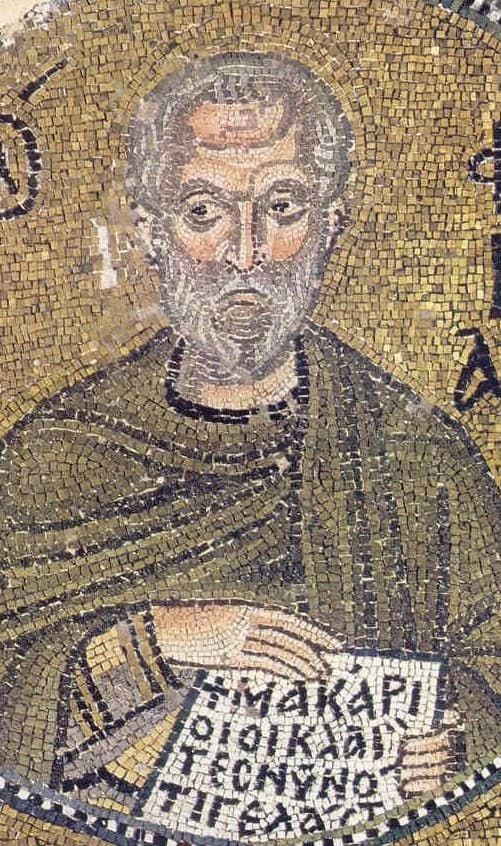
- The only one
- The only Syriac Christian recognized as a Doctor of the Church 1
- Refugee
- He fled Nisibis for Edessa when the emperor ceded the city to Persia 1
- Declined the priesthood
- He is said to have avoided ordination by feigning madness 1
- His method
- He took the tunes of the heretics' own popular songs and set orthodox words to them 1
- Called
- The Harp of the Holy Spirit 1
Saint Ephrem fought heresy by stealing its music. He "would take the popular songs of the heretical groups and using their melodies, compose beautiful hymns embodying orthodox doctrine." 1 He is the only Syriac Christian who is a Doctor of the Church, he declined to be made a priest - reportedly by pretending to be mad - and he lived in a cave above Edessa. 1
Nisibis, and then Edessa
He was born at Nisibis in Mesopotamia around 306, baptized as a young man, and "became famous as a teacher in his native city." 1
Then politics moved the border. "When the Christian emperor had to cede Nisibis to the Persians, Ephrem fled as a refugee to Edessa, along with many other Christians." 1 He was a refugee for the second half of his life, and "he is credited with attracting great glory to the biblical school there." 1
He was ordained a deacon and stopped there. "Ephrem was said to have avoided presbyteral consecration by feigning madness!" 1 Franciscan Media reports it with the exclamation mark, and the story is old enough to be worth repeating with the same caution it is given.
Vatican News lists him as "St. Ephrem, Deacon and Doctor of the Church" - the rank and the title side by side. 2 He is a Doctor of the Church who was never a priest.
Hymns with borrowed tunes
Franciscan Media opens with what he set out to do: he "took upon himself the special task of opposing the many false doctrines rampant at his time, always remaining a true and forceful defender of the Catholic Church." 1
And then the method, which is the reason to know about him. "It is surprising to read that he wrote hymns against the heretics of his day. He would take the popular songs of the heretical groups and using their melodies, compose beautiful hymns embodying orthodox doctrine." 1
The heretics had the better songs, so he kept the songs. It worked well enough that he became "one of the first to introduce song into the Church's public worship as a means of instruction for the faithful", which makes him partly responsible for the fact that congregations sing at all. 1 "His many hymns have earned him the title 'Harp of the Holy Spirit.'" 1
A cave above the city
"Saint Ephrem had a prolific pen, and his writings best illumine his holiness." 1 Franciscan Media is candid about what kind of writer he was: "Although he was not a man of great scholarship, his works reflect deep insight and knowledge of the Scriptures." 1
On the redemption "Ephrem reveals a realistic and humanly sympathetic spirit and a great devotion to the humanity of Jesus." 1 And a long reach: "It is said that his poetic account of the Last Judgment inspired Dante." 1
"Saint Ephrem preferred a simple, austere life, living in a small cave overlooking the city of Edessa. It was here that he died around 373." 1 A Doctor of the Church who lived in a cave and would not be ordained.
What is Saint Ephrem the patron saint of
He belongs to church musicians and hymn-writers above all, having put singing into the liturgy as a way of teaching. 1 He belongs to spiritual directors and to theologians, and to deacons in particular.
Franciscan Media's reflection makes the case for the music being the point rather than the decoration: "Many Catholics still find singing in church a problem, probably because of the rather individualistic piety that they inherited. Yet singing has been a tradition of both the Old and the New Testaments." 1
Saint Ephrem's feast day
Praying with Saint Ephrem
The borrowed melodies are the most practical idea any saint has had about argument. 1 The heretics were winning because their songs were catchy and people sang them at work. Ephrem did not write a refutation nobody would read. He kept the tune and changed the words, and people went on singing.
Notice what that required of him. He had to listen to the other side carefully enough to learn its music, and he had to be willing to be indebted to it. There is no purity in his method at all, and it is why it worked.
The feigned madness is the other half of the man. 1 Offered the priesthood, he is said to have behaved as though he had lost his mind rather than accept it, and stayed a deacon for the rest of his life. Whether or not the story is literally true, it is what the tradition wanted remembered about him, which is its own kind of fact.
And the scroll in the mosaic on this page: blessed are you who weep now, for you shall laugh. 2 He was a refugee who lost his city, lived in a cave, and spent his life writing songs. That is the verse his own tradition put in his hand.
Saint Ephrem, pray for us.
Sources
Saints to turn to next
Others in this collection who are turned to for some of the same things.
- Saint Peter Chrysologusc. 406 - c. 450Study and teachingPrayerWork and vocation
- Saint Lawrence of Brindisi1559 - July 22, 1619Study and teachingPrayerWork and vocation
- Saint Gregory the Greatc. 540 - March 12, 604Work and vocationStudy and teaching
- Saint Isidore of Sevillec. 560 - April 4, 636Study and teachingWork and vocation