Saint Isidore of Seville
c. 560 - April 4, 636
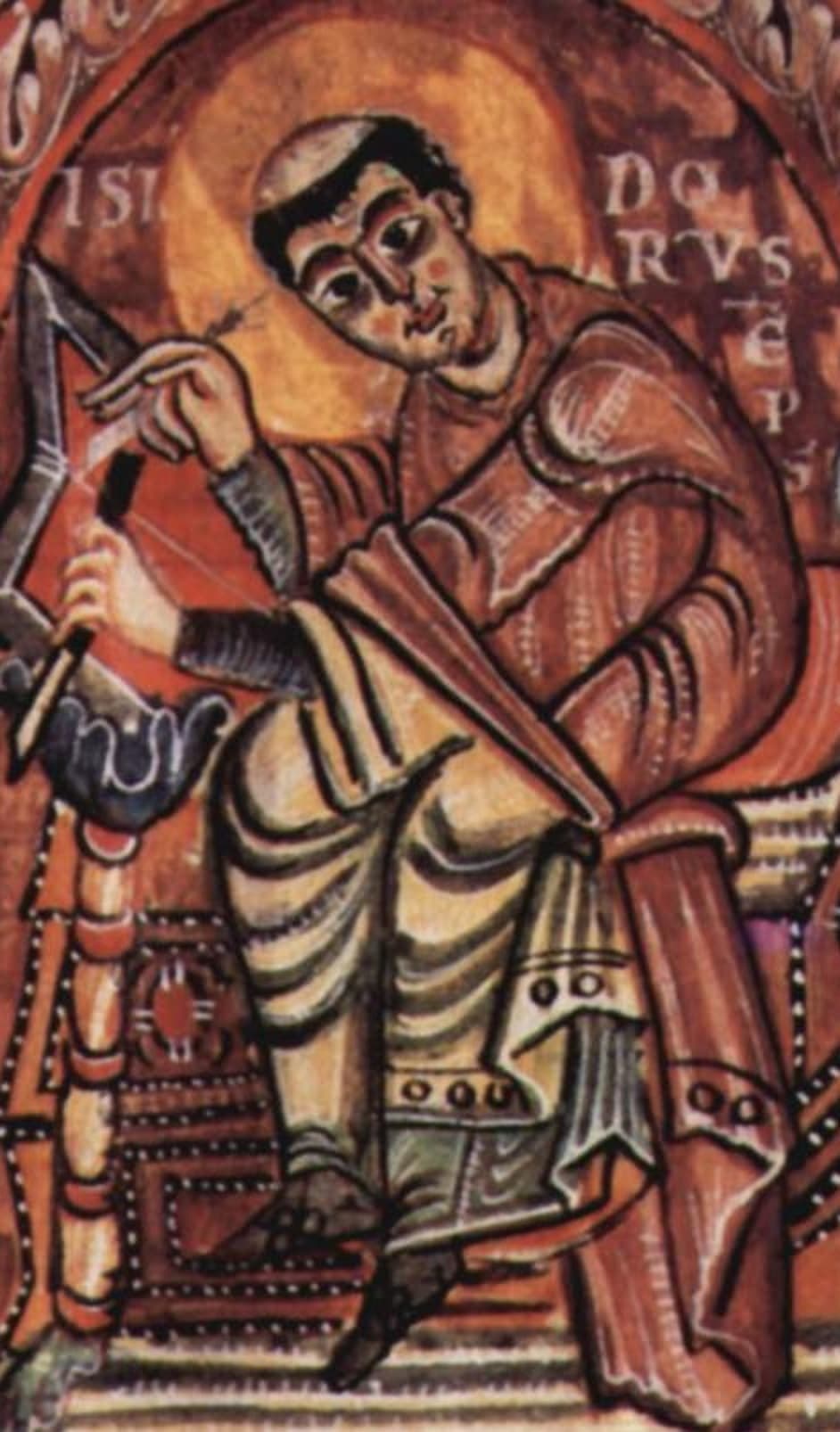
- Patron saint of
- Franciscan Media lists internet and computer users - but says he has been suggested for it, not appointed 2
- Born
- Cartagena, about 560, son of Severianus and Theodora 1
- His family
- Three of his siblings are saints: Leander, his predecessor at Seville; Fulgentius, Bishop of Astigi; and Florentina, a nun 12
- Mastered
- Latin, Greek and Hebrew, "in a remarkably short time" 1
- Made bishops build seminaries
- By a decree of the Fourth Council of Toledo in 633, which he presided over 12
- Wrote
- An encyclopedia used as a textbook for nine centuries, a dictionary, a history of the Goths and a history of the world 2
Saint Isidore of Seville spent his life holding a civilization together while it came apart. 1 The Roman institutions were collapsing, the Visigoths who ruled Spain were Arians who despised learning, and the country was split in two. 12 He compiled an encyclopedia that Europe used as a textbook for nine hundred years, made every bishop in Spain open a school, and died with his house full of the poor. 12
A household of saints
He was born at Cartagena about 560, son of Severianus and Theodora. 1 The family is remarkable even by the standards of this library: his elder brother Leander was his immediate predecessor as Metropolitan of Seville; his younger brother Fulgentius was Bishop of Astigi; and his sister Florentina was a nun who, O'Connor says, "is said to have ruled over forty convents and one thousand religious." 1 Franciscan Media counts "three other sibling saints." 2
He was educated at the cathedral school of Seville, "the first of its kind in Spain", where the trivium and quadrivium were taught by a body of learned men - among them his own brother, the archbishop. 1 O'Connor records the result without qualification: "With such diligence did he apply himself to study that in a remarkably short time mastered Latin, Greek, and Hebrew." 1
Whether he was ever a monk "is still an open question", though he plainly admired them. 1 On becoming bishop "he immediately constituted himself protector of the monks", and in 619 "he pronounced anathema against any ecclesiastic who should in any way molest the monasteries." 1 He put the weight of his office behind people he had not joined.
A country in two halves
Franciscan Media sets out the problem plainly. The Visigoths had invaded a century and a half before he was born and had set up their capital shortly before his birth. "They were Arians - Christians who said Christ was not God. Thus, Spain was split in two: One people (Catholic Romans) struggled with another (Arian Goths)." 2
O'Connor describes the same moment from the inside: "His long incumbency to this office was spent in a period of disintegration and transition. The ancient institutions and classic learning of the Roman Empire were fast disappearing." And of the Goths: "their barbarous manners and contempt of learning threatened greatly to put back her progress in civilization." 1
What Isidore decided to do about it is stated as a policy rather than a sentiment. "Realizing that the spiritual as well as the material well-being of the nation depended on the full assimilation of the foreign elements, St. Isidore set himself to the task of welding into a homogeneous nation the various peoples who made up the Hispano-Gothic kingdom. To this end he availed himself of all the resources of religion and education." 1
And then a judgment O'Connor does not qualify: "His efforts were attended with complete success." 1 Arianism, which had taken deep root among the Visigoths, was eradicated; a newer heresy was stifled at the outset; discipline was strengthened everywhere. 1 Franciscan Media: "Saint Isidore of Seville reunited Spain, making it a center of culture and learning." 2
The councils
Like Leander before him, Isidore took a leading part in the Councils of Toledo and Seville, and O'Connor makes a large claim for what came of it: "it was in a great measure due to the enlightened statecraft of these two illustrious brothers the Visigothic legislation, which emanated from these councils, is regarded by modern historians as exercising a most important influence on the beginnings of representative government." 1
Two Spanish bishops, in the seventh century, shaping the law that historians trace forward to representative government. It is a bigger claim than the internet patronage and it rests on actual legislation.
He presided over the Second Council of Seville from 13 November 619. 1 But the great one was the Fourth National Council of Toledo, which opened on 5 December 633 with every bishop in Spain present. "St. Isidore, though far advanced in years, presided over its deliberations, and was the originator of most of its enactments." 1 He was about seventy-three.
And there he got the decree that mattered most: "a decree was promulgated commanding all bishops to establish seminaries in their Cathedral Cities, along the lines of the school already existing at Seville." 1 Franciscan Media: "He required seminaries to be built in every diocese... and founded schools that taught every branch of learning." 2 One old man made an entire country start educating its clergy.
The books
Franciscan Media gives the output: "Isidore wrote numerous books, including a dictionary, an encyclopedia, a history of Goths, and a history of the world - beginning with creation!" 2 He also "wrote a Rule for religious orders" and "completed the Mozarabic liturgy, which is still in use in Toledo, Spain." 2
The encyclopedia is the one that made him. He is "sometimes called 'The Schoolmaster of the Middle Ages' because the encyclopedia he wrote was used as a textbook for nine centuries." 2 Nine hundred years of European schoolrooms working from a book compiled in Visigothic Spain while the Roman world was going dark.
Which is where the modern claim comes from, and it needs stating carefully. Franciscan Media: "For all these reasons, Isidore has been suggested as patron of the Internet. Several others - including Anthony of Padua - also have been suggested." 2 Suggested. Not appointed, not declared. The internet will tell a reader otherwise on a great many pages; the source used here will not.
The last six months
Franciscan Media closes its account with the detail worth ending on. He "continued his austerities even as he approached age 80. During the last six months of his life, he increased his charities so much that his house was crowded from morning till night with the poor of the countryside." 2
A man who had presided over national councils and written the textbook of Europe spent his final half-year with his door open and his house full. He died on 4 April 636. 1
What is Saint Isidore of Seville the patron saint of?
Franciscan Media lists Saint Isidore of Seville as patron of internet users and computer users, and immediately qualifies it: he "has been suggested as patron of the Internet", alongside others including Anthony of Padua. 2 O'Connor, writing in 1910, assigns no patronage at all. 1
The suggestion is a good one on its merits. A man who set out to gather all known learning into a single searchable work, organized by subject and cross-referenced so that a reader could find a thing without reading everything, was doing something a modern reader would recognize. 2 The encyclopedia is the ancestor of the reference site.
What he is soundly the patron of is students, teachers and schools. He built one school system by decree and supplied the textbook for another nine centuries of them. 12 That patronage needs no argument.
Saint Isidore of Seville's feast day
The feast of Saint Isidore of Seville is April 4, the day he died in 636. 12 O'Connor gives the death date exactly and Franciscan Media presents him on the same day.
On his age at death the two sources do not agree with each other, or with themselves. O'Connor gives a birth "about 560", making him about seventy-six. 1 Franciscan Media opens by calling them "the 76 years of Isidore's life" and later has him approaching eighty. 2 This page follows O'Connor and treats the birth year as approximate, which is what "about" means.
He should not be confused with Saint Isidore the Farmer, the eleventh-century laborer of Madrid who is patron of farmers, and whose feast is May 15.
Praying with Saint Isidore
He is the patron of people doing preservation work in a bad century. Isidore did not live in an age of building; he lived while an old order was visibly failing and a new one had not yet formed. O'Connor calls it "a period of disintegration and transition." 1 What he did about it was write things down, teach languages, found schools, and get a law passed requiring every diocese to educate its clergy. None of that is dramatic and all of it lasted.
The encyclopedia is the model. He did not try to be original; he tried to be complete, and to be usable. The measure of his success is that nobody needed to redo it for nine hundred years. 2 There is a vocation in gathering what other people already know and arranging it so the next generation can find it, and the Church has canonized a man for doing exactly that.
His method with the Goths is worth noticing too, because it was not denunciation. Franciscan Media describes a country split into two peoples; O'Connor says Isidore set himself to welding them into one, using "all the resources of religion and education." 12 He wanted the Arians to become Catholics and he went about it by building schools rather than by winning arguments. It worked.
And then the last six months, with the house full of the poor from morning until night. 2 The great scholar of the age, at nearly eighty, spending his final half-year handing things out at his own door. Whatever he thought the books had been for, that is what he did when there was no more time for books.
Saint Isidore of Seville, pray for us.
Sources
Saints to turn to next
Others in this collection who are turned to for some of the same things.
- Saint Peter CanisiusMay 8, 1521 - December 21, 1597Study and teachingWork and vocationConversion
- Saint Ephremc. 306 - June 9, 373Study and teachingWork and vocation
- Saint Hilary of Poitiersc. 315 - 368Study and teachingConversion
- Saint John Henry NewmanFebruary 21, 1801 - August 11, 1890Study and teachingConversion