Saint Hilary of Poitiers
c. 315 - 368
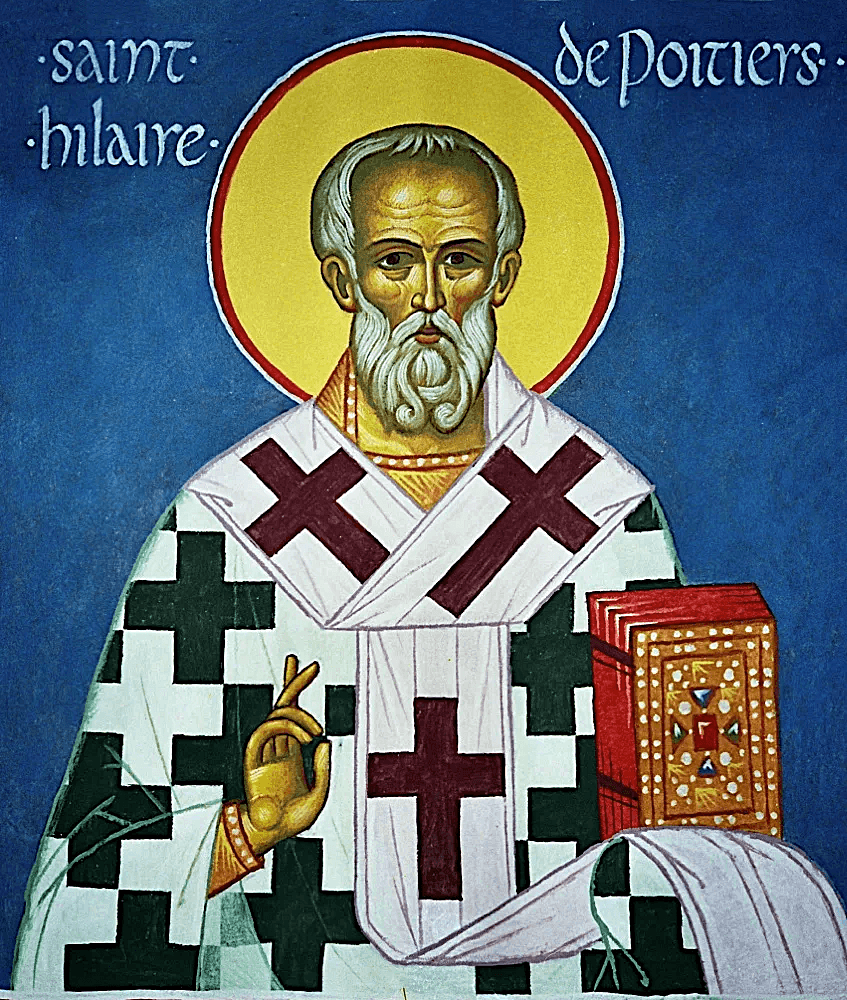
- Feast day
- January 13, the Roman Breviary's date. Clugnet says the most accredited opinion puts his death on 1 November 1
- Born
- Poitiers, early fourth century, into a noble and probably pagan family 1
- Became a Christian
- By reading. He took up the Scriptures, found what he was looking for, and was baptized 12
- Exiled to
- Phrygia, by the Emperor Constantius, after the Council of Beziers in 356 1
- Called
- The Athanasius of the West 2
Saint Hilary of Poitiers read his way into Christianity out of a pagan household, was made a bishop against his will, and was exiled to Asia Minor for refusing to condemn a man he thought was right. 12 Exile did not work. He wrote, argued and became so effective that the Arians who had arranged his banishment asked the emperor to send him home. 2
Converted by reading
He was born at Poitiers early in the fourth century, "belonging to a noble and very probably pagan family", and was given a full education "in all the branches of profane learning." 1 Franciscan Media says flatly that he was "raised a pagan." 2
The conversion has no drama in it and that is what makes it interesting. Clugnet: "having also taken up the study of Holy Scripture and finding there the truth which he sought so ardently, he renounced idolatry and was baptized." 1 Franciscan Media's phrasing is lovelier - he "was converted to Christianity when he met his God of nature in the Scriptures." 2 A well-read pagan picked up a book he had not read before.
About 350 "his wide learning and his zeal for the Faith attracted such attention that he was chosen to govern the body of the faithful" at Poitiers. 1 He did not want it. Franciscan Media: he was chosen "against his will." 2 And a detail worth noting, since it surprises modern readers: "His wife was still living when he was chosen." 2
Clugnet observes that Hilary "is the first concerning whom we have authentic information" among the bishops of Poitiers, a see that had existed since the third century - "and this is due to the important part he played in opposing heresy." 1 We know he existed because of the fight he got into.
Beziers, and a bishop who would not sign
Clugnet sets the scene without flattering anybody: "The Church was then greatly disturbed by internal discords, the authority of the popes not being so powerful in practice as either to prevent or to stop them. Arianism had made frightful ravages in various regions and threatened to invade Gaul, where it already had numerous partisans more or less secretly affiliated with it." 1
Franciscan Media borrows Jerome for the scale of it: "The world groaned and marveled to find that it was Arian." 2
Hilary exposed the most active of the Gallic Arian sympathizers, Saturninus, Bishop of Arles - who responded by convening a council at Beziers in 356 "with the intention of justifying himself, or rather of establishing his false doctrine." 1 Hilary went. "The Bishop of Poitiers courageously presented himself to defend orthodoxy, but the council, composed for the most part of Arians, refused to hear him." 1
Franciscan Media identifies the specific refusal that finished him: "When Emperor Constantius ordered all the bishops of the West to sign a condemnation of Athanasius, the great defender of the faith in the East, Saint Hilary of Poitiers refused." 2 He was denounced to Constantius, "the protector of Arianism", and "transported to the distant coasts of Phrygia." 1 Gaul to central Asia Minor, for declining to put his name to a document about a man he had never met.
The most productive exile of the fourth century
Clugnet's verdict on the punishment is one sentence: "But persecution could not subdue the valiant champion. Instead of remaining inactive during his exile he gave himself up to study, completed certain of his works which he had begun, and wrote his treatise on the synods." 1 Franciscan Media notes he was "devoted to writing some of the greatest theology on the Trinity." 2
The treatise on the synods is where he did something braver than refusing to sign. He went through the professions of faith issued by the Eastern bishops at Ancyra, Antioch and Sirmium, condemned them as Arian in substance - and then argued that "sometimes the difference between the doctrines of certain heretics and orthodox beliefs was rather in the words than in the ideas, which led to his counselling the bishops of the West to be reserved in their condemnation." 1
He was in exile for refusing to compromise, and he used the exile to tell his own party to slow down. It cost him. "He was sharply reproached for his indulgence by certain ardent Catholics, the leader of whom was Lucifer, Bishop of Cagliari." 1
His reputation ran ahead of him. When a large synod of Eastern bishops met at Seleucia in 359, "Hilary, whom everyone wished to see and hear, so great was his reputation for learning and virtue, was invited to be present at this assembly. The governor of the province even furnished him with post horses for the journey." 1 An exiled foreign bishop, given official transport because the Eastern Church wanted to hear him.
There he explained the faith of the Gallic bishops "and easily proved that, contrary to the opinion current in the East, these latter were not Sabellians" - clearing his own side of a charge nobody in Gaul had known they were under. 1 Then he went on to Constantinople, "the stronghold of heresy, to continue his battle against error." 1
Sent home as a nuisance
What ended the exile is the best thing in either account. Franciscan Media: he "sought public debate with the heretical bishop who had exiled him" - and "the Arians, dreading the meeting and its outcome, pleaded with the emperor to send this troublemaker back home." 2
He had been banished to silence him. They asked for the banishment to be lifted because it had made him louder. "Saint Hilary of Poitiers was welcomed by his people." 2
Franciscan Media's summary of what he was like is worth keeping whole, because the two halves are usually assigned to different men: "This staunch defender of the divinity of Christ was a gentle and courteous man, devoted to writing some of the greatest theology on the Trinity, and was like his Master in being labeled a 'disturber of the peace.'" 2 Courteous and intolerable, at the same time, to the same people.
"Eventually he was called the 'Athanasius of the West.'" 2 Which is the higher compliment available in that century.
What is Saint Hilary of Poitiers the patron saint of?
Neither Clugnet nor Franciscan Media assigns Saint Hilary a patronage. 12 He is claimed in practice by theologians and by his own city, and he was declared a Doctor of the Church - though neither source here records the declaration, so this page states only what they support.
He is a reasonable patron for two kinds of person. The first is the convert who arrived by reading rather than by crisis: nothing happened to Hilary except that he opened the Scriptures and could not put them down. 12 The second is anyone who has been punished by an institution for saying something true, and who has to decide what to do with the time.
Saint Hilary of Poitiers's feast day
The feast of Saint Hilary of Poitiers is January 13. 12
Clugnet is unusually direct about the difficulty underneath that date. Hilary died at Poitiers "1 November, according to the most accredited opinion, or according to the Roman Breviary, on 13 January, 368." 1 The best historical opinion of his own day put the death in November; the liturgical books put it in January; the feast follows the books. Both are recorded here rather than reconciled.
English readers may recognize the date from another direction entirely: the Hilary term at Oxford and Dublin, and the Hilary sittings of the English courts, are named for this feast. A bishop exiled to Phrygia in 356 still sets the name of a university term.
Praying with Saint Hilary
The most useful thing about him is what he did with a punishment. Constantius sent him to Phrygia to shut him up, and Hilary treated the years as a research fellowship - finishing books he had started, writing the treatise on the synods, learning the Eastern controversies from inside. 1 He came back better equipped than he left. Not everyone can do that with an enforced interruption, but almost everyone is offered one eventually.
The De Synodis is the part worth admiring and the part that got him attacked. He had just been exiled for refusing to condemn a man on command, and he used his freedom to argue that some of the people on the other side were being condemned over wording rather than substance. 1 Lucifer of Cagliari called that indulgence. It is at least as easy to call it accuracy. A person who has paid a price for holding a line is exactly the person best placed to say where the line actually runs.
The ending is almost comic and entirely instructive. His opponents had the power to remove him from Gaul and did. What they could not do was make him stop, and when he asked for a public debate they petitioned to have the exile ended rather than face it. 2 Some kinds of opposition cannot be outlasted by force because force is not what they run on.
And underneath all of it, a pagan nobleman who picked up a book. 12 Nothing in his conversion was extraordinary - no vision, no crisis, no near death. He was looking for something true, and he found it in a text he had not been raised on, and it cost him his career and his country. Reading is not usually thought of as dangerous. It was for him.
Saint Hilary of Poitiers, pray for us.
Sources
Saints to turn to next
Others in this collection who are turned to for some of the same things.