Saint Justin Martyr
c. 100 - c. 165
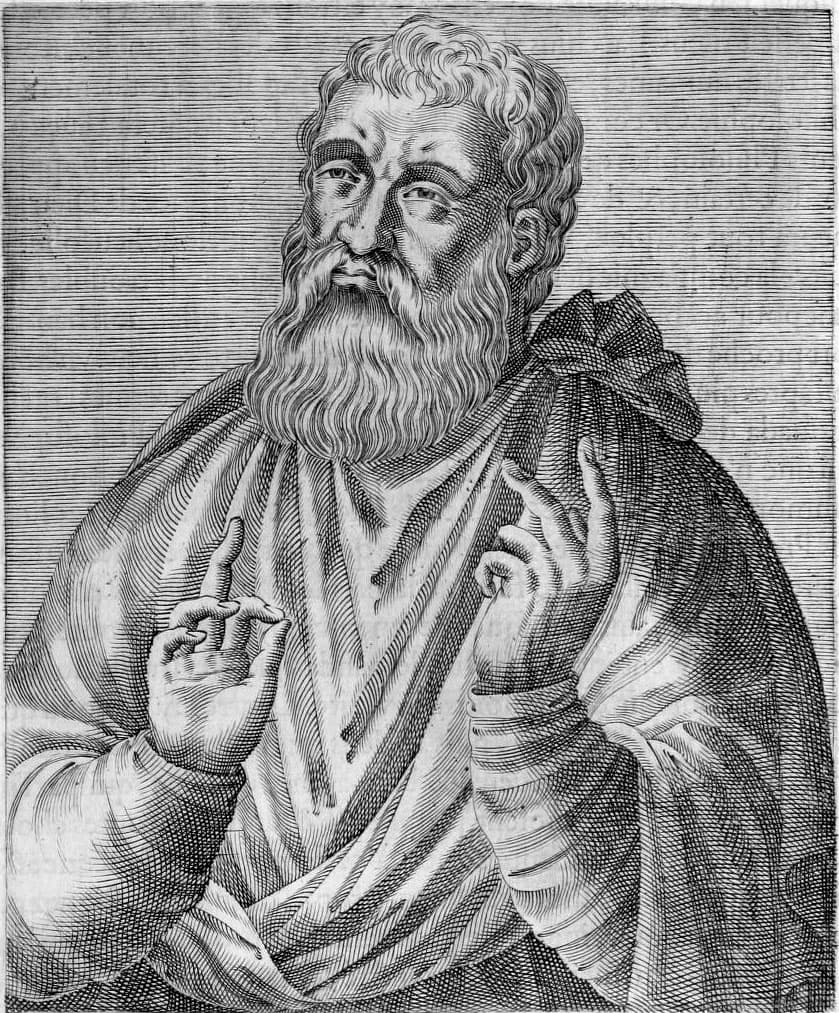
- Feast day
- June 1. Leo XIII had set it for 14 April, which Lebreton records 1
- Born
- Flavia Neapolis in Palestinian Syria, about 100, of a pagan family 1
- Converted
- About 130, after trying four schools of philosophy 1
- Known as
- The first Christian philosopher - he kept wearing the philosopher's cloak 2
Saint Justin Martyr tried four schools of philosophy before Christianity and was disappointed by all of them - one teacher knew nothing about God, one asked for a fee, and one would not begin until he had learned geometry. 1 What finally convinced him was partly an argument on a beach and partly watching Christians being killed and concluding that people who died like that could not be living as they were accused of living. 1 He kept wearing the philosopher's cloak for the rest of his life. 2
Four teachers
He was born at Flavia Neapolis in Palestinian Syria about the year 100. 1 The town had been founded by Vespasian in 72 near Sichem, and its people were mostly pagan; the names of Justin's father and grandfather suggest a pagan family, and he says of himself that he was uncircumcised. 1 He names himself in his own first line: "Justin, the son of Priscos, son of Baccheios, of Flavia Neapolis, in Palestinian Syria." 1
Lebreton says something about him that he says about no one else in the period: "Among the Fathers of the second century his life is the best known, and from the most authentic documents." 1 Justin wrote about himself, and the writings survive.
The education is the famous passage, and Lebreton hands it over with a caution first. Justin's account "cannot be taken too literally; the facts seem to be arranged with a view to showing the weakness of the pagan philosophies and of contrasting them with the teachings of the Prophets and of Christ. The main facts, however, may be accepted." 1
So, as Justin tells it: he went first to a Stoic, and "after some time found that he had learned nothing about God and that in fact his master had nothing to teach him on the subject." 1 Then a Peripatetic, who "welcomed him at first but afterwards demanded a fee from him; this proved that he was not a philosopher." 1 Then a Pythagorean, who "refused to teach him anything until he should have learned music, astronomy, and geometry." 1 And at last "a Platonist arrived on the scene and for some time delighted Justin." 1
Lebreton thinks the arrangement is rhetorical and the substance real: "the works of Justin seem to show just such a philosophic development as is here described, Eclectic, but owing much to Stoicism and more to Platonism." 1 Franciscan Media: "As a young man, he was principally attracted to the school of Plato." 2
The old man on the shore
Justin was still a Platonist when, walking by the sea one day, he met an old man he does not name. 1
Lebreton gives the conclusion of their long argument: "the soul could not arrive through human knowledge at the idea of God, but that it needed to be instructed by the Prophets who, inspired by the Holy Ghost, had known God and could make Him known." 1 A Platonist was argued out of the sufficiency of reason, on a beach, by a stranger.
But that is only half of the conversion, and the other half is the half worth having. Justin writes, in the Second Apology: "When I was a disciple of Plato, hearing the accusations made against the Christians and seeing them intrepid in the face of death and of all that men fear, I said to myself that it was impossible that they should be living in evil and in the love of pleasure." 1
He had heard the standard charges against Christians - the ones every educated Roman had heard - and he had also seen how Christians died. He reasoned from the second to the falsity of the first. That is an argument from evidence, made by a professional, about people he did not yet belong to.
It was about the year 130. 1 Franciscan Media: he "found that the Christian religion answered the great questions about life and existence better than the philosophers." 2
The cloak
What he did next is the thing he is remembered for. "Upon his conversion he continued to wear the philosopher's mantle, and became the first Christian philosopher." 2
The cloak was a uniform. A man in it was making a public claim about what he did for a living, and Justin went on making it - now as a Christian. He did not exchange one identity for another; he carried the first into the second.
And he argued accordingly. Franciscan Media: "He combined the Christian religion with the best elements in Greek philosophy. In his view, philosophy was a pedagogue of Christ, an educator that was to lead one to Christ." 2 Not a rival to be defeated but a teacher that had been pointing somewhere all along.
He taught and defended the faith in Asia Minor and then at Rome. 1 What survives is two Apologies and the Dialogue with Trypho, an extended argument with a Jewish interlocutor. 1 Franciscan Media describes the genre: an apologist is "one who defends in writing the Christian religion against the attacks and misunderstandings of the pagans", and Justin's two are "addressed to the Roman emperor and to the Senate." 2
Read that again. A private citizen of a persecuted sect wrote to the emperor and to the Senate, in the expectation of being read, to argue that the charges were false.
Rome
He was beheaded at Rome about the year 165. 12 Franciscan Media: "For his staunch adherence to the Christian religion, Justin was beheaded in Rome in 165." 2
Lebreton makes a point of the evidence here, and it is a real distinction in a field full of legendary Acts: "For his martyrdom we have documents of undisputed authority." 1 The record of his trial survives. He was examined, refused to sacrifice, and was condemned - and the account of it is not in dispute.
He had argued, in writing, to an emperor, that Christians should not be killed for being Christians. Then he was killed for being one.
What is Saint Justin Martyr the patron saint of?
Neither Lebreton nor Franciscan Media assigns Saint Justin Martyr a patronage. 12 He is invoked in practice by philosophers, apologists and anybody whose work is to explain the faith to people outside it - which is precisely what he invented.
He also belongs to converts who came by argument. Justin did not have a vision or a crisis; he read, he tried four teachers, he was beaten in a conversation on a beach, and he drew an inference from the way martyrs behaved. 1 For a reader whose route to belief has been intellectual and slow, and who suspects that this is a lesser road, Justin is the answer: the first Christian philosopher took it, and the Church made him a saint.
And he is a patron for people who keep their old trade. He did not stop being a philosopher; he went on wearing the cloak. 2
Saint Justin Martyr's feast day
The feast of Saint Justin Martyr is June 1. 2
A reader consulting older books will find April 14, and Lebreton explains where that came from: "Leo XIII had a Mass and an Office composed in his honour and set his feast for 14 April." 1 Writing in 1910, that was the current date. The calendar reform of 1969 moved him to June 1, which is the day the Church keeps now. Both are recorded here and the modern one is used.
On the year of his death, both sources give about 165, and Lebreton is unusually confident about the martyrdom itself because the trial record survives. 12 The birth is dated only "about A.D. 100". 1
Praying with Saint Justin
The inference from the martyrs is the thing to take from him, and it is a properly philosophical move. He had heard that Christians were debauched criminals. He watched some of them die and observed that they were not afraid. He concluded that the first claim could not be true of the people in front of him. 1 That is not sentiment; it is a man revising a belief because the evidence would not fit it.
His four teachers are a comfort to anyone who has looked for an answer in several places and been let down each time. One had nothing to say about God, one wanted money, one set a syllabus of prerequisites, and one was genuinely delightful and still not enough. 1 Justin does not describe any of this as wasted. Franciscan Media says he held that philosophy "was a pedagogue of Christ, an educator that was to lead one to Christ" - the schools were the road, not a detour from it. 2
The cloak is the smallest detail and the most imitable. He kept it on. 2 Whatever a person was before they believed - a scholar, a soldier, a lawyer, a mechanic - Justin's example is that the previous thing may be exactly what is now to be offered, in public, without disguise.
And then the letters to the emperor. He wrote to the most powerful men in the world, from inside a persecuted minority, arguing that they had the facts wrong. 2 It did not save him. It is still being read eighteen centuries later, which is longer than the arguments of most emperors have lasted.
Saint Justin Martyr, pray for us.
Sources
Saints to turn to next
Others in this collection who are turned to for some of the same things.