Saint Catherine of Alexandria
Died c. 310
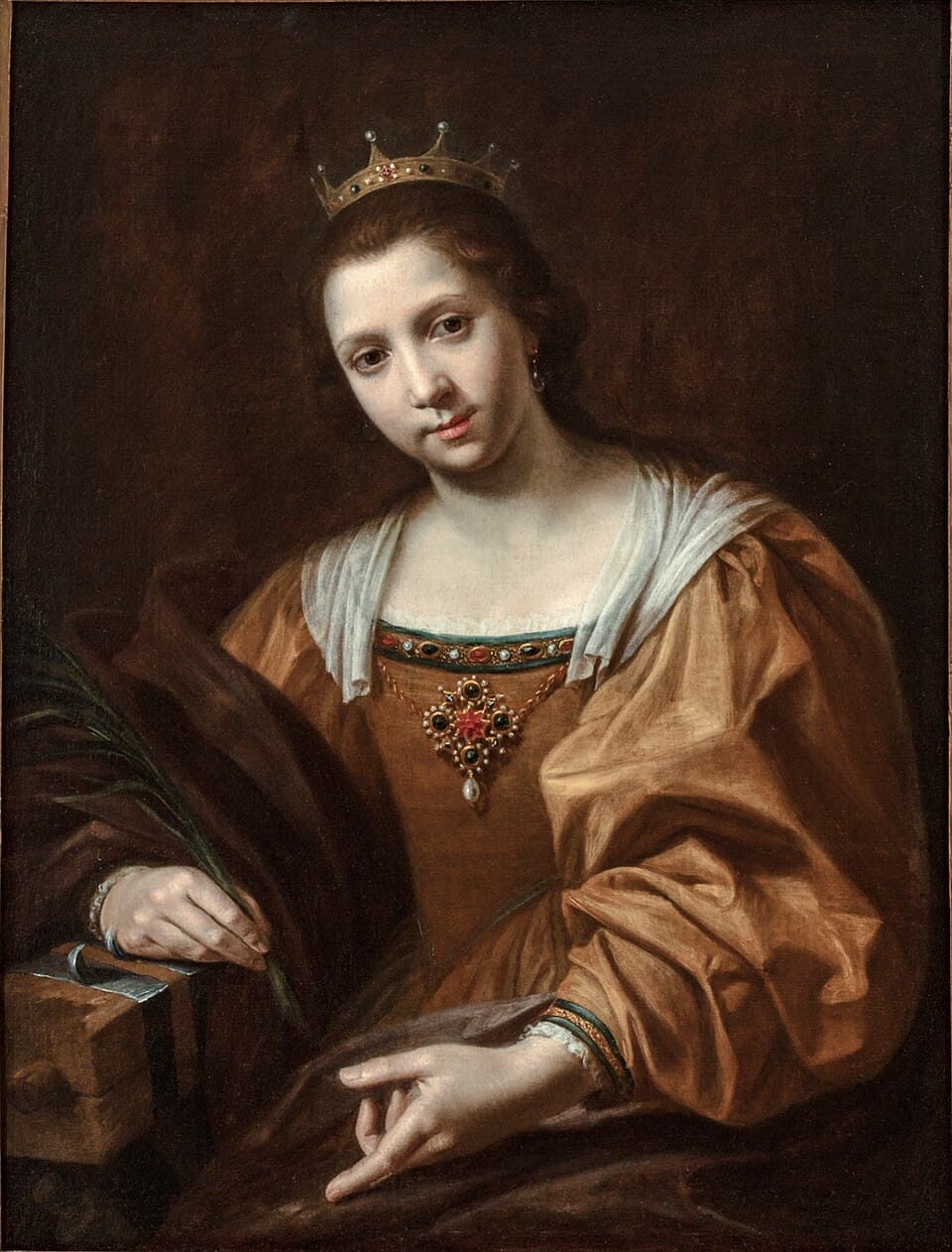
- Patron saint of
- Lawyers, librarians, philosophers, students and teachers, per Franciscan Media 2
- Feast day
- November 25, kept "in the Latin Church and in the various Oriental churches" on that day 1
- Died
- Alexandria, about 310, beheaded under the Emperor Maximinus 1
- What the sources allow
- Clugnet doubts the texts and not the woman: their authenticity is "more than doubtful", but that casts no shadow "around the existence of the saint" 1
Saint Catherine of Alexandria is said to have been eighteen years old when she walked into the emperor's presence, told him his persecution was wrong, and out-argued the scholars he summoned to refute her. 1 For six centuries she was one of the most popular saints in Europe - a holy day of obligation in French dioceses, a statue in nearly every church, the adviser Joan of Arc claimed to hear. 1 Then the scholarship caught up with her legend, and the devotion collapsed. 1
The story as the Acts tell it
Clugnet sets it out before taking it apart. Catherine was of noble birth and "learned in the sciences", and at eighteen she presented herself to the Emperor Maximinus, "upbraided him for his cruelty and endeavoured to prove how iniquitous was the worship of false gods." 1
He was, in Clugnet's words, "astounded at the young girl's audacity, but incompetent to vie with her in point of learning", so he kept her in the palace and summoned scholars to argue her out of her faith by "specious reasoning." 1 "But she emerged from the debate victorious." 1 Franciscan Media, calling it the Legend of St. Catherine, gives numbers Clugnet does not: fifty pagan philosophers, and about two hundred soldiers and members of the emperor's household who converted as a result. 2 All of them were killed. 12
She was scourged and imprisoned. The empress came to the dungeon with Porphyry, the commander of the troops, out of curiosity to see her - and both of them "yielded to Catherine's exhortations, believed, were baptized, and immediately won the martyr's crown." 1
Then the wheel. She was condemned to die on it and "at her touch, this instrument of torture was miraculously destroyed." 1 Franciscan Media: "Sentenced to be executed on a spiked wheel, Catherine of Alexandria touched the wheel and it shattered." 2 The emperor had her beheaded instead, and angels carried her body to Mount Sinai, where a church and monastery were later built. 12
And then Clugnet stops the narrative with four words: "So far the Acts of St. Catherine." 1
What the Acts are worth
His verdict is severe. We do not have the Acts in their original form, "but transformed and distorted by fantastic and diffuse descriptions which are entirely due to the imagination of the narrators who cared less to state authentic facts than to charm their readers by recitals of the marvellous." 1 The critics who studied the Greek, Latin and Arabic texts reached a conclusion "which, in all likelihood, they will never have to retract." 1
He then gives an argument rather than an assertion, and it is the most instructive paragraph in the article. Every version of the legend describes the miraculous carrying of her body to Sinai. But "the itineraries of the ancient pilgrims who visited Sinai do not contain the slightest allusion to it." 1 People went to that mountain and wrote down what they saw there, and none of them had heard the story.
What should be kept, then? Clugnet is precise: "if the principal facts forming the outline are to be accepted as true, the multitude of details by which these facts are almost obscured, most of the wonderful narratives with which they are embellished, and the long discourses that are put into the mouth of St. Catherine, are to be rejected as inventions, pure and simple." 1
And then the sentence that governs how this library handles every saint like her: doubting these texts "is not therefore meant to cast even the shadow of a doubt around the existence of the saint." 1 A bad document about a real person is a bad document. It is not evidence that the person is fictional.
How large she once was
It is hard to overstate what she was to medieval Europe, and Clugnet does not try to. She was "for almost six centuries the object of a very popular devotion", ranked with Margaret and Barbara among the fourteen most helpful saints in heaven, "unceasingly praised by preachers and sung by poets." 1 Bossuet dedicated one of his finest panegyrics to her, and Adam of Saint-Victor wrote a poem in her honor. 1
Her feast was kept "with the utmost solemnity, servile work being suppressed." In several dioceses of France it was a holy day of obligation until the beginning of the seventeenth century, "the splendour of its ceremonial eclipsing that of the feasts of some of the Apostles." 1 Chapels beyond counting were placed under her patronage, and "her statue was found in nearly all churches." 2
Franciscan Media notes that the devotion spread west as a result of the Crusades, and that she was especially venerated in Germany and Hungary. 2 Clugnet adds the episode that gave it fresh force in France: in the early fifteenth century "it was rumoured that she had appeared to Joan of Arc and, together with St. Margaret, had been divinely appointed Joan's adviser." 1
And how quickly she went
Clugnet dates the turn and names the man. In the eighteenth century Dom Deforis, the Benedictine editing Bossuet's works, "declared the tradition followed by this orator in his panegyric on the saint, to be in a great measure false" - and "it was just at this time that the feast of St. Catherine disappeared from the Breviary of Paris." 1
Then, flatly: "Since then devotion to the virgin of Alexandria has lost all its former popularity." 1
An encyclopedia article is not usually where one reads an obituary for a cult. Six centuries of preaching, poetry, statues and holy days ended within a generation or two of somebody checking the sources, and Clugnet, writing in 1908, reports it as a settled fact.
What is Saint Catherine of Alexandria the patron saint of?
Saint Catherine of Alexandria is the patron saint of lawyers, librarians, philosophers, students and teachers. 2 Clugnet explains where each one came from, and the reasoning is unusually traceable.
Because Nicholas of Myra was taken as patron of young bachelors and students, "St. Catherine became the patroness of young maidens and female students", and, as "the holiest and most illustrious of the virgins of Christ", was given the virgins of the cloister and the young women of the world to watch over. 1 Because the spiked wheel became her emblem, "wheelwrights and mechanics placed themselves under her patronage" - a trade claimed her on the strength of a picture. 1
And because she "triumphed in science by closing the mouths of sophists", her intercession "was implored by theologians, apologists, pulpit orators, and philosophers. Before studying, writing, or preaching, they besought her to illumine their minds, guide their pens, and impart eloquence to their words." 1 That is the patronage that survived, and it is the one a student still has use for.
Saint Catherine of Alexandria's feast day
The feast of Saint Catherine of Alexandria is November 25. Clugnet states it in his first sentence, and states it broadly: her feast "is celebrated in the Latin Church and in the various Oriental churches on 25 November." 1 Franciscan Media presents her on the same day. 2 East and West on one date is not common in this library, and it is worth noting for a saint whose documentation is otherwise so thin.
The feast has had a harder history than the date suggests. It was suppressed in the Breviary of Paris in the eighteenth century, and in 1969 it was removed from the General Roman Calendar; it was restored as an optional memorial in 2002. Clugnet, writing in 1908, could see only the first of those. 1
On the year she died, neither source is firm. The persecution under Maximinus places it around 310. 12
Praying with Saint Catherine of Alexandria
She is the patron of everyone who has to say the true thing in a room organized against it. Whatever the Acts have invented, the shape they preserved is a young woman walking into a hall full of professional arguers and not losing. 1 The people who prayed to her before writing or preaching were not asking for courage in the abstract. They were asking not to be talked out of what they knew. 1
Clugnet's distinction is the second thing to take from her, and it is a gift to any reader who has ever felt that learning something about a saint's sources meant losing the saint. The texts are late, embellished and in places invented. The woman is not thereby invented. 1 Scholarship can take a legend apart without touching the person underneath it, and honest devotion has nothing to fear from a careful historian.
The collapse of her cult is worth sitting with too. Six centuries of enormous popularity ended, and Clugnet records the ending without lament. 1 Devotions rise and fall, and a saint is not diminished by being out of fashion. Catherine spent three hundred years as one of the most invoked names in Europe and the last three hundred largely forgotten, and nothing about her changed in between.
What is left is small and serviceable: a wheel in a stained-glass window, a patronage over students and teachers, and the habit her medieval devotees had of asking her to "illumine their minds, guide their pens, and impart eloquence to their words" before sitting down to work. 1 That prayer costs nothing to keep and does not depend on a single disputed document.
Saint Catherine of Alexandria, pray for us.
Sources
Saints to turn to next
Others in this collection who are turned to for some of the same things.