Saint Charles Borromeo
October 2, 1538 - November 3, 1584
- Patron saint of
- Neither source assigns a patronage. He is invoked by bishops, catechists and seminarians 12
- Feast day
- November 4, fixed by Paul V at the canonization in 1610. He died on 3 November 1
- Born
- The Castle of Arona on Lago Maggiore, 2 October 1538 1
- Emblem
- The word humilitas under a crown, taken from the Borromeo shield 1
- Shot at
- While kneeling at the altar in 1569. The ball did not pierce his clothes 1
- Canonized
- By Paul V on 1 November 1610, twenty-six years after his death 1
Saint Charles Borromeo was made a cardinal at twenty-one by an uncle who had just become pope, which is exactly the kind of appointment the Reformation was complaining about. 12 He spent the rest of his life dismantling the system that produced him - keeping the Council of Trent from collapsing, writing the catechism that came out of it, giving away his income, and staying in Milan through the plague of 1576 after the civil authorities had gone. 12
The cardinal-nephew
He was born in the Castle of Arona on Lago Maggiore on 2 October 1538, second son and third of six children of Count Giberto Borromeo and Margherita de' Medici. 1 His mother died when he was about nine. 1 At twelve his father let him receive the tonsure, and on his uncle's resignation he became titular abbot of a house at Arona - a benefice held by a child, which is precisely the abuse he would later spend his life attacking. 1
Keogh includes a detail that most accounts skip. At Pavia his father allowed him only a small sum, "and that often he was in straitened circumstances, which caused him considerable inconvenience. It was not only that he himself suffered, but that his retinue also were not suitably clothed. Charles evidently felt bitterly his humiliation, but he does not seem to have shown impatience." 1 A Borromeo, at the University of Pavia, unable to dress his servants properly.
His father died in August 1558. Though he was not the eldest son, the family - including his elder brother - asked him to take charge of all its business, and he did, negotiating the disputed ownership of the Castle of Arona between France and Spain through to the Peace of Cambrai in 1559. 1 He took his doctorate in civil and canon law the same year. 1
In December 1559 his mother's younger brother was elected Pope Pius IV. On 3 January 1560 a courier reached Charles with a summons to Rome. 1 He was made cardinal-deacon and administrator of the Archdiocese of Milan while still, as Franciscan Media puts it, "a layman and a young student." 2 He was given several offices in the Vatican and eventually the secretaryship of state with responsibility for the papal states. 2
Keeping Trent alive
The Council of Trent had been suspended since 1552 and looked finished. Keogh: "Charles was very soon occupied as secretary of state in using his influence to bring about the re-assembling of the Council of Trent." 1 It resumed on 18 January 1562 "with two cardinals, 106 bishops, 4 mitred abbots, and 4 generals of religious orders present." 1
Franciscan Media makes the claim that matters: "Working behind the scenes, Saint Charles deserves the credit for keeping the Council of Trent in session when at several points it was on the verge of breaking up." 2 He took on the entire correspondence of the final phase himself. 2 The most consequential Church council in a thousand years was held together in part by a man in his twenties doing the letters.
Afterward he was "much occupied with the production of the catechism embodying the teaching of the council, the revision of the Missal and Breviary." 1 The Roman Catechism, the Missal and the Breviary that shaped Catholic worship for the next four centuries all passed across his desk.
Meanwhile his elder brother died unexpectedly, and Charles decided to be ordained - against his relatives, who wanted him to marry and continue the line. 2 He was made a priest at twenty-five and consecrated bishop of Milan soon after. 2 He could not take up residence there until the council ended. 2
What he did to Milan, and to himself
Franciscan Media is blunt about what he found: "the religious and moral picture was far from bright." 2 He began with a provincial council of all the bishops under him and drew up specific regulations for bishops and clergy, on a principle it states plainly - "If the people were to be converted to a better life, Borromeo had to be the first to give a good example." 2
So he went first. "He allotted most of his income to charity, forbade himself all luxury, and imposed severe penances upon himself. He sacrificed wealth, high honors, esteem, and influence to become poor." 2 A Medici nephew with a cardinal's revenues chose to have nothing.
He built the machinery to make it stick. In September he sent thirty Jesuit Fathers to assist his vicar, three of them placed over a seminary that opened that November. 1 And he founded the Confraternity of Christian Doctrine "in order that the children might be carefully and systematically instructed." 1
Keogh adds a footnote to that last one which is worth the space: "This work was really the beginning of what is now known as the Sunday school, and there is a remarkable testimony to this in an inscription under a statue outside the Essex Unitarian Church, Kensington, London, where Cardinal Borromeo is mentioned in connexion with the work." 1 A Counter-Reformation cardinal, credited by name on a Unitarian church in London.
The shot at the altar
In 1569 somebody tried to kill him during vespers.
Keogh sets the scene with the music. Orlando Lasso's motet "Tempus est ut revertar ad eum qui me misit" was being sung, and "the words 'Non turbetur cor vestrum, neque formidet' had just been sung, when the assassin fired his weapon, loaded with ball, and struck Charles, who was kneeling at the altar." 1 The line means: let not your heart be troubled, neither let it fear.
He finished the service. "At their conclusion it was found that the ball had not even pierced his clothes, but some of the shot had penetrated to the skin, and where the ball had struck a slight swelling appeared, which remained through his life." 1 He carried the mark of it for fifteen years.
Then the part that is usually left out. "Notwithstanding his wish to forgive those who had attempted his life, and his efforts to prevent their prosecution, four of the conspirators (amongst them Farina, who actually fired) were sentenced to death. All being of the clergy, they were handed over to the civil power (29 July, 1570); two were beheaded; Farina and another were hanged." 1 He tried to stop it and could not. The forgiveness was real and it did not save them.
The famine and the plague
A short harvest brought famine to the whole province, and Keogh records that "Charles worked with unceasing toil to help the starving, relieving at his own expense as many as 3000 daily for three months." 1
Then plague. Franciscan Media gives the scale and the method: "During the plague and famine of 1576, Borromeo tried to feed 60,000 to 70,000 people daily. To do this he borrowed large sums of money that required years to repay." 2 He was still paying for it long afterward.
And the sentence that fixed him in memory: "Whereas the civil authorities fled at the height of the plague, he stayed in the city, where he ministered to the sick and the dying, helping those in want." 2
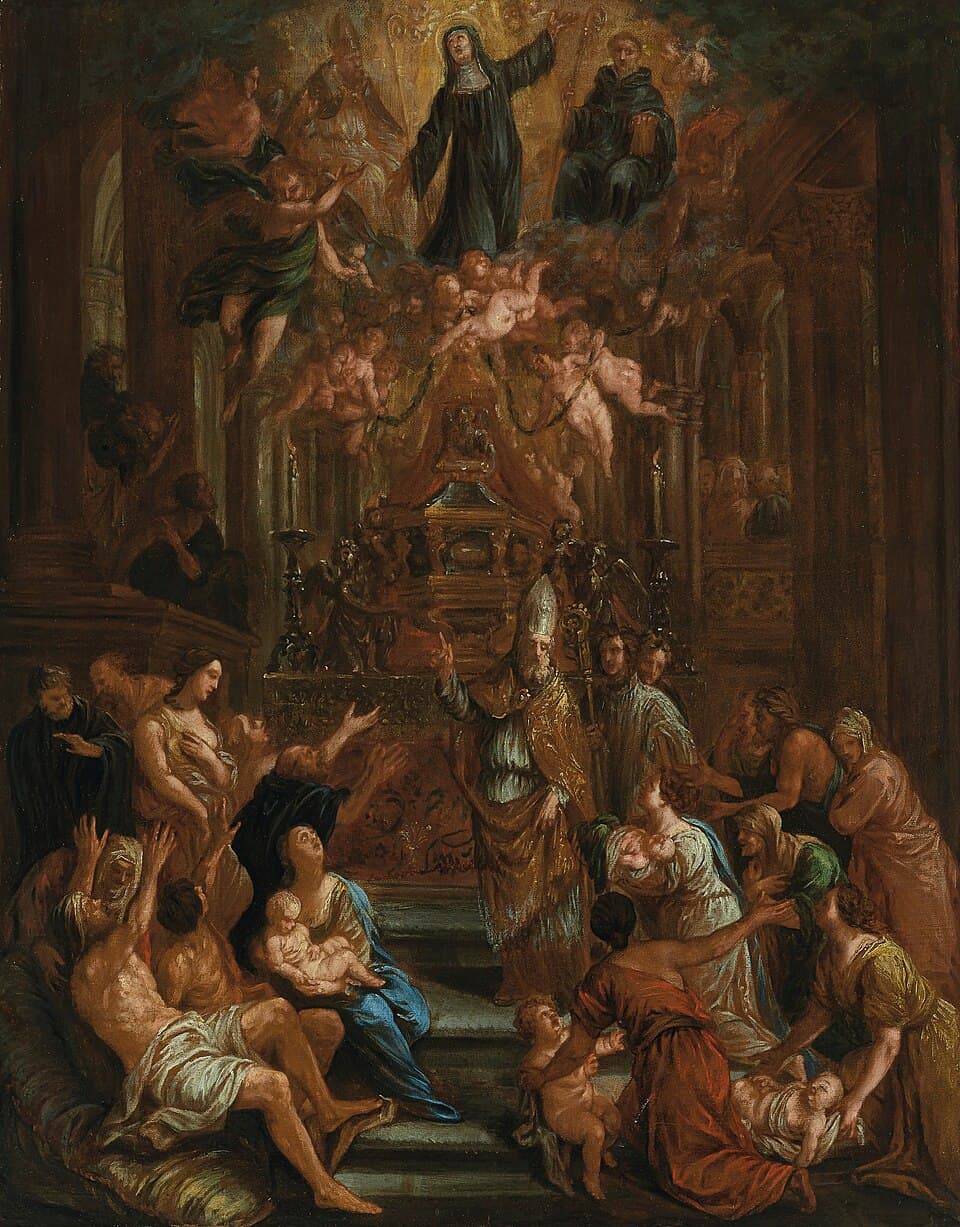
Keogh adds what he did besides the feeding. "Wishing to do penance for his people, he walked in procession, barefooted, with a rope round his neck, at one time bearing in his hand the relic of the Holy Nail." 1 That is why he is painted as he is - "in his cardinal's robes, barefoot, carrying the cross as archbishop; a rope round his neck, one hand raised in blessing." 1
Franciscan Media closes on the cost: "Work and the heavy burdens of his high office began to affect Archbishop Borromeo's health, leading to his death at the age of 46." 2 He died at Milan on 3 November 1584.
Keogh notes what happened next without waiting for Rome: "Devotion to him as a saint was at once shown and gradually grew, and the Milanese kept his anniversary as though he were canonized." 1 Paul V made it official on 1 November 1610. 1
What is Saint Charles Borromeo the patron saint of?
Neither Keogh nor Franciscan Media assigns Saint Charles Borromeo a patronage, and this page does not manufacture one. 12 In practice he is invoked by bishops and parish priests, by catechists and by seminarians - the three groups whose working conditions he personally rewrote.
The catechists have the strongest claim. The Confraternity of Christian Doctrine he founded so that children "might be carefully and systematically instructed" is, in Keogh's judgment, the origin of the Sunday school. 1 Anybody teaching a class of children on a Sunday morning is doing something he invented.
Saint Charles Borromeo's feast day
The feast of Saint Charles Borromeo is November 4. Keogh gives it in his opening paragraph - "His feast is kept on 4 November" - and gives its origin at the other end of the article: "Finally, 1 November, 1610, Paul V solemnly canonized Charles Borromeo, and fixed his feast for the 4th day of November." 1
He died on 3 November 1584, so the feast falls the day after the anniversary of his death rather than on it. 1 Franciscan Media presents him on the 4th as well. 2
Praying with Saint Charles Borromeo
He is the saint for people who benefited from a bad system and then had to decide what to do about it. Charles Borromeo was the textbook case of the abuse Trent was called to end: a boy given an abbey at twelve, a cardinal at twenty-one because his uncle was pope, a layman administering an archdiocese. 12 He did not resign in protest. He stayed inside it and spent twenty-five years making it impossible for anyone to be appointed as he had been.
The reform began with himself, and Franciscan Media states the logic without decoration: the people would not be converted unless he went first. 2 So he gave away his income, refused every luxury, and lived poor while holding one of the richest sees in Europe. Reform that starts anywhere else is advice.
The assassination is the episode to sit with, and not for the miracle of the ball that failed to pierce his clothes. It is what he did afterward: he asked for the men to be spared, worked to prevent their prosecution, and was overruled. 1 Four men died anyway, two beheaded and two hanged. Forgiveness did not produce the outcome he wanted, and he offered it regardless. That is the harder and more common case.
Then 1576. The civil authorities left; he stayed, fed tens of thousands a day on money he did not have, and walked barefoot through his own plague-stricken city with a rope around his neck. 12 He was dead eight years later at forty-six, worn out. Franciscan Media says the office killed him, and there is no reason to soften that. He spent himself on it deliberately and would not have described it as a loss.
Saint Charles Borromeo, pray for us.
Sources
Saints to turn to next
Others in this collection who are turned to for some of the same things.
- Saint Peter CanisiusMay 8, 1521 - December 21, 1597Study and teachingWork and vocation
- Saint Catherine of AlexandriaDied c. 310Study and teachingSuffering and illness
- Saint Ephremc. 306 - June 9, 373Study and teachingWork and vocation
- Saint Gregory the Greatc. 540 - March 12, 604Work and vocationStudy and teaching