Saint Peter Canisius
May 8, 1521 - December 21, 1597
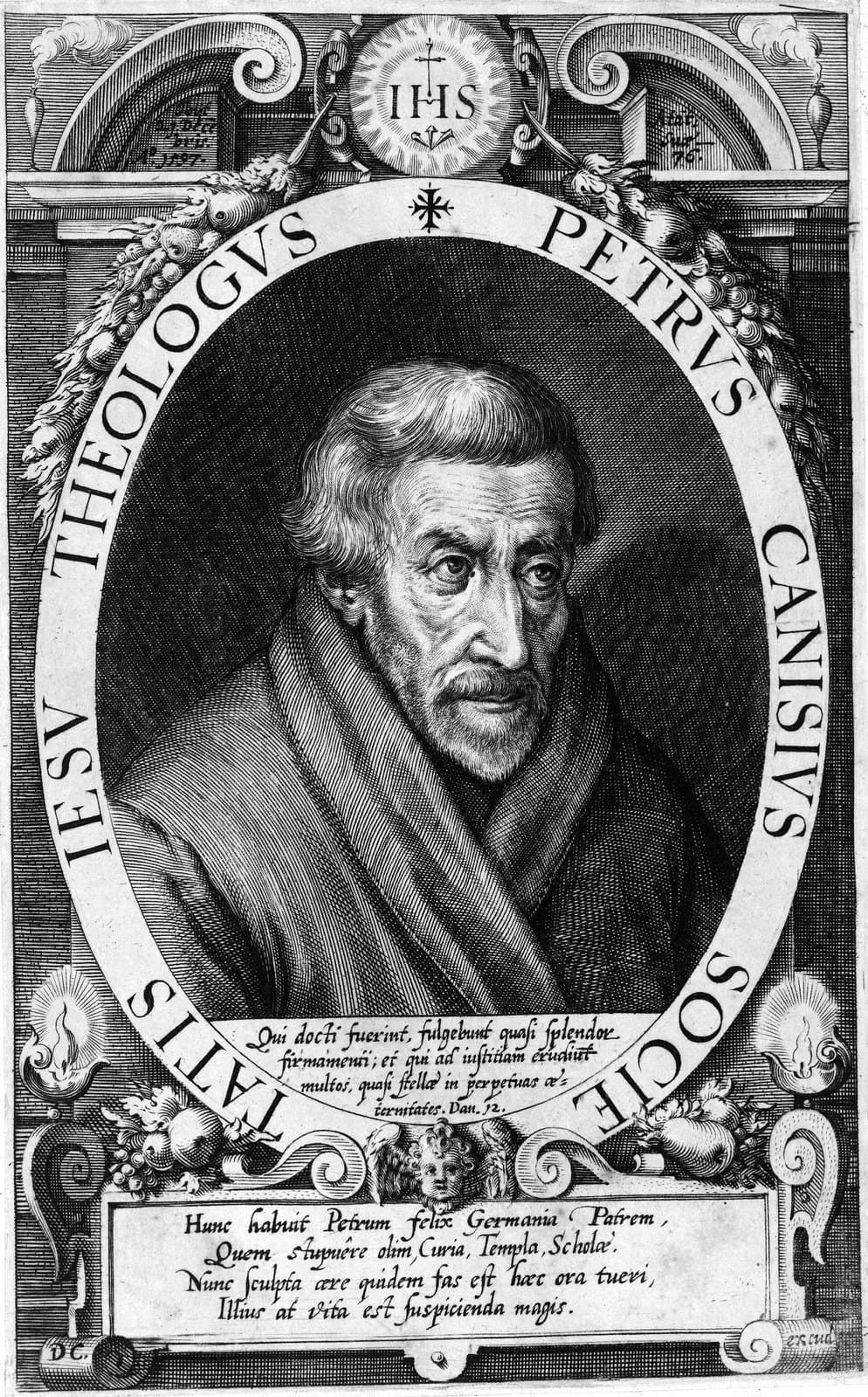
- Born
- Nijmegen, in the Netherlands, May 8, 1521 1
- Joined the Jesuits
- After meeting Peter Faber, the first disciple of Ignatius. He was the first Dutch Jesuit 23
- Trent
- He attended sessions in 1547 and was later assigned to implement its decrees 2
- At seventy
- A paralytic seizure. He went on preaching and writing with a secretary for six more years 2
Saint Peter Canisius wrote a catechism "that explained the Catholic faith in a way that common people could understand", which Franciscan Media calls "a great need of that age." 2 He is the second apostle of Germany after Boniface, one of the architects of the renewal Trent set in motion, and a Doctor of the Church. 23 His letters fill eight volumes. 2
A master of arts at nineteen
He was born at Nijmegen on May 8, 1521, son of the wealthy burgomaster Jacob Canisius; his mother died shortly after his birth. 1 He was sent to Cologne in 1536 to study arts, civil law and theology, spent part of 1539 at Louvain, and took his master's degree at Cologne in 1540, at nineteen. 1
Franciscan Media notes wryly that "Peter Canisius once accused himself of idleness in his youth" and then observes that "he could not have been idle too long" given the degree. 2 Soon after it he met Peter Faber, the first disciple of Ignatius of Loyola, "who influenced Peter so much that he joined the recently formed Society of Jesus." 2 He was the first Dutchman to do so. 3
He was ordained in 1546 and "became widely known for his editions of the writings of St. Cyril of Alexandria and St. Leo the Great." 2 Alongside the scholarship, "he could often be found visiting the sick or imprisoned, even when his assigned duties in other areas were more than enough to keep most people fully occupied." 2
Germany
He attended sessions of the Council of Trent in 1547 and "was later assigned to implement" its decrees - which is a different and harder job than attending. 2 After a short teaching post at Messina he was given the mission to Germany, "from that point on his life's work." 2
The encyclopedia's account of that work is a list of places and a pace: preaching in the cathedral of Worms, visiting the Bishop of Strasburg at Zabern during Advent and Christmas, negotiating for a Jesuit college there, preaching, "explained the catechism to the children, and heard their confessions", then preaching in Strasburg cathedral and strengthening the Catholics of Alsace and Freiburg. 1 The emperor Ferdinand met him at Nuremberg on the way to be proclaimed and "confided his troubles to him"; Duke Albert V of Bavaria then secured his services. 1
Vatican News gives the summary: he "was one of the architects of the spiritual renewal of the Catholic Church promoted by the Council of Trent." 3 Franciscan Media says he "played such a key role that he has often been called the 'second apostle of Germany,' in that his life parallels the earlier work of Boniface." 2
He taught in several universities and helped establish many colleges and seminaries. 2 And he wrote the catechism, which is the thing that reached furthest: not a work of controversy but an explanation ordinary people could follow. 2
Eight volumes of letters, and a stroke
"Renowned as a popular preacher, Peter packed churches with those eager to hear his eloquent proclamation of the gospel." 2 He also had "great diplomatic ability, often serving as a reconciler between disputing factions" - useful in sixteenth-century Germany, where the factions were not disputing politely. 2
His correspondence fills eight volumes, "words of wisdom and counsel to people in all walks of life." 2 Franciscan Media adds a detail worth keeping: "At times he wrote unprecedented letters of criticism to leaders of the Church - yet always in the context of a loving, sympathetic concern." 2 He criticized upward, and it was received.
"At 70, Peter suffered a paralytic seizure, but he continued to preach and write with the aid of a secretary", for six more years. 2 He died on December 21, 1597. 23
Two notes on that sentence, because the sources disagree and a reader who checks will see it. The encyclopedia gives the date as November 21; the feast is December 21 and Vatican News keeps it there, and a feast follows the day of death. 123 And Franciscan Media places his death "in his hometown of Nijmegen" - but the encyclopedia's opening sentence names Nijmegen as where he was born and Fribourg as where he died. 12
What is Saint Peter Canisius the patron saint of
He belongs to writers, to teachers and to the Catholic press. Franciscan Media makes the case directly: "He is regarded as one of the creators of the Catholic press, and can easily be a model for the Christian author or journalist. Teachers can see in his life a passion for the transmission of truth." 2
Vatican News calls him "Jesuit and Doctor of the Church", and "a prolific writer." 3 The catechism is why - a book written so that people who were not scholars could follow it.
Saint Peter Canisius's feast day
The feast of Saint Peter Canisius is December 21. 23 Vatican News keeps his day page there, listing him as "St. Peter Canisius, Jesuit and Doctor of the Church". 3
He was canonized and declared a Doctor of the Church in 1925, which is why the 1908 encyclopedia article is headed "Blessed Peter Canisius". 1
Praying with Saint Peter Canisius
The catechism is the achievement and it is the least glamorous thing he did. Not a refutation, not a treatise: an explanation "in a way that common people could understand". 2 He was capable of editing Cyril of Alexandria and Leo the Great, and what he is remembered for is writing plainly for people who could not. 2
The letters of criticism to Church leaders are worth sitting with, particularly the qualification. Unprecedented, Franciscan Media says - "yet always in the context of a loving, sympathetic concern." 2 Criticism that lands is nearly always criticism from someone who is obviously on your side, and he seems to have understood that as a discipline rather than a tactic.
And the stroke at seventy. 2 He did not stop. He got a secretary and went on for six years with half a body, preaching and writing, and died still working. There is nothing dramatic in that sentence and it is the hardest thing in the life.
The two small errors between his sources are a fitting footnote for a man who spent his life getting information to people accurately. Each account has one thing wrong and neither is wrong about him.
Saint Peter Canisius, pray for us.
Sources
Saints to turn to next
Others in this collection who are turned to for some of the same things.
- Saint Isidore of Sevillec. 560 - April 4, 636Study and teachingWork and vocationConversion
- Saint Charles BorromeoOctober 2, 1538 - November 3, 1584Work and vocationStudy and teaching
- Saint Ephremc. 306 - June 9, 373Study and teachingWork and vocation
- Saint Bonifacec. 675 - June 5, 754Work and vocationConversion