Saint John Fisher
1469 - June 22, 1535
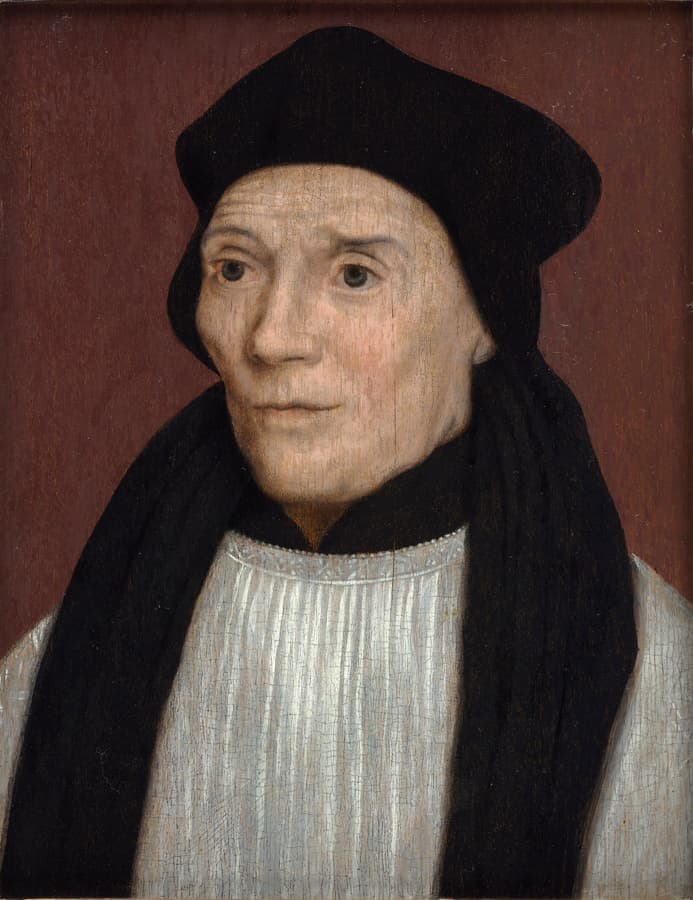
- Patron saint of
- Neither source assigns a patronage. He is invoked with Thomas More by lawyers and bishops 12
- Feast day
- June 22, the day he was beheaded. Franciscan Media states it outright 2
- Born
- Beverley, Yorkshire, son of a merchant. Huddleston gives "1459 (?1469)"; 1469 fits Franciscan Media's arithmetic 12
- Chancellor of Cambridge
- Elected in 1504, re-elected annually for ten years, then appointed for life 1
- Founded, through Lady Margaret
- St John's and Christ's Colleges, Cambridge, and the Lady Margaret chairs of divinity at both universities 1
- Held in the Tower
- Fourteen months without trial 2
- Died
- Beheaded 22 June 1535. His body was left on the scaffold all day and his head set on London Bridge 2
Saint John Fisher was the most learned bishop in England, chancellor of Cambridge for life, the man who brought Erasmus there and protected the study of Greek. 1 He may also have tutored the boy who became Henry VIII. 1 When the king wanted his marriage annulled, Fisher told the court he was prepared to die over it, and thirty-one years after the schoolroom the king took him at his word. 12
The scholar
He was born at Beverley in Yorkshire, eldest son of Robert Fisher, a merchant, and his wife Agnes. 1 Huddleston gives the year as "1459 (?1469)" - the question mark is his. 1 Franciscan Media provides an argument without meaning to: Fisher "had been made a bishop at 35", and he was made Bishop of Rochester in 1504, which works for 1469 and not for 1459. 12
He went up to Cambridge in 1484 and never really left. B.A. in 1487, M.A. in 1491 and a fellowship the same year; proctor of the university in 1494; Master of his college by 1497; D.D. and Vice-Chancellor in 1501. 1 In 1504 he was made Bishop of Rochester and elected Chancellor of Cambridge - "to which post he was re-elected annually for ten years and then appointed for life." 1
What he did with that position is the substantial achievement of his life, and it was done through somebody else's money. As chaplain and confessor to Margaret Beaufort, mother of Henry VII, he guided her benefactions: "Under Fisher's guidance, the Lady Margaret founded St. John's and Christ's Colleges at Cambridge, and also the two 'Lady Margaret' professorships of divinity at Oxford and Cambridge respectively, Fisher himself being the first occupant of the Cambridge chair." 1 Two colleges and two chairs, still there.
He also brought in Erasmus, and Huddleston records what Erasmus thought that was worth: he "attributes it to Fisher's protection that the study of Greek was allowed to proceed at Cambridge without the active molestation that it encountered at Oxford." 1 Greek was controversial. Fisher stood over it.
Franciscan Media places him among his peers: "John Fisher is usually associated with Erasmus, Thomas More, and other Renaissance humanists... he was a man of learning, associated with the intellectuals and political leaders of his day." 2 He was also a working preacher - his "sermons on the penitential psalms were reprinted seven times before his death", and his "eight books against heresy gave him a leading position among European theologians." 2
And then the line that changes the shape of everything after it. Of 1504, Huddleston writes: "At this date also he is said to have acted as tutor to Prince Henry, afterwards Henry VIII." 1 Said to have. It is not certain, and it is not nothing.
The queen's counselor
In 1521 Fisher preached at St Paul's Cross on the day Luther's books were burned in London, and he had already, before that, "denounced various abuses in the Church, urging the need of disciplinary reforms." 1 He was not a man defending everything as it stood.
The same year he was asked to examine the question of Henry's marriage to Catherine of Aragon, his brother's widow. 2 He concluded it was valid, and he did not keep the conclusion to himself.
"When the question of Henry's divorce from Queen Catherine arose, Fisher became the Queen's chief supporter and most trusted counsellor." 1 Appearing for her before the legates' court, "he startled his hearers by the directness of his language and most of all by declaring that, like St. John the Baptist, he was ready to die on behalf of the indissolubility of marriage." 1 John the Baptist was beheaded for telling a king his marriage was unlawful. Everyone in that room knew the reference.
Henry knew it too. He "was so enraged by it that he himself composed a long Latin address to the legates in answer to the bishop's speech." 1 And here is the detail that says most about Fisher: "Fisher's copy of this still exists, with his manuscript annotations in the margin which show how little he feared the royal anger." 1 The king of England wrote a personal rebuttal to him, and he read it with a pen in his hand.
The Tower
Getting rid of him took several attempts. Franciscan Media: "In an attempt to be rid of him, Henry first had John Fisher accused of not reporting all the 'revelations' of the nun of Kent, Elizabeth Barton." 2 A charge about somebody else's prophecies.
What finally caught him was an oath. "In feeble health, Fisher was summoned to take the oath to the new Act of Succession. He and Thomas More refused to do so because the Act presumed the legality of Henry's divorce and his claim to be head of the English Church." 2
They went to the Tower, "where Fisher remained 14 months without trial." 2 He was in his sixties and already ill. Both men were eventually sentenced to life imprisonment and the loss of everything they owned. 2
Then the trap. Called for further interrogation, "they remained silent" - the legally correct answer, since silence could not be construed as denial. 2 "On the supposition that he was speaking privately as a priest, Fisher was tricked into declaring again that the king was not supreme head of the church in England." 2 Somebody let him believe he was speaking in confidence to a penitent. He said what he thought, and it was used.
The pope then made him a cardinal, which enraged Henry further, and he was tried for high treason. 2 He was condemned and beheaded on 22 June 1535.
Franciscan Media does not spare the aftermath: "his body left to lie all day on the scaffold and his head hung on London Bridge. More was executed two weeks later." 2
What is Saint John Fisher the patron saint of?
Neither Huddleston nor Franciscan Media assigns Saint John Fisher a patronage. 12 He is honored jointly with Thomas More, and the pair are invoked by lawyers, judges, politicians and bishops - by people, that is, whose office can require them to say no to the person who appointed them.
He has a second and less obvious claim on universities. Cambridge owes him two colleges, two chairs, the presence of Erasmus and the survival of Greek study, and he was its chancellor for life. 1 A scholar who used a noblewoman's fortune to endow learning rather than to enrich himself is a reasonable patron for anyone raising money for a school.
Saint John Fisher's feast day
The feast of Saint John Fisher is June 22, the day he was executed in 1535. Franciscan Media states it outright: "John Fisher's liturgical feast is celebrated on June 22." 2
He shares the day with Thomas More, who was beheaded on 6 July, two weeks after him. 2 The two are kept together, on Fisher's date rather than More's - the bishop and the lawyer who refused the same oath for the same reason.
On the birth year the sources are genuinely unsure, and Huddleston says so with a question mark inside his own parenthesis: "1459 (?1469)." 1 Franciscan Media's statement that he was made a bishop at thirty-five, in a year Huddleston dates exactly to 1504, points to 1469. 12 This page uses 1469 and shows the reasoning rather than hiding the doubt.
Praying with Saint John Fisher
He is the patron of people who have to disagree with someone who can destroy them. Fisher was not a natural martyr; he was an academic administrator, a fundraiser, a preacher and a controversialist, and he was old and sick when the moment came. 12 He also had the best possible reasons for accommodation: he had criticized abuses in the Church himself, he was not defending the status quo out of complacency, and he could have signed an oath about a succession without believing every premise behind it. He declined.
The annotated Latin address is the image to keep. Henry VIII personally wrote a long reply to a speech Fisher had made, and Fisher sat down and wrote notes in the margins of it. 1 That is not defiance for an audience. It is a scholar treating a king's argument as an argument, which is both the most respectful and the most dangerous thing he could have done with it.
The silence in the Tower deserves attention too, because it was wisdom rather than evasion. He and More both understood that they could not be convicted on what they had not said. 2 What broke Fisher was not weakness but a false confidence - a man who approached him as though the conversation were sacramental. He was destroyed by his own priesthood being used against him.
And then the tutor. If Huddleston's "said to have" is right, the boy Fisher taught in 1504 signed the order in 1535. 1 Everything Fisher built - the colleges, the chairs, the Greek, the library of a lifetime - stood in a country ruled by his own pupil, who left his body on the scaffold all day and put his head on a bridge. 2 The work outlasted both of them. St John's and Christ's are still teaching.
Saint John Fisher, pray for us.
Sources
Saints to turn to next
Others in this collection who are turned to for some of the same things.
- Saint Catherine of AlexandriaDied c. 310Study and teachingCourageSuffering and illness
- Saint Hilary of Poitiersc. 315 - 368Study and teachingCourage
- Saint Charles BorromeoOctober 2, 1538 - November 3, 1584Study and teachingSuffering and illness
- Saint Ignatius of Antiochc. 50 - c. 107CourageSuffering and illness