Saint John Henry Newman
February 21, 1801 - August 11, 1890
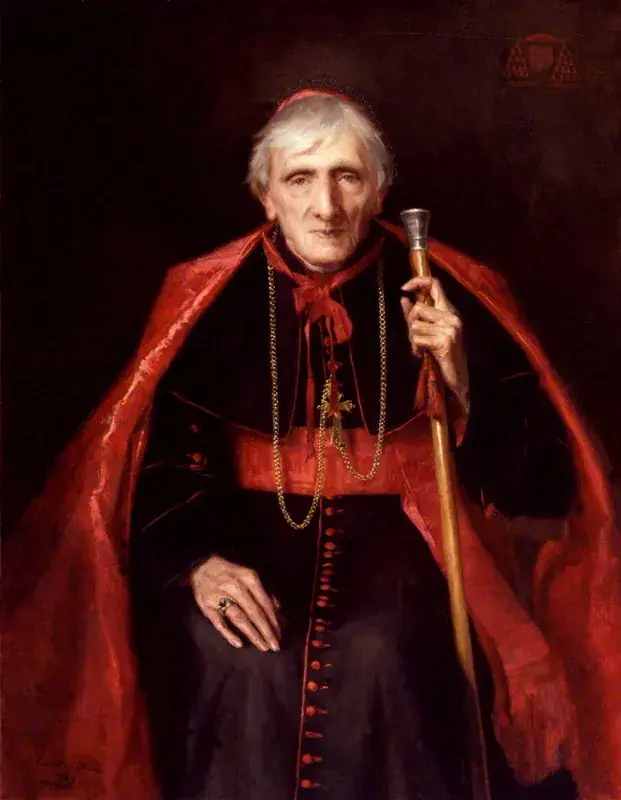
- Patron saint of
- Proclaimed by Leo XIV "together with Saint Thomas Aquinas, as co-Patron of the Church's educational mission" 3
- Feast day
- October 9, an optional memorial, by decree of 9 November 2025 3
- Born
- The City of London, February 21, 1801 1
- Received into the Church
- October 9, 1845, by the Passionist Father Dominic 1
- Made a cardinal
- May 12, 1879, by Leo XIII 1
- Doctor of the Church
- Proclaimed by Leo XIV on November 1, 2025 3
Saint John Henry Newman was the most admired Anglican clergyman in England, and on 9 October 1845 he was received into the Catholic Church by an Italian Passionist, which cost him his position, most of his friends, and the next thirty years of his reputation. 1 He is now a Doctor of the Church, and his feast is kept on the anniversary of the day he changed. 3
Two and two only absolute beings
Newman was born in the City of London on 21 February 1801, the eldest of six children of a banker and a mother of Huguenot descent. 1 He was brought up on the Bible but had no formed religious convictions until he was fifteen, when he underwent what he called a conversion - not, the encyclopedia notes, quite as Evangelicals practice it. From Calvinist writers he "gained definite dogmatic ideas," and came to rest "in the thought of two and two only absolute and luminously self-evident beings, myself and my Creator." 1
Barry's comment is the key to everything after: "In other words, personality became the primal truth in his philosophy; not matter, law, reason, or the experience of the senses. Henceforth, Newman was a Christian mystic, and such he remained." 1
He worked too hard for his degree and broke down, taking only third-class honors in 1821. It did not matter for long: Oriel was the first college in Oxford for intellect, and he was elected a fellow of it in April 1822 - a day he "ever felt to be the turning point in his life, and of all days most memorable." 1
The Oxford Movement, and Tract 90
Ordained in 1824 and made vicar of St Mary's, the university church, in 1828, he preached the Parochial Sermons there "without eloquence or gesture, for he had no popular gifts, but with a thrilling earnestness and a knowledge of human nature seldom equalled." 1 Someone said of them that they "beat all other sermons out of the market as Scott's tales beat all other stories." 1
On 14 July 1833 Keble preached the Assize sermon on National Apostasy, and the Oxford Movement began. Newman started the Tracts for the Times, in his own phrase, "out of his own head." 1 His position was the Via Media: the English Church standing at an equal distance from Rome and Geneva, Catholic in origin and doctrine, protesting against what he then called Roman corruptions. 1
Tract 90 ended it. Published in February 1841 and meant to keep waverers from Rome by distinguishing the corruptions the Thirty-Nine Articles condemned from the doctrines of Trent they did not, it produced "a furious and universal agitation." The University called the tract an evasion; bishops condemned it for three years. To a man with Newman's idea of episcopal authority, that was a verdict. 1 He stopped the Tracts, gave up St Mary's, and retired to Littlemore.
Barry's judgment on that retreat is severe and worth quoting: "Nothing is clearer than that, if he had held on quietly, he would have won the day... But he had lost faith in himself." 1
Securus judicat orbis terrarum
Reading church history at Littlemore, he found the Via Media was not new. It had been the refuge of the Semiarians, and it had made the fortune of the Monophysites. Wiseman, writing on the Donatists, quoted Augustine at him: Securus judicat orbis terrarum - which Barry glosses, "Catholic consent is the judge of controversy." 1
That sentence did the work. "Not antiquity studied in books, not the bare succession of bishops, but the living Church now broke upon him as alone peremptory and infallible." 1 He wrote the Essay on the Development of Christian Doctrine to explain how doctrine could change and remain the same, and on 9 October 1845 was received into the Church by Father Dominic, an Italian Passionist. 1
Barry does not pretend it was a triumph. "His conversion divides a life of almost ninety years into equal parts - the first more dramatic and its perspective ascertained; the second as yet imperfectly told, but spent for a quarter of a century sub luce maligna, under suspicion from one side or another, his plans thwarted, his motives misconstrued." 1 English Catholics distrusted him too; Talbot called him "the most dangerous man in England." 1
The Apologia
The turn came from an insult. In January 1864 Charles Kingsley wrote that "Truth, for its own sake, had never been a virtue with the Roman clergy. Father Newman informs us that it need not, and on the whole ought not to be." Newman demanded proof; Kingsley withdrew the charge in terms that left its injustice unreproved; and Newman published, in seven parts between 21 April and 2 June 1864, the Apologia pro Vita sua. 1
It is, Barry says, "a marvel of swift and cogent writing" that "annihilated the opponent and his charge" and "added a unique specimen of religious autobiography to our language." More than that, it changed the standing of Catholicism in England: "From that day the Catholic religion may date its reentrance into the national literature." 1 Englishmen who had read the successive chapters "with breathless admiration" were brought round before he had even reached the accusations.
Barry's summary of what the book actually accomplished is the best sentence in the article: "the problem which staggered Protestants and modern minds - how to reconcile individual genius with tradition, private judgment with authority - was resolved in Newman's great example." 1
The cloud lifted
For twenty years Rome misconstrued him, largely through Ward and Manning. 1 In February 1878 Pius IX died and Newman returned to Oxford as an honorary fellow of Trinity; the following February Leo XIII let it be known that he intended to make him a cardinal. "The message affected him to tears, and he exclaimed that the cloud was lifted from him forever." 1
He was created Cardinal-Deacon of the Title of St George on 12 May 1879 - and the encyclopedia notes how unusual that was: "Hitherto, in modern times, no simple priest, without duties in the Roman Curia, had been raised to the Sacred College." 1 His biglietto speech declared him the lifelong enemy of Liberalism, "the doctrine that there is no truth in religion, but that one creed is as good as another." 1
He died at Edgbaston on 11 August 1890 and was buried in the same grave as Ambrose St John, whom he called his "life under God for thirty-two years." His epitaph reads Ex umbris et imaginibus in veritatem - out of shadows and images into the truth. 1
Doctor of the Church
Benedict XVI beatified him at Cofton Park, Birmingham, on 19 September 2010, and chose to end on Newman the parish priest rather than Newman the thinker: "his devoted care for the people of Birmingham during the years that he spent at the Oratory he founded, visiting the sick and the poor, comforting the bereaved, caring for those in prison." 2 He took the cardinal's motto, Cor ad cor loquitur - "Heart speaks unto heart" - as the key to the man, "an insight into his understanding of the Christian life as a call to holiness." 2
On 1 November 2025 Leo XIV proclaimed him a Doctor of the Church and, "together with Saint Thomas Aquinas, as co-Patron of the Church's educational mission." 3 The Dicastery for Divine Worship then issued a decree, dated 9 November 2025, inscribing him in the General Roman Calendar on 9 October with the rank of optional memorial, and published the Latin liturgical texts. 3
Cardinal Roche's commentary explains what the Collect for the day is built on: God led him by his "kindly light" until he brought him into the peace of his Church - the phrase taken from the hymn Newman wrote becalmed in the Straits of Bonifacio in 1833. 13 The second reading in the Office is from the Apologia, where he compares his conversion to a ship coming into port after a rough sea. 3
What is Saint John Henry Newman the patron saint of?
The Church's educational mission, which he now shares with Thomas Aquinas by the proclamation of Leo XIV on 1 November 2025. 3 That is the exact wording, and it is not quite the same as being patron of teachers or of students; this page tags both because they are the nearest concepts it has, and prints the sentence so the difference is visible.
Leo XIV connected the patronage to what he thinks education is for: "The task of education is precisely to offer this Kindly Light to those who might otherwise remain imprisoned by the particularly insidious shadows of pessimism and fear." 3
Saint John Henry Newman's feast day
The feast of Saint John Henry Newman is October 9, an optional memorial in the General Roman Calendar since the decree of 9 November 2025. 3 The Roman Martyrology gives his elogium first place among the saints commemorated that day. 3
It is the anniversary of his reception into the Catholic Church at Littlemore in 1845, not of his death, which was on 11 August. 1 For a man whose life divides in two at that date, it is the right choice.
Praying with Saint John Henry Newman
He changed his mind slowly, in public, at enormous cost, and then spent twenty-five years under suspicion from the people he had joined as well as the people he had left. 1 Anyone who has followed an argument to a conclusion their friends could not accept has a saint who did it in front of a whole country and did not get to enjoy being right.
What moved him in the end was not a proof but a sentence: Securus judicat orbis terrarum. 1 He had been reading history for years and it was six words of Augustine, quoted at him in a review, that reorganized everything. That is often how it goes, and it is not an argument for reading less.
The Apologia exists because a man insulted him in a magazine. 1 Newman had been collecting material for years without an occasion; the occasion turned out to be Charles Kingsley being wrong about him in print. Some vocations wait a long time for a bad-tempered accident to release them.
Benedict XVI, given the whole of that intellectual life to preach on, talked instead about a priest visiting the sick and sitting with the bereaved in Birmingham, and about a motto that says the only thing that finally moves anybody is one heart speaking to another. 2 Newman had built a case for the development of doctrine and an argument about the grounds of assent. What he asked to have carved on his grave was that he had come out of shadows and images into the truth. 1
Saint John Henry Newman, pray for us.
Sources
- 1.William Barry, "John Henry Newman," The Catholic Encyclopedia, Vol. 10 (New York: Robert Appleton Company, 1911).
- 2.Benedict XVI, Homily at the Beatification of Cardinal John Henry Newman, Cofton Park, Birmingham, 19 September 2010.
- 3.Cardinal Arthur Roche, "Saint John Henry Newman proclaimed Doctor of the Church and inscribed in the General Roman Calendar," Dicastery for Divine Worship and the Discipline of the Sacraments.
Saints to turn to next
Others in this collection who are turned to for some of the same things.
- Saint Augustine of HippoNovember 13, 354 - August 28, 430ConversionStudy and teachingDiscernment
- Saint Cyril of AlexandriaBirth unknown - 444Study and teachingConversionDiscernment
- Saint John VianneyMay 8, 1786 - August 4, 1859ConversionDiscernmentStudy and teaching
- Saint Isidore of Sevillec. 560 - April 4, 636Study and teachingConversion