Saint Cyril of Alexandria
Birth unknown - 444
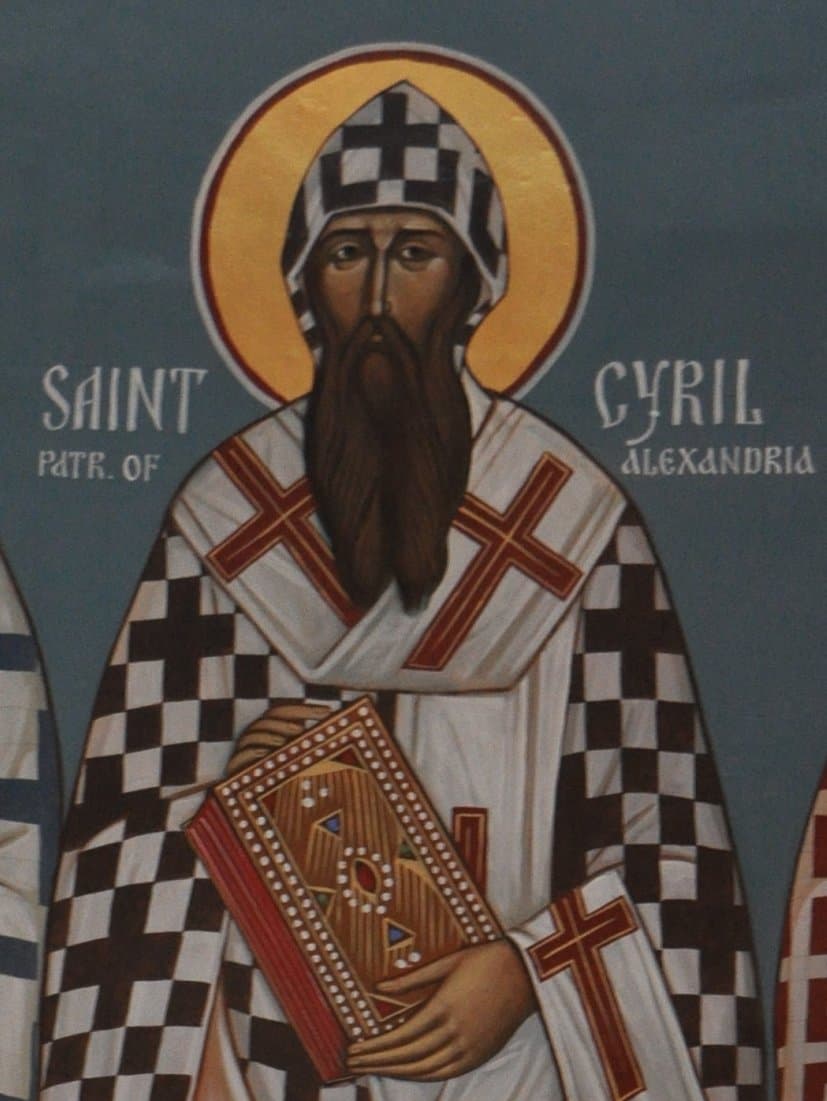
- Feast day
- June 27. The 1908 encyclopedia gives January 28 in the West and June 9 in the Greek books 1
- Was
- Patriarch of Alexandria from October 18, 412, and a Doctor of the Church 1
- Began
- His episcopate, Franciscan Media says, "with impulsive, often violent, actions" 2
- Is known for
- The Council of Ephesus in 431, and for the title Theotokos, God-bearer, given to Mary 2
- Was
- Deposed and imprisoned for three months after that council, then welcomed back to Alexandria 2
- Refused
- On his deathbed, and under pressure, to condemn the teacher of Nestorius 2
Saint Cyril of Alexandria is a Doctor of the Church whose own sources record him closing churches by force, expelling the Jewish community of Alexandria, and presiding over a see in which a woman was murdered by a mob. 12 He is also the bishop who established that Mary may be called the Mother of God, and who spent his last years restraining the allies who thought he had conceded too much. 2 Franciscan Media begins its account of him with a sentence worth keeping: "Saints are not born with halos around their heads." 2
What both sources put first
He was the nephew of Theophilus, patriarch of Alexandria, and went with him to Constantinople in 402 for the synod that deposed John Chrysostom. 1 When Theophilus died in 412 Cyril was consecrated in his place three days later, "but only after a riot between his supporters and those of his rival Timotheus." 1
Chapman does not hide what followed and neither does Franciscan Media. "Socrates complains bitterly that one of his first acts was to plunder and shut the churches of the Novatians." 1 Franciscan Media lists the same act and two others: he "pillaged and closed the churches of the Novatian heretics... participated in the deposing of Saint John Chrysostom, and confiscated Jewish property, expelling the Jews from Alexandria in retaliation for their attacks on Christians." 2
Chapman records the expulsion of a community that "had formed a flourishing community there since Alexander the Great", and then argues for it: "But they had caused tumults and had massacred the Christians, to defend whom Cyril himself assembled a mob. This may have been the only possible defence." 1 That is the 1908 encyclopedia's judgment, offered in its own voice, and it is reproduced here as its judgment.
The prefect of Egypt, Orestes, was furious about the expulsion and, Chapman adds, "was also jealous of the power of Cyril, which certainly rivaled his own." 1 Five hundred monks came down from Nitria to back the patriarch; in the disorder Orestes was hit in the head by a stone thrown by a monk named Ammonius; the prefect had Ammonius tortured to death; and "the young and fiery patriarch honoured his remains for a time as those of a martyr." 1
Hypatia
Chapman sets the context first: "The Alexandrians were always riotous", a point he supports from Socrates and from one of Cyril's own Easter homilies. 1 A prefect, Callistus, was killed in a riot in 422. 1
And in another, Hypatia was murdered. Chapman describes her as "a highly-respected teacher of neo-Platonism, of advanced age and (it is said) many virtues", a friend of Orestes, whom many believed "prevented a reconciliation between the prefect and patriarch." 1 What happened is given plainly: "A mob led by a lector, named Peter, dragged her to a church and tore her flesh with potsherds till she died." 1
Then the defense, which is quoted in full because the shape of it matters. "This brought great disgrace, says Socrates, on the Church of Alexandria and on its bishop; but a lector at Alexandria was not a cleric, and Socrates does not suggest that Cyril himself was to blame. Damascius, indeed, accuses him, but he is a late authority and a hater of Christians." 1
Three moves in one sentence: the man who led the mob is distinguished from the clergy, the nearer source is said not to blame Cyril, and the source that does blame him is discounted for lateness and bias. That is Chapman's case and it is his to make. This page does not adjudicate it, and does not leave it out. Franciscan Media does not mention Hypatia at all. 2
Learning prudence
There is a change in him, and Chapman dates it. For years Cyril refused to enter John Chrysostom's name in the diptychs of his church - a formal refusal to commemorate the man his uncle had helped depose. He yielded eventually to Isidore of Pelusium, whom Chapman calls his spiritual father, though even after Ephesus "that saint still found something to rebuke in him on this matter." 1 The change is real and it is not sudden.
It shows most clearly in how he handled Nestorius. Alexandria had a history here: one predecessor had tried to appoint a bishop of Constantinople and another had deposed one. Cyril did neither. "Cyril had learnt prudence... though in this case Alexandria was in the right, does not act in his own name, but denounces Nestorius to St. Celestine, since ancient custom, he says, persuaded him to bring the matter before the pope." 1
The pope's answer was, in Chapman's words, "of astonishing severity": Nestorius had ten days from receipt to recant or be cut off, and Cyril was to act with the authority of the Roman See. 1
The argument, and what it was actually about
Franciscan Media explains the substance better than any summary could. Nestorius "would not agree to the title 'God-bearer' for Mary. He preferred 'Christ-bearer,' saying there are two distinct persons in Christ - divine and human - joined only by a moral union. He said Mary was not the mother of God but only of the man Christ, whose humanity was only a temple of God." 2
And it draws the consequence that makes it matter: "Nestorianism implied that the humanity of Christ was a mere disguise." 2 The question was never really about Mary. It was about whether the man who was born and died was God.
At Ephesus in 431, presiding as the pope's representative, "Cyril condemned Nestorianism and proclaimed Mary truly the 'God-bearer' - the mother of the one Person who is truly God and truly human." 2
Chapman is not admiring about how he ran it. John of Antioch and his bishops had been delayed; Cyril suspected he was stalling; "he opened the council without John, on 22 June, in spite of the request of sixty-eight bishops for a delay. This was an initial error, which had disastrous results." 1 The Roman legates had not arrived either, so a question Cyril had put to the pope went unanswered while he proceeded. 1
Nor are Cyril's own twelve propositions treated as above criticism. "The epistle was not conciliatory, and Nestorius may well have been taken aback. The twelve propositions did not emanate from Rome, and were not equally clear; one or two of them were later among the authorities invoked by the Monophysite heretics in their own favour." 1 His own formulations were later quoted by the opposite heresy.
Nestorius preached against him as a calumniator who had used bribes, and Chapman's aside on the charge is the driest line in the article: "(which was probably as true as it was usual)". 1
The end, and the part that is unlike the beginning
It did not go smoothly for him afterward. "In the confusion that followed, Cyril of Alexandria was deposed and imprisoned for three months, after which he was welcomed back to Alexandria." 2
What he did with the rest of his life is the reason he is worth reading. He had to soften his opposition to people who had sided with Nestorius, and that cost him: "Cyril had difficulties with some of his own allies, who thought he had gone too far, sacrificing not only language but orthodoxy." 2 The men who had backed him hardest now thought he had sold the position.
He held that line to the end. "Until his death, his policy of moderation kept his extreme partisans under control." 2 And Franciscan Media closes with the sentence that turns the whole entry around: "On his deathbed, despite pressure, he refused to condemn the teacher of Nestorius." 2
The man who began by shutting other people's churches by force ended by refusing, while dying, to denounce a dead man's teacher because somebody wanted him to.
What is Saint Cyril of Alexandria the patron saint of?
Neither source cited here gives him a patronage. 12 Chapman's article is a study of the controversy and Franciscan Media's entry ends at his deathbed; neither names a cause he is invoked for, and this page does not supply one.
What he is titled is Doctor of the Church, which Chapman states in his opening words. 1 It is given for teaching, not for conduct, and the sources make clear those were not the same thing in his case.
Saint Cyril of Alexandria's feast day
The feast of Saint Cyril of Alexandria is June 27.
The 1908 encyclopedia gives three different dates and not that one. "St. Cyril has his feast in the Western Church on the 28th of January; in the Greek Menaea it is found on the 9th of June, and (together with St. Athanasius) on the 18th of January." 1 The January 28 was the Western date when the article was written; the modern calendar keeps June 27.
All of them are printed here rather than one being chosen silently. A reader meeting January 28 in an older book, or June 9 in a Greek one, is not looking at an error.
Praying with Saint Cyril of Alexandria
He is the hardest saint in this library to pray with honestly, and Franciscan Media is the one that says so first. "Saints are not born with halos around their heads." 2 The record of his first years as patriarch includes churches plundered and shut, a whole community expelled from a city it had lived in since Alexander, and a public murder that Socrates said disgraced the church and its bishop. 12 The encyclopedia cited here argues he was not responsible for that last one; it is his argument, and it is on the page as his.
What can be said without arguing is that he did not stay as he began. Chapman, who defends him, also records him being rebuked by his own spiritual father years after Ephesus and still deserving it. 1 The prudence is described as something he learnt, which means there was a time when he did not have it.
The thing to take from him is the last part, not the first. He won the argument of his life, and then spent what was left of it restraining the people who had won it with him - conceding language to former opponents, losing the confidence of allies who thought he had given away too much, and holding that line "until his death". 2 Winning made him more careful rather than less. That is rarer than the courage that got him there.
And the last recorded act is a refusal. Dying, pressed by people who wanted one more condemnation, he would not give it. 2 Whatever else is true of him, he did not end as the man who shut the Novatian churches.
Saint Cyril of Alexandria, pray for us.
Sources
Saints to turn to next
Others in this collection who are turned to for some of the same things.
- Saint Augustine of HippoNovember 13, 354 - August 28, 430ConversionStudy and teachingDiscernment
- Saint John Henry NewmanFebruary 21, 1801 - August 11, 1890Study and teachingDiscernmentConversion
- Saint John VianneyMay 8, 1786 - August 4, 1859ConversionDiscernmentStudy and teaching
- Saint Aloysius GonzagaMarch 9, 1568 - June 21, 1591DiscernmentConversion