Saint John Vianney
May 8, 1786 - August 4, 1859
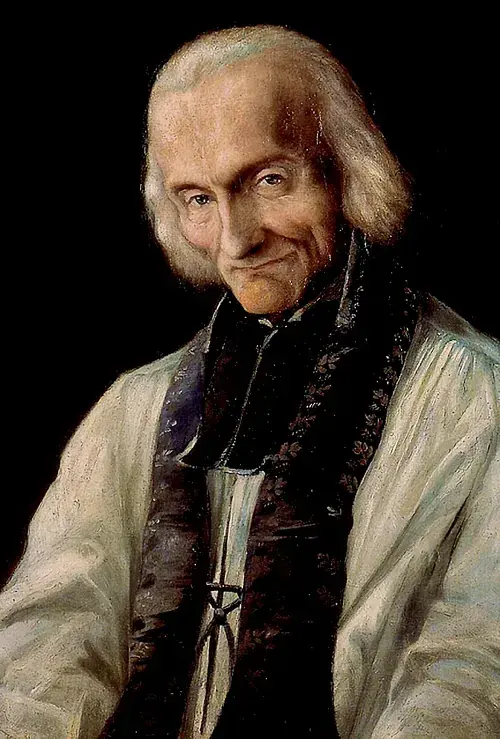
- Patron saint of
- Parish priests and confessors 3
- Curé of Ars
- From 1818 until his death, forty-one years in one village 2
Saint John Vianney could not learn Latin, failed his seminary examinations, and was ordained at twenty-nine largely because one older priest kept vouching for him. 12 He was then sent to Ars, a village not far from Lyons, and stayed forty-one years - and by 1855 twenty thousand pilgrims a year were coming there to confess to him. 2 Benedict XVI opened the Year for Priests on the anniversary of his death. 1
Illiterate at seventeen
Vianney was born at Dardilly near Lyons on 8 May 1786, into a family Benedict XVI describes as "poor in material possessions but rich in humanity and in faith." He was baptized the day he was born, and he spent so much of his childhood in the fields and with the flocks that "at the age of 17 he was still illiterate." What he had instead were the prayers his mother had taught him, which he knew by heart. 1
In 1806 the curé at Ecully, M. Balley, opened a school for boys who wanted to be priests, and Jean-Marie was sent to him. The encyclopedia is unsparing about the raw material: he was "of average intelligence," his knowledge was "extremely limited, being confined to a little arithmetic, history, and geography," and he found learning, "especially the study of Latin, excessively difficult." A fellow student, Matthias Loras - later the first Bishop of Dubuque - sat with him over his Latin. 2
The year he was a deserter
Then Napoleon needed men for the war in Spain and withdrew the exemption that had protected ecclesiastical students, and Vianney was drawn in the conscription. His father tried and failed to buy a substitute, so he had to go. 2
On the morning his regiment marched, he went to church to pray. He came back to the barracks and found that everyone had left without him. He was threatened with arrest, but the recruiting captain believed his story and sent him after the troops. At nightfall a young man offered to guide him to his regiment and instead led him to Noes, where a group of deserters had collected. The mayor of the village persuaded him to stay on under an assumed name as the local schoolmaster. 2
He was there fourteen months before he could get word to his family. His father, appalled to learn that his son was a deserter, ordered him to give himself up - and the matter was settled only because his younger brother offered to serve in his place and was accepted. 2 None of this appears in the popular accounts, and the encyclopedia tells it without embarrassment.
Ordained anyway
He went back to his studies at Ecully, and in 1812 was sent to the seminary at Verrieres, where his Latin was so weak that he had to follow the philosophy course in French. He failed the examinations for entry to the major seminary. He was re-examined three months later and passed. On 23 June 1815 he was ordained deacon and on 13 August a priest, by the Bishop of Grenoble. 12
Franciscan Media puts the obstacles in a row: "his meager formal schooling, which inadequately prepared him for seminary studies," and "the reluctance of the bishop, who questioned his abilities. John almost ended up a farmer instead of a priest." 3 Benedict XVI reaches the same place from the other side: he was ordained "only after many ordeals and misunderstandings, with the help of far-sighted priests who did not stop at considering his human limitations but looked beyond them," and arrived at the altar at twenty-nine "after numerous uncertainties, quite a few failures and many tears." 1
The encyclopedia offers a diagnosis worth quoting in full, because it refuses to pretend he was secretly brilliant. His difficulty was "a lack of mental suppleness in dealing with theory as distinct from practice - a lack accounted for by the meagreness of his early schooling, the advanced age at which he began to study, the fact that he was not of more than average intelligence, and that he was far advanced in spiritual science and in the practice of virtue long before he came to study it in the abstract." 2
The one who kept him in was M. Balley, who had first recognized his vocation, urged him on "when the obstacles in his way seemed insurmountable," interceded with the examiners when he failed, and was, the article says, "his model as well as his preceptor and patron." 2 Vianney served as his assistant until Balley died in 1818.
Ars
In 1818 he was made parish priest of Ars, a village not far from Lyons, and Franciscan Media describes what he found: people who were "indifferent and quite comfortable with their style of living." 23 He answered it with severe fasts and short nights, and stayed forty-one years.
A few years in he founded what the encyclopedia calls "The Providence," a home for destitute girls, set up with Catherine Lassagne and Benedicta Lardet; it became the model for similar institutions all over France. 23 He taught the catechism there himself, and the instructions grew so popular that in the end he was giving them daily in the church to large crowds. 2
It was his favorite work and he closed it in 1847 - not because it failed, but because "the holy curé thought that he was not justified in maintaining it in the face of the opposition of many good people." The encyclopedia adds, flatly: "Its closing was a very heavy trial to him." 2 The best thing he built, given up to keep the peace.
The confessional
The direction of souls was the real work. People began arriving from neighboring parishes, then from distant places, then from all over France, and finally from other countries. By 1835 his bishop had excused him from the annual diocesan retreats because of "the souls awaiting him yonder." By 1855 the pilgrims numbered twenty thousand a year. 2
How long he sat there depends on who is counting. The encyclopedia says that in his last ten years "he spent from sixteen to eighteen hours a day in the confessional"; Franciscan Media says eleven to twelve hours daily in winter, rising to sixteen in summer. 23 Benedict XVI describes him passing "with a single inner impulse from the altar to the confessional." 1
What people got there was not learning. His direction was marked by "common sense, remarkable insight, and supernatural knowledge," and he would sometimes name a sin that had been held back in an imperfect confession. His instructions were plain, "full of imagery drawn from daily life and country scenes," and delivered with a voice that at the end was almost inaudible. 2 Franciscan Media reports that the devil disturbed even the few hours of sleep he allowed himself. 3
The greatest miracle
His biographers record miracles in three classes, the encyclopedia says: money arriving for his charities and food for his orphans, knowledge of the past and the future, and the healing of the sick, especially children. 2
Then it sets all of that aside in one sentence: "The greatest miracle of all was his life." For forty years his food and his sleep were, "humanly speaking, insufficient to sustain life," and he worked without stopping "with unfailing humility, gentleness, patience, and cheerfulness" until he was past seventy-three. 2 He died at two in the morning on 4 August 1859. 1
What is Saint John Vianney the patron saint of?
Franciscan Media names him the patron saint of parish priests and of confessors. 3 The encyclopedia, writing before his canonization, records that Pius X "proposed him as a model to the parochial clergy." 2
Benedict XVI used the 150th anniversary of his death to inaugurate a Year for Priests, on the theme "Faithfulness of Christ, Faithfulness of Priests," and put the reason plainly: "The credibility of witness depends on holiness." 1 He also raised the obvious objection himself - how could a priest today imitate a man whose methods belong to a nineteenth-century French village? - and answered that what made the Curé holy "was his humble faithfulness to the mission to which God had called him," which is not period-specific. 1
Saint John Vianney's feast day
Praying with Saint John Vianney
He is the patron of parish priests and he was nearly not ordained. 13 The encyclopedia does not claim he was secretly clever; it says he was of average intelligence, badly schooled, too old when he started, and already far ahead in holiness of anything he could explain in the abstract. 2 Anyone who has been told they are not able enough for the thing they are certain they are for has a saint who was told it by examiners and was right anyway.
What he needed was one person who would not let go. M. Balley found him, taught him, argued with the examiners on his behalf, and kept telling him to continue when it looked hopeless. 2 Vocations do not usually survive on their own, and the older priest is the reason there was a Curé of Ars at all.
Sixteen hours a day in a wooden box, for ten years, listening. 2 Whatever else that is, it is not glamorous, and it is the whole of what he is famous for. He was not a builder, an administrator or a writer; he sat still and let people tell him the worst thing about themselves, and by the end his voice had almost gone. 2
The Providence is the part that stays uncomfortable. He built a home for destitute girls, taught the children himself, watched it become a model copied across France, and then shut it down because good people objected and he could not see how to justify keeping it. The encyclopedia says the closing was a very heavy trial to him and leaves it there. 2 It is not resolved, and the page will not resolve it either.
Saint John Vianney, pray for us.
Sources
Saints to turn to next
Others in this collection who are turned to for some of the same things.
- Saint Augustine of HippoNovember 13, 354 - August 28, 430ConversionStudy and teachingDiscernment
- Saint Cyril of AlexandriaBirth unknown - 444Study and teachingConversionDiscernment
- Saint John Henry NewmanFebruary 21, 1801 - August 11, 1890Study and teachingDiscernmentConversion
- Saint Aloysius GonzagaMarch 9, 1568 - June 21, 1591DiscernmentConversion