Saint Lawrence of Brindisi
1559 - July 22, 1619
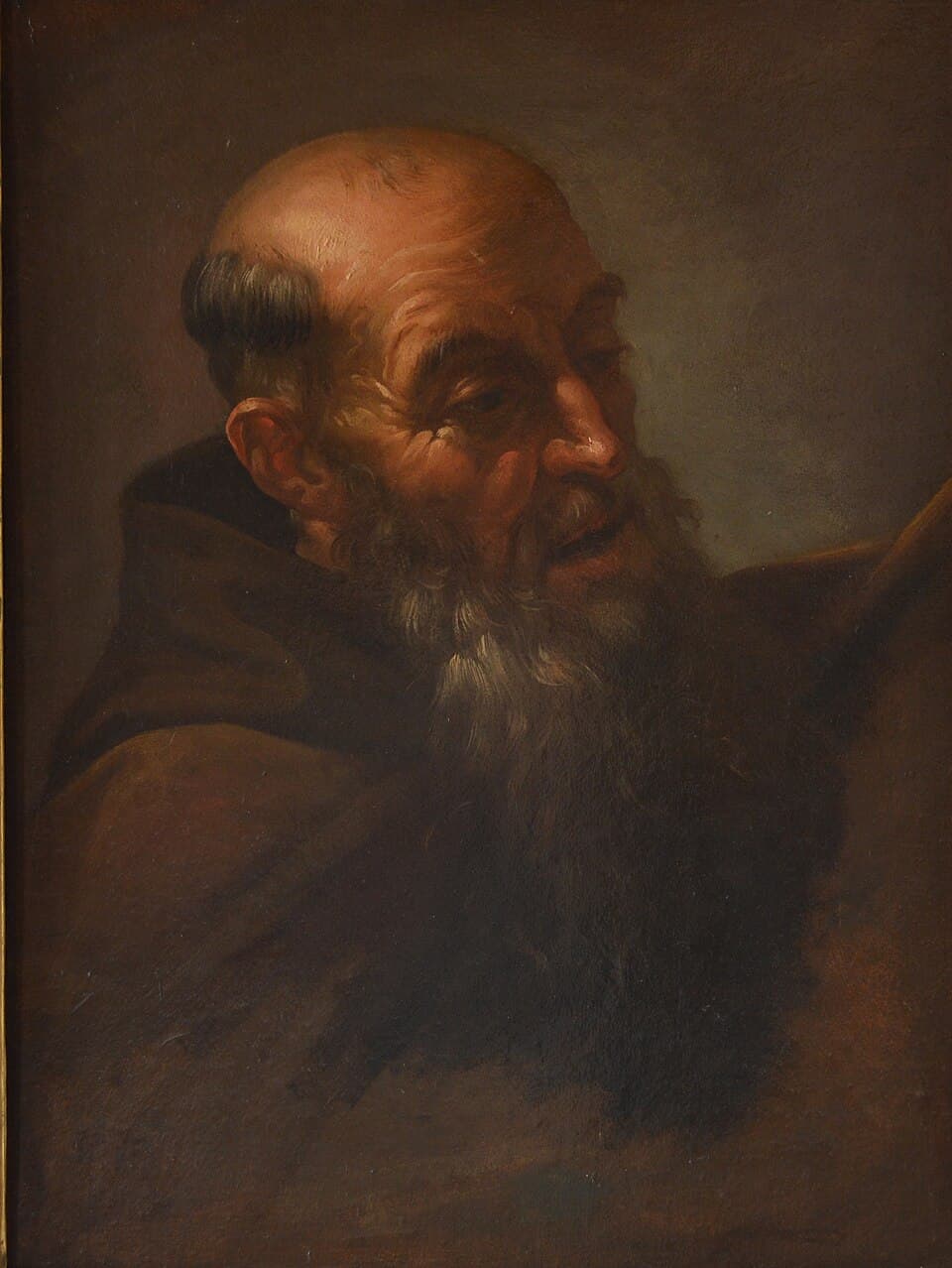
- Languages
- Greek, Hebrew, Syriac, French and German besides Italian and Latin; Candide says he knew the whole original text of the Bible 12
- Minister General
- Of the Capuchins from 1602 to 1605, besides several terms as provincial 2
- Doctor of the Church
- Doctor Apostolicus, conferred by John XXIII in 1959 for the fourth centenary of his birth 2
Saint Lawrence of Brindisi knew the Bible in the original languages well enough that the examiners at his beatification thought it needed explaining, and rabbis who heard him preach treated him with respect. 12 He was also chaplain to an imperial army marching against the Turks, minister general of the Capuchins, and a diplomat who died in Lisbon while arguing somebody else's case with the King of Spain. 12 He left eight folio volumes of sermons. 1
A child who was given the Christmas sermon
He was born at Brindisi in 1559 and baptized Julius Caesar. 12 Candide names his parents - Guglielmo de Rossi, or Russi according to a contemporary writer, and Elisabetta Masella - and says both were excellent Christians. 1 Benedict XVI gives the family name as Russo. 2
His father died when he was a boy, and the sources differ slightly on the age: Candide says twelve, Benedict says seven. 12 The Conventual friars of Brindisi took over his education. 12 Candide records a detail that is hard to improve on: at barely six he had already shown what he would become, so he was "always the one chosen to address, in accordance with the Italian custom, a short sermon to his compatriots on the Infant Jesus during the Christmas festivities." 1
He continued his studies at Venice, where Benedict says he met the Capuchins, then working hard at the reform the Council of Trent had set in motion. 2 He was received among them in 1575 as Brother Lorenzo, studied philosophy and theology at Padua, and was ordained in 1582. 12
The languages came easily and the sources agree they were the foundation of everything else. Benedict lists Greek, Hebrew, Syriac, French and German on top of Italian and Latin. 2 Candide goes further: "Owing to his wonderful memory he mastered not only the principal European languages, but also most of the Semitic tongues. It was said he knew the entire original text of the Bible." 1 Many people, he adds, could account for such knowledge only by supernatural assistance, and the examiners of his writings at the beatification judged that he "can truly be numbered among the holy doctors of the Church." 1
What he did with them
He preached the Lent at Venice while still a deacon, and Candide says the success was such that he was called to all the principal cities of the peninsula in turn, and then across most of the countries of Europe. 1 The surviving sermons "fill no less than eight folio volumes." 1
Benedict is interested in what the languages made possible rather than in the feat itself. Lawrence's knowledge of rabbinic literature as well as of Scripture was deep enough that "even the Rabbis, impressed and full of admiration, treated him with esteem and respect." 2 And in Germany he set out Catholic doctrine to people who had gone over to the Reformation, demonstrating "with his calm, clear exposition" the biblical and patristic grounds of the articles Luther disputed - the primacy of Peter, the divine origin of the episcopate, justification as an inner transformation, the need for good works. 2
Benedict draws a present-day moral from it: that in ecumenical dialogue, reference to Scripture read within the Tradition "is an indispensable element of fundamental importance." 2 The argument worked because both sides accepted the text it appealed to.
He did not preach only to the learned. Benedict notes that "even the simplest members of the faithful, those not endowed with great culture, benefited from the convincing words of Lawrence," who told them plainly to make their lives match the faith they professed. 2 Candide describes the same instinct as a method: Lawrence preached the way the great Franciscan missionaries did, "aiming primarily to reach men's hearts and convert them," and adapted his style to his hearers. 1
The army, and the peace
The episode the two sources treat most differently is the campaign, and the difference is worth marking.
Candide gives it in full. At the founding of the convent at Prague in 1601, Lawrence was named chaplain of the Imperial army, then about to march against the Turks. 1 The victory at Lepanto in 1571 had only temporarily checked the Moslem advance; Mohammed III had taken a large part of Hungary since his accession in 1595, and the emperor, determined to stop him going further, sent Lawrence as deputy to the German princes to obtain their cooperation. 1 They agreed, and the Duke of Mercoeur brought his forces to the imperial army. 1
Benedict XVI, giving a whole catechesis on the man, does not mention the campaign at all. What he dwells on instead is the opposite errand: the diplomatic missions entrusted to Lawrence by popes and Catholic princes "to settle controversies and to encourage harmony among the European States," and the moral authority that made him "a counsellor both sought after and listened to." 2 His conclusion is that the world still needs "peaceful and peacemaking men and women." 2
Both are true of the same man, and this page does not smooth them into one. He raised troops against an invasion and he spent years talking Christian princes out of fighting each other, and he died doing the second: in Lisbon in 1619, where he had gone to see Philip III of Spain "to plead the cause of the Neapolitan subjects oppressed by the local authorities." 2 Candide dates the death to 22 July. 1
The Mass that would not end
Benedict raises the question anyone would ask of a man holding that many offices - professor of theology, novice master, several times provincial, definitor general, minister general from 1602 to 1605, and a preaching schedule across Europe throughout. 2 He calls it surprising that the preaching never stopped. 2
The answer he gives is about prayer, and it is specific rather than pious. Lawrence gave much time to it, and "especially, to the celebration of Holy Mass - often protracted for hours - caught up in and moved by the memorial of the Passion, death and Resurrection of the Lord." 2 Hours. A working administrator with a continent-sized diary.
Benedict turns that into a warning for priests about activism, "acting, that is, without remembering the profound motives of his ministry," and quotes himself at Brindisi: "the time he spends in prayer is the most important time in a priest's life... if we are not interiorly in communion with God we cannot even give anything to others." 2
Lawrence pressed the same thing on everybody, not only clergy, and the reason he gives is worth having whole: "God is truly present to us when we speak to him in prayer; that he truly listens to our prayers, even if we pray only with our hearts and minds. And that not only is he present and hears us, indeed he willingly and with the greatest of pleasure wishes to grant our requests." 2
What is Saint Lawrence of Brindisi the patron saint of?
None of the three sources used here states a patronage for Saint Lawrence of Brindisi, and this profile does not supply one. 123 Franciscan Media, which is cited on many of these pages precisely because it lists patronages, lists none for him. 3 What he has instead is a title: Doctor Apostolicus, the Apostolic Doctor, given by John XXIII in 1959 at the fourth centenary of his birth. 2 He had been canonized in 1881. 2
Saint Lawrence of Brindisi's feast day
The feast of Saint Lawrence of Brindisi is July 21. 3 The encyclopedia gives a different day and was right about its own calendar: writing in 1910, Candide records that "his feast is kept on 6 July." 1 He died on 22 July, so the current date sits beside the anniversary of his death and the older one did not. 13 This library has now met the same 1969 shift on three pages, which is why a date read out of the 1913 encyclopedia is never published here without a current source beside it.
Praying with Saint Lawrence
The scholarship is the first thing anyone notices and the least useful to imitate. Most people will not learn Syriac. What can be taken from it is the purpose the learning served: he studied the rabbinic literature well enough that rabbis respected him, and argued with Lutherans from the Scripture and the Fathers they also accepted. 2 He took the trouble to be able to speak to people in terms they already granted.
Then the Mass that ran for hours. 2 It sits oddly next to a diary containing a province, an order, an imperial court and half the pulpits in Europe, and the oddity is the point. Benedict puts it as a caution against acting without remembering why, which is a failure available to anyone with too much to do and no particular vice to blame it on.
His account of prayer asks very little. God is present when we speak to him, hears us even when we pray only in our hearts and minds, and wants to answer. 2 There is no method in it and no precondition. The most learned man in the room describing prayer in terms a child could use.
He died a long way from home, on an errand for people who were not his own - Neapolitan subjects being ill-treated, a case to put to the King of Spain, a journey to Lisbon at sixty. 2 Candide gives the date and place and leaves it there. 1 It is an unremarkable end for a remarkable man, and it is the kind of thing he seems to have spent his life doing.
Saint Lawrence of Brindisi, pray for us.
Sources
Saints to turn to next
Others in this collection who are turned to for some of the same things.