Saint Albert the Great
c. 1206 - November 15, 1280
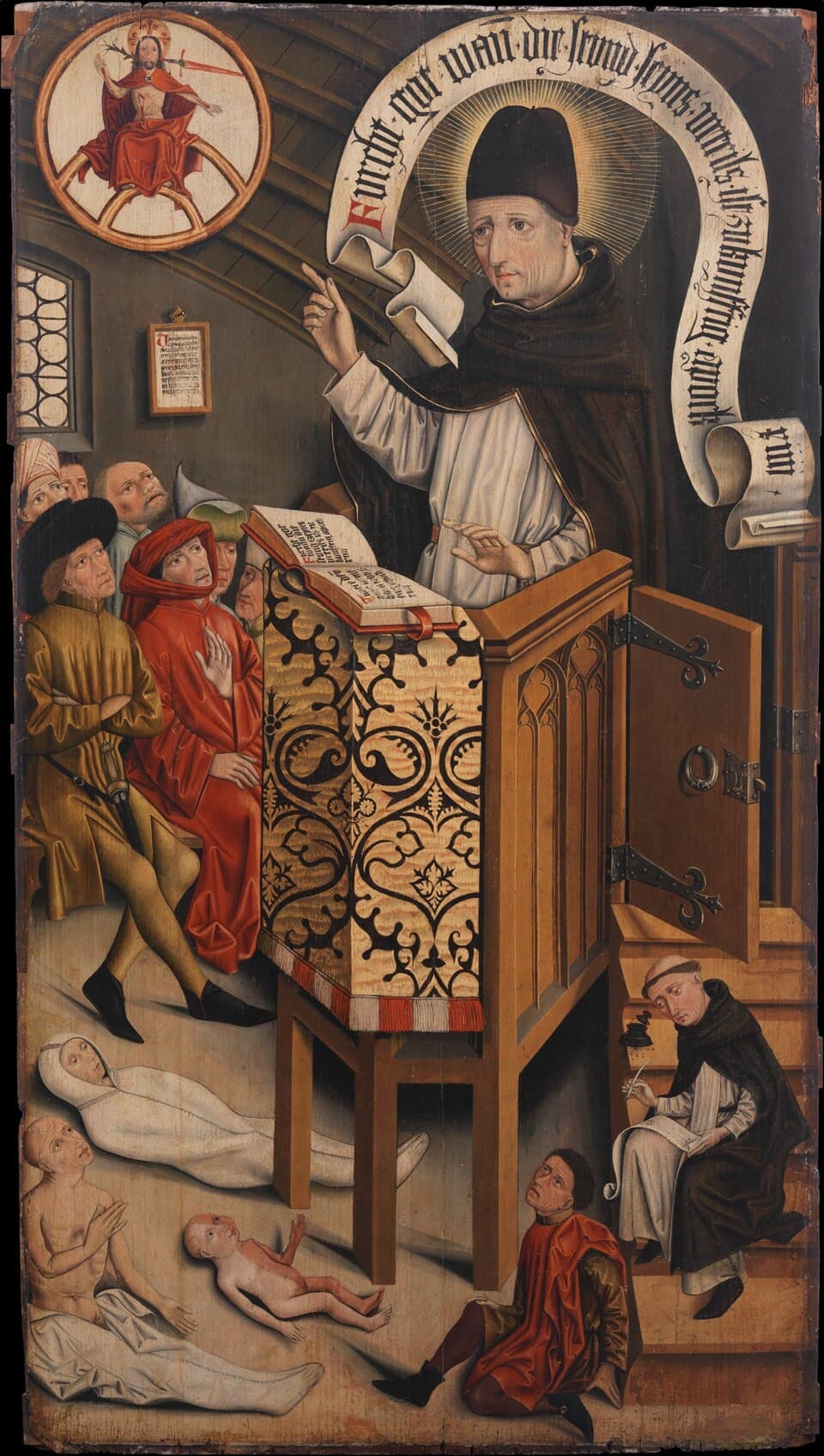
- Patron saint of
- Enthusiasts of the natural sciences, named by Pius XII, who also called him "Doctor universalis" 2
- Feast day
- November 15, which is also the day he died at Cologne in 1280 1
- Born
- Lauingen, Swabia. Kennedy gives c. 1206, noting that "many historians give it as 1193"; Benedict XVI says only the beginning of the 13th century 12
- Taught
- Thomas Aquinas, at Cologne and Paris. Kennedy says he recognized the silent youth's genius and foretold his greatness 1
- Bishop of Regensburg
- From 1260 to 1262, restoring order to a diocese in difficulty 2
- Canonized
- In 1931 by Pius XI, who proclaimed him a Doctor of the Church at the same time 2
Saint Albert the Great wrote that "experiment is the only safe guide" in the study of plants, and that anyone who thinks Aristotle never erred must believe Aristotle was a god. 1 He is a thirteenth-century Dominican friar, the teacher of Thomas Aquinas, and the patron of people who are keen on the natural sciences - a title Pius XII gave him for a body of work covering physics, chemistry, astronomy, mineralogy, botany and zoology. 2 He is also the old man who traveled to Paris to defend his dead student's reputation. 1
The student he brought from Paris
Albert was the eldest son of the Count of Bollstadt, born at Lauingen in Swabia. 1 He went to Padua as a young man to study the liberal arts, and Benedict XVI notes that it was there he showed the interest in natural science that became his specialty. 2 He attended the Dominican church in the city and joined the order in 1223, drawn by the preaching of Blessed Jordan of Saxony, Dominic's successor. 12 Benedict says the decision came gradually and that Albert had to overcome his family's resistance to make it. 2
He taught at Dominican houses, perfected his theology at Paris, and in 1248 was sent to open a house of studies at Cologne, the city that became his. 2 Benedict mentions in one sentence the thing that would secure Albert's place even if he had written nothing: "He brought with him from Paris an exceptional student, Thomas Aquinas." 2
Kennedy fills that in. During the years of teaching at Cologne and Paris, Albert counted among his hearers "St. Thomas Aquinas, then a silent, thoughtful youth, whose genius he recognized and whose future greatness he foretold." 1 Thomas went with him to Paris in 1245 and came back with him to Cologne in 1248, where Albert was Regent and Thomas became second professor and Master of Students. 1 Benedict says a relationship of mutual esteem and friendship grew between them, and that this was "very helpful in the development of this branch of knowledge." 2
What he thought science was for
The quotations Kennedy assembles are worth reading closely, because they are from a Dominican friar writing around 1250 and they do not sound like it.
On method: "The aim of natural science is not simply to accept the statements of others, but to investigate the causes that are at work in nature." 1 In the treatise on plants he sets down a principle in four Latin words, Experimentum solum certificat in talibus - experiment is the only safe guide in such investigations. 1
On the boundary between his two fields, he is stricter than many modern readers would expect a medieval theologian to be. "In studying nature we have not to inquire how God the Creator may, as He freely wills, use His creatures to work miracles and thereby show forth His power: we have rather to inquire what Nature with its immanent causes can naturally bring to pass." 1 Miracles are not an explanation inside natural science, and he says so.
On authority, including the authority he is usually accused of deferring to: "Whoever believes that Aristotle was a god, must also believe that he never erred. But if one believe that Aristotle was a man, then doubtless he was liable to error just as we are." 1 Kennedy notes that Albert devoted a lengthy chapter to what he himself called "the errors of Aristotle." 1 His appreciation of the Greek, in Kennedy's summary, is critical. 1
Benedict is honest about the limits. The methods Albert used "were not those that came to be established in the following centuries"; what he did was observe, describe and classify. 2 The claim is not that he invented modern science. It is that he opened the door for the research that followed. 2
Aristotle, and the question underneath
The scale of what Albert took on is easy to miss at this distance. Works of Aristotle were spreading in the West, especially in ethics and metaphysics, and they arrived by way of Arab commentators in interpretations that looked, at least in places, irreconcilable with Christian faith. 2 Benedict states the dilemma that produced: "are faith and reason in conflict with each other or not?" 2
Many Christian thinkers were afraid of the answer. Albert studied the works with scientific rigor, Benedict says, "convinced that all that is truly rational is compatible with the faith revealed in the Sacred Scriptures." 2 The consequence was a cultural revolution in its day - the acceptance of a pagan, pre-Christian philosophy into medieval thought, given definitive form afterward by Thomas. 2
The structural result matters more than the biography. Benedict says Albert contributed to the formation of "an autonomous philosophy, distinct from theology and united with it only by the unity of the truth," so that in the thirteenth century a clear distinction came into being between two branches of knowledge which then converse without collapsing into each other. 2 That is the architecture the Church has argued from ever since.
Benedict draws the lesson he plainly wants drawn: "St Albert shows that there is no opposition between faith and science," and a person of faith and prayer "can serenely foster the study of the natural sciences and progress in knowledge of the micro- and macrocosm." 2 He adds that scientists, through their vocation to study nature, "can take an authentic and fascinating path of holiness." 2
The last years
He did not spend his life in a library. Alexander IV kept him at the papal court for a time as a theological adviser, and then made him Bishop of Regensburg, a large and celebrated diocese going through a hard period. 2 Albert held it from 1260 to 1262 and, in Benedict's account, restored peace to the city, reorganized parishes and convents, and revived its charitable work. 2 He preached in Germany and Bohemia at Urban IV's request, then went back to Cologne to lecture and write. 2 At the Second Council of Lyons in 1274 he worked for union between the Latin and Greek Churches. 2
Thomas Aquinas died that same year, and the last thing recorded of Albert in strength is about him. Kennedy says he could not restrain his tears whenever Thomas's name was mentioned. 1 When it was announced in 1277 that Stephen Tempier and others meant to condemn Thomas's writings for being too favorable to the unbelieving philosophers, something of Albert's old vigor returned and he made the journey to Paris to defend his disciple's memory. 1 He was past seventy and Thomas was dead, and he went anyway.
The ending Kennedy gives is unsparing. Some time after 1278, the year he drew up his testament, Albert "suffered a lapse of memory; his strong mind gradually became clouded; his body, weakened by vigils, austerities, and manifold labours, sank under the weight of years." 1 The universal doctor lost his memory. He died in his cell at the convent of the Holy Cross in Cologne in 1280 and was venerated by his brethren almost at once. 2
What is Saint Albert the Great the patron saint of?
Saint Albert the Great is the patron of people devoted to the natural sciences. Benedict XVI states that Pius XII "named him Patron of enthusiasts of the natural sciences," and also called him "Doctor universalis" for the range of his interests and knowledge. 2 Kennedy notes that the same title, Doctor Universalis, was attached to him in his own century, along with "the Great," because he was proficient in every branch of learning then cultivated and surpassed all his contemporaries in the knowledge of nature - "except perhaps Roger Bacon." 1
Saint Albert the Great's feast day
The feast of Saint Albert the Great is November 15. 1 Kennedy gives the date of his death at Cologne as 15 November 1280 and states separately that his feast is celebrated on the fifteenth of November, so the two facts are independently sourced rather than one inferred from the other. 1 He was beatified by Gregory XV in 1622, and the German bishops petitioned for his canonization from Fulda in September 1872; it came in 1931, when Pius XI canonized him and made him a Doctor of the Church in a single act. 12
Praying with Saint Albert
Albert is the obvious saint for anybody who has been told, or has half believed, that taking the world seriously and taking God seriously are in competition. His answer was not an argument so much as a working life: decades of observing, describing and classifying plants, minerals and animals, carried on by a friar who also ran a province, governed a diocese and preached. 12
The instruction he left about method has a spiritual shape to it. Do not simply accept what others have said; find out what is actually causing this. 1 Do not reach for a miracle when you are asking what nature can do by itself. 1 Do not treat any authority, however great, as incapable of error. 1 Those are habits of honesty before they are techniques, and they cost something to keep.
Benedict quotes the formula Albert lived by, which is stranger and more demanding than it first sounds: "to desire all that I desire for the glory of God, as God desires for his glory all that he desires." 2 Not a rule about what to want. A rule about the reason for wanting it.
The end of him is the part that resists tidying. The man called the Universal Doctor, whose knowledge his contemporaries called a miracle, lost his memory some years before he died and his mind clouded over. 1 Whatever holiness turned out to consist of in his case, it was not the knowledge, because the knowledge went first. What the records keep from those last years is an old man crying at his student's name and getting on the road to Paris to defend him. 1
Saint Albert the Great, pray for us.
Sources
Saints to turn to next
Others in this collection who are turned to for some of the same things.