Saint Peter Chrysologus
c. 406 - c. 450
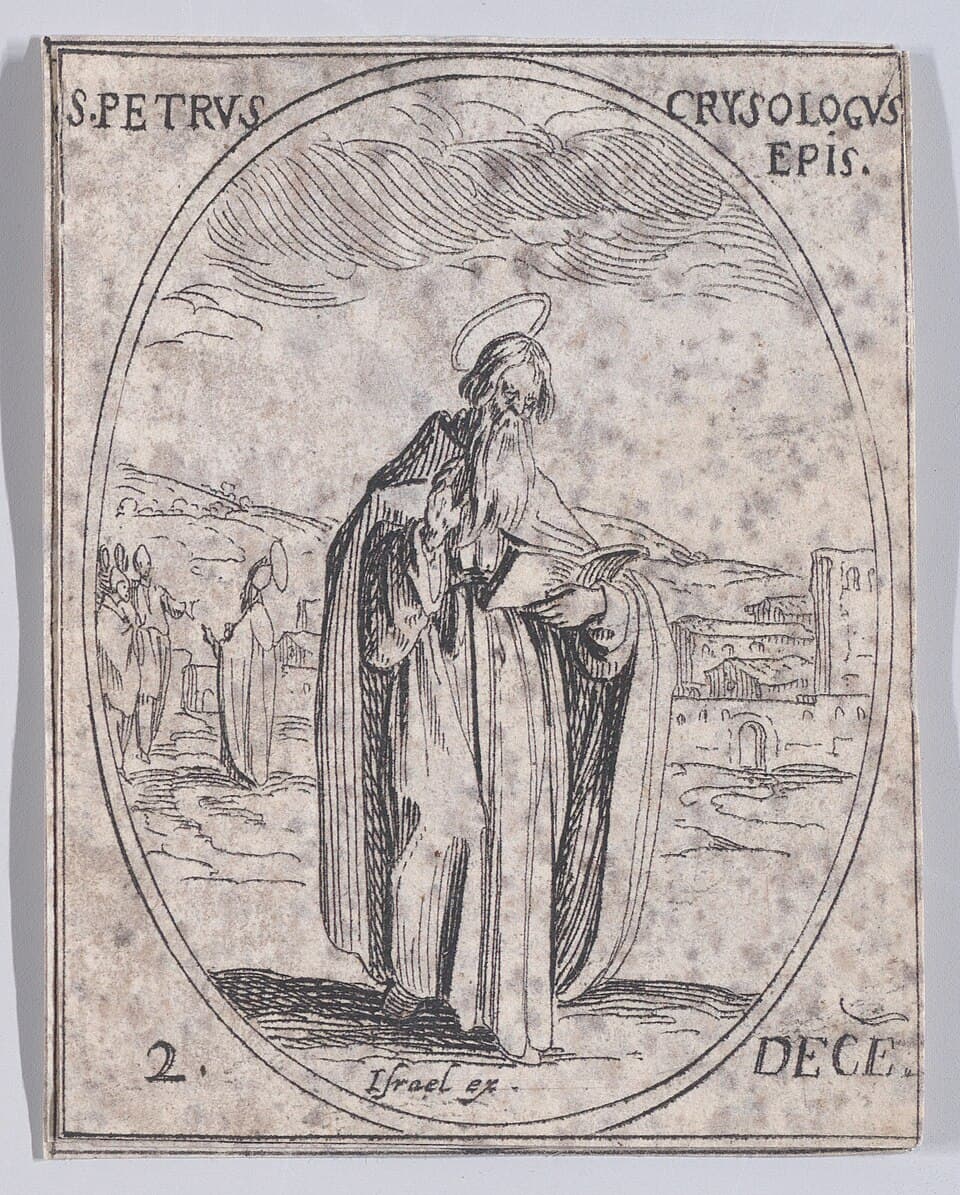
- Feast day
- July 30 2
- What survives
- 176 homilies, collected by a later bishop of Ravenna some 250 years after his death 1
- Declared a Doctor
- By Benedict XIII, about thirteen centuries after he preached 2
Saint Peter Chrysologus was bishop of Ravenna when Ravenna was the capital of the Western empire, and his weapon against the paganism still left in his diocese was the short sermon. 2 A hundred and seventy-six of them survive. 1 Franciscan Media's verdict on them is startlingly honest - "They do not contain great originality of thought" - and he was made a Doctor of the Church for them anyway. 2
What little is known
Smith opens by admitting the problem: the earliest life of him was written by Agnellus in the ninth century, four hundred years after he died, and it "gives but scanty information about him." 1
What can be said: he was born at Imola about 406, and was "baptised, educated, and ordained deacon by Cornelius, Bishop of Imola." 1 One man saw him through every stage. In 433 he was made Bishop of Ravenna. 1
Franciscan Media points out what that see was at that moment: Ravenna was "the capital of the empire in the West." 2 Not a provincial posting. The imperial court was there.
"His piety and zeal won for him universal admiration, and his oratory merited for him the name Chrysologus" - golden-worded. 1 Franciscan Media renders it "Peter 'of the Golden Words'." 2
He moved in the highest circles the Church of his day had. "He shared the confidence of Leo the Great and enjoyed the patronage of the Empress Galla Placidia." 1 The pope trusted him and the empress protected him.
The letter he did not write
One episode shows what that standing was worth, and what he did with it.
Eutyches, whose teaching on the person of Christ was condemned by a synod at Constantinople in 448, went looking for allies among the bishops of the West. Smith records the result in a single clause: "the Monophysite Eutyches endeavoured to win the support of Peter, but without success." 1
A condemned man with imperial connections approached the bishop of the imperial capital, who had the ear of the pope and the friendship of the empress, and got nowhere. Franciscan Media describes the quality that made that predictable: he "was distinguished by a fierce loyalty to the Church, not only in its teaching, but in its authority as well." 2
Short sermons
Franciscan Media identifies the problem he faced and the tool he chose. "At the time there were abuses and vestiges of paganism evident in his diocese, and these [he] was determined to battle and overcome. His principal weapon was the short sermon." 2
Smith describes what they are like: "They are in a great measure explanatory of Biblical texts and are brief and concise." 1 He preached on the Incarnation, against Arius and Eutyches, on the Apostles' Creed, and gave whole series to the Blessed Virgin and to John the Baptist. 1
And then Franciscan Media's assessment, which is worth reading twice because almost nobody writes this about a Doctor of the Church: "They do not contain great originality of thought. They are, however, full of moral applications, sound in doctrine, and historically significant in that they reveal Christian life in fifth-century Ravenna." 2
Not original. Sound, useful, and - because he was talking about the actual lives of actual people in one Italian city - a window into how ordinary Christians lived in the fifth century that nothing else provides.
They survived by accident of a later bishop's interest. A collection of 176 was made by Felix, Bishop of Ravenna, between 707 and 717 - two and a half centuries after Peter's death - and Smith notes that "some are interpolations", while other genuine homilies ended up filed under other men's names. 1 Nine more were recovered from Italian manuscripts as late as 1863. 1
Then the outcome Franciscan Media draws out: "So authentic were the contents of his sermons that some 13 centuries later, he was declared a doctor of the Church by Pope Benedict XIII. He who had earnestly sought to teach and motivate his own flock was recognized as a teacher of the universal Church." 2
Learning as an obligation
One conviction of his is worth stating on its own, because it is not the usual one.
Franciscan Media: "He looked upon learning not as a mere opportunity but as an obligation for all, both as a development of God-given faculties and as a solid support for the worship of God." 2
An obligation for all - not a privilege for clergy or a luxury for the leisured. He held that a person owes it to God to develop the mind they were given, and that worship is better for it.
Franciscan Media's opening line frames the whole life: "A man who vigorously pursues a goal may produce results far beyond his expectations and his intentions." 2 He set out to clean up one diocese by preaching short sermons in it. The sermons are still being read.
Some time before his death around 450 he went home to Imola, where he had been baptized and ordained, and died there. 12
What is Saint Peter Chrysologus the patron saint of?
Neither Smith nor Franciscan Media assigns Saint Peter Chrysologus a patronage. 12 He is invoked in practice by preachers, and he is a better patron for them than most.
What he modeled is not eloquence in the abstract. It is brevity, doctrinal safety, and application to the people actually in the room. 12 Anybody who has to speak regularly to the same congregation about their ordinary lives has, in him, a Doctor of the Church who did exactly that and was not especially original about it.
He also belongs to teachers, on the strength of his conviction that learning is owed rather than optional. 2
Saint Peter Chrysologus's feast day
The feast of Saint Peter Chrysologus is July 30. Franciscan Media states it outright. 2
Two other dates are attached to him and neither is his feast. Franciscan Media's Saint of the Day column runs him in a November 5 slot, which is where this library first recorded him before the error was caught - a column has to fill every day of the year, and the day it puts a saint on is not the day the Church keeps. 2 And Jacques Callot's engraving of him, the image on this page, is lettered for December 2, the day his 1636 series assigned him. A reader meeting either date is looking at a publishing schedule, three centuries apart.
Smith gives his birth at Imola in 406 and his death there in 450, both without qualification, though the earliest life of him was written four centuries later. 1 Most modern accounts add a "circa" to both, which is the more honest form.
Praying with Saint Peter Chrysologus
He is the patron of everyone who suspects they have nothing new to say. Franciscan Media, which admires him, states plainly that his sermons are not original. 2 They were short, they were correct, they were about the actual conduct of the people listening, and the Church eventually declared their author a teacher of the universal Church. Originality turns out not to have been the qualification.
The second thing is the scale he worked at. He was bishop of the imperial capital, a friend of Leo the Great, protected by an empress - and what he did with all that was preach brief sermons to his own congregation about how to live. 12 When a condemned heresiarch came looking for a powerful ally, he declined and went back to work. 1
His view of learning deserves repeating in a culture that treats education as a positional good. He thought it was owed: a duty to develop the faculties one has been given, and a support for worship. 2 Not a credential, not a pleasure - an obligation, and one that belonged to everybody.
And there is the accident that preserved him. He preached; somebody two and a half centuries later thought the sermons worth collecting; some of that collection turned out to be other people's work, and some of his ended up under other names. 1 He had no control over any of it. He did the work in front of him and the rest was out of his hands, which is the ordinary condition of anyone who makes anything.
Saint Peter Chrysologus, pray for us.
Sources
Saints to turn to next
Others in this collection who are turned to for some of the same things.
- Saint Ephremc. 306 - June 9, 373Study and teachingPrayerWork and vocation
- Saint Lawrence of Brindisi1559 - July 22, 1619Study and teachingPrayerWork and vocation
- Saint Isidore of Sevillec. 560 - April 4, 636Study and teachingWork and vocation
- Saint Thomas Aquinasc. 1225 - March 7, 1274Study and teachingPrayer