Saint Abercius of Hieropolis
Second century; died at seventy-two or later
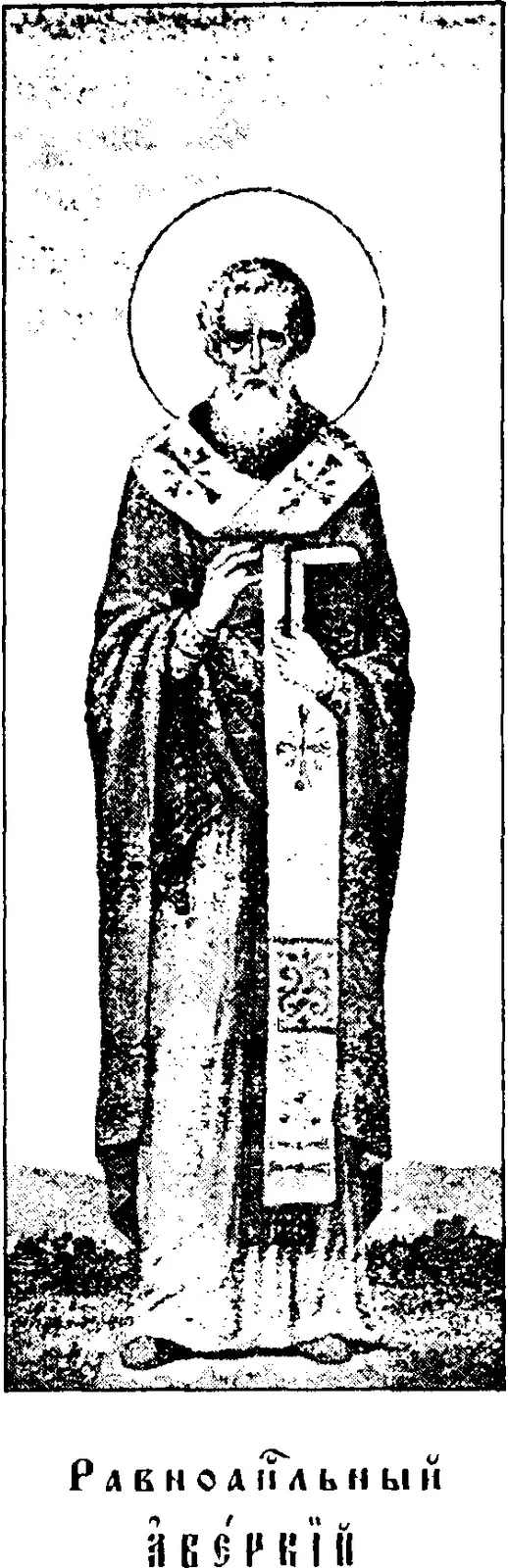
- Lived
- Under Marcus Antoninus, says the 1897 Martyrology 7; about 95 to about 167, says katolsk.no 5; his epitaph dates from before 216, says the Catholic Encyclopedia 1
Saint Abercius was a bishop of Hieropolis, a small town of Phrygia in what is now Turkey, who at the age of seventy-two wrote the inscription for his own tomb. 1 In sixteen lines he described a journey to Rome and back through Syria to Nisibis, and in words meant for believers he told of a holy shepherd, a people bearing a shining seal, and a fish from the spring that faith set before him everywhere with bread and wine. 13 The stone was found in the 1880s, and the Church remembers him on October 22. 16
A legend that turned out to have a stone
For a long time Abercius was known only from a Greek Life, and the Life is not a careful document. 1 The Norwegian bishops' database, katolsk.no, dates it to the end of the fourth century and says it credited him with a letter to the Emperor Marcus Aurelius, so many conversions that he was called "equal to the apostles," and a journey to Rome at the emperor's own command to drive a demon out of his daughter Lucilla. 5 The Life was full of wonders, and katolsk.no says that strict historians came to treat Abercius as pure fiction. 5
The Life did contain a transcription of an epitaph that Abercius was supposed to have written for himself. 1 Henri Leclercq, writing in the Catholic Encyclopedia, thinks the inscription may well have inspired the whole Life, since every detail of the Life can be explained from hints in the epitaph or else belongs to the common stock of saints' legends. 1 Renan regarded both the Life and the inscription as fanciful compositions. 1
Then, in 1882, the English traveler William Ramsay found at Kelendres, near Synnada, a Christian gravestone dated to the year 216, made for a man named Alexander, son of Anthony. 1 Its opening and closing verses matched the epitaph of Abercius almost word for word. 1 The next year Ramsay went back to the site of Hieropolis and found two more inscribed fragments, built, Leclercq says, into the masonry of the public baths; katolsk.no says into the wall of a mosque. 15 They were the middle of Abercius's own stone. Between the fragments and the text kept in the Life, the epitaph could now be restored "with practical certainty." 1
The epitaph
In Leclercq's translation it begins: "The citizen of a chosen city, this [monument] I made [while] living, that there I might have in time a resting-place of my body, [I] being by name Abercius, the disciple of a holy shepherd who feeds flocks of sheep [both] on mountains and on plains, who has great eyes that see everywhere. For this [shepherd] taught me [that the] book [of life] is worthy of belief." 1
It goes on: "And to Rome he sent me to contemplate majesty, and to see a queen golden-robed and golden-sandalled; there also I saw a people bearing a shining mark. And I saw the land of Syria and all [its] cities Nisibis [I saw] when I passed over Euphrates. But everywhere I had brethren. I had Paul. . . . Faith everywhere led me forward, and everywhere provided as my food a fish of exceeding great size, and perfect, which a holy virgin drew with her hands from a fountain and this it [faith] ever gives to its friends to eat, it having wine of great virtue, and giving it mingled with bread." 1
And it ends: "These things I, Abercius, having been a witness [of them] told to be written here. Verily I was passing through my seventy-second year. He that discerneth these things, every fellow-believer [namely], let him pray for Abercius." 1 The last lines forbid anyone to put another grave over his, on pain of two thousand gold pieces to the Roman treasury and a thousand to "my good native city of Hieropolis." 1
What the stone says
Leclercq notes that the poem is written in a language "not understood by all," and its own request makes the point: only a fellow believer who understands it is asked to pray for its author. 1 katolsk.no gives the reading that those inside would have taken for granted. The virgin and the queen are the Church, the people with the shining seal are the Christians, and the fish is Christ, because the Greek word for fish, ICHTHYS, spells out the initials of "Jesus Christ, Son of God, Savior." 5
From the text Leclercq draws four points: the shining seal is baptism; Abercius met Christians wherever he went; the fish is Christ, Son of God and of Mary, received in the Eucharist; and he was received under the forms of bread and wine. 1 He adds that the inscription is valuable evidence of the importance of the Church of Rome in the second century. 1 Maurice Hassett, writing on the symbolism of the fish in the same encyclopedia, says the link between the fish and the Eucharist is "strongly emphasized" here, and translates the key line a little differently: everywhere on the way Abercius received "the Fish from the spring, the great, the pure," with "wine mixed with water, together with bread." 3
The gap in the stone after "I had Paul" has been filled in many ways. Leclercq suggests it may once have told how Abercius came home along the route of Saint Paul's third missionary journey, but the words are lost. 1
A pagan priest?
Once the stone was found, the argument moved from whether the epitaph was real to whether it was Christian. 1 In 1894 G. Ficker, supported by O. Hirschfeld, argued that Abercius had been a priest of Cybele; in 1895 A. Harnack offered a reading that made him the spokesman of an ill-defined religious mixture; in 1896 Dieterich made him a priest of Attis. 1 Leclercq says these theories were refuted by archaeologists, especially De Rossi, Duchesne and Cumont. 1 katolsk.no says the same in a sentence: it is now generally accepted that this is Abercius's epitaph and that he was bishop of Hieropolis. 5
The man behind the stone
Leclercq thinks the author of the epitaph may be identified with Abercius Marcellus, the man to whom an anonymous writer addressed a treatise against the Montanists about the year 193. 1 Eusebius preserves its opening: "Having for a very long and sufficient time, O beloved Avircius Marcellus, been urged by you to write a treatise against the heresy of those who are called after Miltiades, I have hesitated till the present time." 4 The writer goes on to say that he had recently disputed with the Montanists for many days in the church at Ancyra. 4 Sophrone Pétridès, writing on Hierapolis for the Catholic Encyclopedia, also allows that the two may be the same man. 2
If they are, the epitaph belongs to the last years of the second century or the first of the third, and Leclercq dates it in any case before the stone of Alexander in 216. 1 The 1897 Martyrology places him under the Emperor Marcus Antoninus, and katolsk.no gives his life as about 95 to about 167, with a question mark that he may have lived to about 200. 57
Pétridès adds a doubt the others do not share. Tradition, he says, makes Abercius the first bishop of the town, but he was "probably only a priest." 2 Leclercq, katolsk.no and both Martyrologies call him a bishop. 1567
There is also the question of the town. Leclercq says the Life names the wrong city: he belongs to Hieropolis in Phrygia Salutaris, not to the larger Hierapolis in Phrygia Pacatiana, and Duchesne proved it. 1 katolsk.no notes that the Roman Martyrology repeats the Life's mistake. 5
His cult and his stone
Leclercq says the liturgical cult of Abercius has no special interest: his name first appears in the Greek menologies of the tenth century and is not in the ancient Martyrology of Saint Jerome. 1 katolsk.no says his cult has been popular in the Eastern Church since the 900s. 5
The stone itself went to Rome. Leclercq, writing in 1907, says the fragments were in the Vatican's Christian museum; katolsk.no says Sultan Abdul Hamid gave them to Pope Leo XIII and that they were kept in the Lateran Museum. 15
What is Saint Abercius the patron saint of?
Saint Abercius's feast day
Saint Abercius's feast day is October 22. The current Roman Martyrology, as the Italian bishops print it, commemorates him at Hierapolis in Phrygia, in present-day Turkey, as a bishop and disciple of Christ the good shepherd who, as the story goes, was led by faith as a pilgrim through many lands, feeding on mystical food. 6
The 1897 English Martyrology lists him on the same day: "At Hierapolis, in Phrygia, of St. Abercius, bishop, who flourished under the emperor Marcus Antoninus." 7 Pétridès gives October 22 as his feast in the Greek Church as well. 2
Praying with Saint Abercius
The current Martyrology borrows the epitaph's own images for him: a disciple of the good shepherd, a pilgrim led by faith, fed on mystical food. 6 It is a fair summary of a life of which almost nothing else is known. 1
He wrote about the Eucharist in words that only a believer would understand. 15 What he chose to remember of a long journey was not the cities but the people: "everywhere I had brethren," and everywhere the same food. 1
He did not ask to be remembered for anything. He asked to be prayed for, by anyone who understood. 1
Saint Abercius of Hieropolis, pray for us.
Sources
- 1.Henri Leclercq, "Inscription of Abercius," The Catholic Encyclopedia, vol. 1 (New York: Robert Appleton Company, 1907).
- 2.Sophrone Pétridès, "Hierapolis," The Catholic Encyclopedia, vol. 7 (New York: Robert Appleton Company, 1910).
- 3.Maurice Hassett, "Symbolism of the Fish," The Catholic Encyclopedia, vol. 6 (New York: Robert Appleton Company, 1909).
- 4.Eusebius, Church History, Book V, chapter 16, trans. Arthur Cushman McGiffert, Nicene and Post-Nicene Fathers, Second Series, vol. 1 (1890), at New Advent.
- 5."Den hellige Abercius av Hieropolis," Den katolske kirke, the saints database of the Catholic Church in Norway, katolsk.no (in Norwegian).
- 6.Roman Martyrology, entry for October 22, "Sant'Abercio, vescovo," Santo del giorno, Conferenza Episcopale Italiana (in Italian).
- 7.The Roman Martyrology, October 22 (Baltimore: John Murphy Company, 1897), Internet Archive.
Saints to turn to next
Others in this collection who are turned to for some of the same things.