Saint Hildegard of Bingen
1098 - 1179
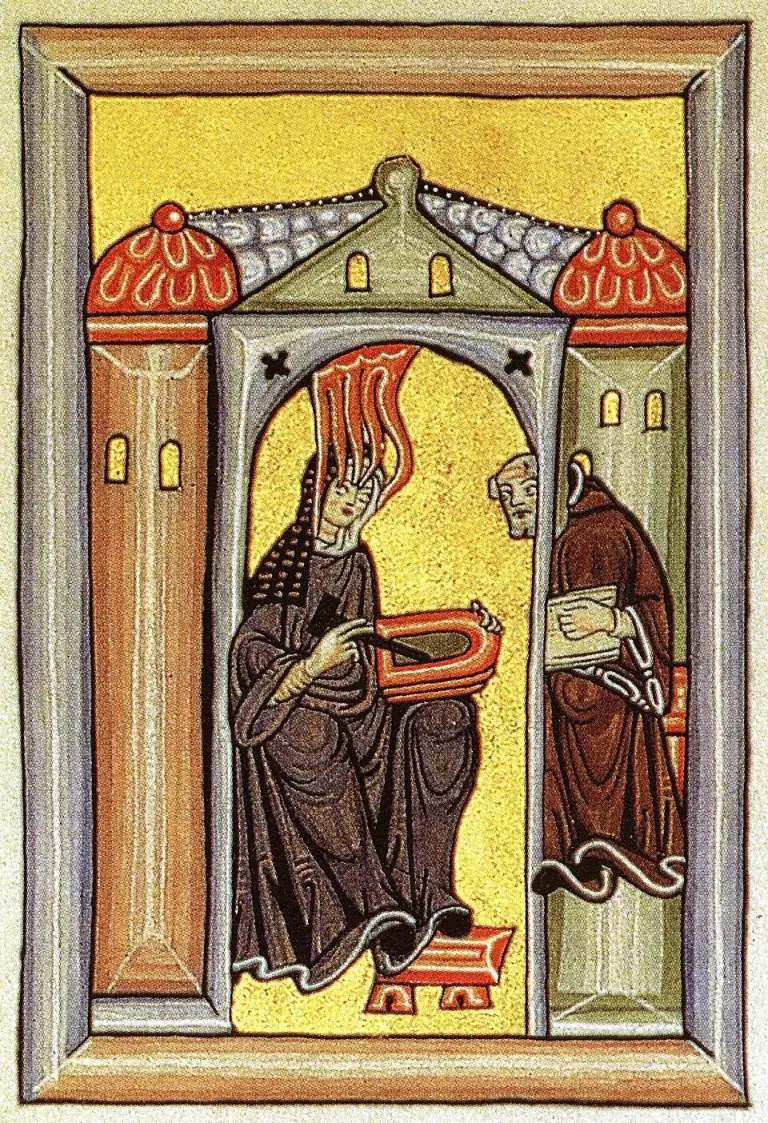
- Feast day
- September 17 3
- Died
- 1179, aged eighty-one, "in spite of having always been in poor health" 1
- Doctor of the Church
- Canonized and proclaimed a Doctor of the Universal Church in 2012 by Benedict XVI 34
Saint Hildegard was given to a monastery at eight years old, spent her life in poor health, and became a theologian, composer, physician and preacher whose advice was sought by bishops, abbots and an emperor. 123 She had been receiving visions since childhood and did not trust them until other people had checked them - first Bernard of Clairvaux, then a pope. 13 In 2012 Benedict XVI made her a Doctor of the Universal Church. 4
Given to God at eight
Hildegard was born in 1098 at Bermersheim in the Rhineland, into a large noble family of wealthy landowners, and her parents dedicated her to God from birth. 14 At eight she was offered for the religious state, following the provision in chapter 59 of the Rule of Saint Benedict, and was entrusted first to the consecrated widow Uda and then to Jutta of Spanheim at the Benedictine monastery of Saint Disibodenberg. 14
The sources put her profession slightly differently. The Apostolic Letter of 2012 says she was received as an oblate at eight and made her religious profession in 1115; Franciscan Media says she was instructed for ten years by Jutta and became a Benedictine nun at eighteen. 34 When Jutta died around 1136, the sisters chose Hildegard to succeed her as magistra. 14
Benedict XVI thought her way of holding authority was worth holding up as an example: she "inspired holy emulation in the practice of good to such an extent that, as time was to tell, both the mother and her daughters competed in mutual esteem and in serving each other." 1
She had the visions checked
She had been seeing things since she was small - Franciscan Media says since the age of three - and it was her confessor who ordered her to write them down. Scivias, "Know the Ways," took her ten years. 3 She dictated to the monk Volmar, her spiritual director, and to Richardis von Stade, a sister she was fond of. 1
What she did next is the part Benedict XVI dwells on. "As always happens in the life of true mystics, Hildegard too wanted to put herself under the authority of wise people to discern the origin of her visions, fearing that they were the product of illusions and did not come from God." She wrote to the most respected man in the Church of her day, Bernard of Clairvaux, and he calmed and encouraged her. 1
The larger approval came in 1147, when Pope Eugene III, presiding at a synod at Trier, read a text of hers brought to him by the Archbishop of Mainz and authorized her both to write down her visions and to speak in public. 13 Her contemporaries began calling her the "Teutonic prophetess." 1 Benedict draws the lesson out plainly: "the person endowed with supernatural gifts never boasts of them, never flaunts them and, above all, shows complete obedience to the ecclesial authority." 1
What she actually saw
Hildegard described the experience to Bernard in a letter: "The vision fascinates my whole being: I do not see with the eyes of the body but it appears to me in the spirit of the mysteries.... This vision burns like a flame in my breast and in my soul and teaches me to understand the text profoundly." 2 Benedict compares her visions to those of the Old Testament prophets: she read Scripture in that light and applied it to whatever was in front of her, and everyone who heard her came away wanting to live differently. 2
Scivias sums up the history of salvation in thirty-five visions, from the creation of the world to the end of time, with the marriage between God and humanity in the Incarnation at its heart. 2 Two further books record more of them: the Liber vitae meritorum, on virtue and vice and a God who "gives life to the cosmos with his power and his light," and the Liber divinorum operum, which many consider her masterpiece, five visions built on the prologue of John's Gospel. 2
Benedict takes the occasion to make a general point about who does theology. "Theology too can receive a special contribution from women because they are able to talk about God and the mysteries of faith using their own particular intelligence and sensitivity," and he points those doing that work toward "the great riches, not yet fully explored, of the medieval mystic tradition." 2
Medicine, music, and three hundred letters
She was not only a visionary. Hildegard wrote short works on medicine and physiology and took a serious interest in the natural sciences, which Benedict presents as evidence against the prejudices still attached to medieval women's monasteries. 23 She wrote more than three hundred letters to people who asked her for advice, and sought advice herself from contemporaries including Bernard of Clairvaux. 3
And she composed. Her hymns, antiphons and songs were gathered as the Symphonia Harmoniae Caelestium Revelationum, the Symphony of the Harmony of Heavenly Revelations; they were sung in her monasteries and they have come down to us. 2 Benedict gives the reason the music is not a sideline: "For her, the entire creation is a symphony of the Holy Spirit who is in himself joy and jubilation." 2
Not a quiet nun
Partly because too many young women were arriving, Hildegard broke her community away from the dominant male monastery at Disibodenberg and moved it to Bingen, to a house named for Saint Rupert. 1 Franciscan Media reports that the monks she was leaving "protested vigorously." 3
She confronted the Emperor Frederick Barbarossa for supporting at least three antipopes, and she challenged the Cathars, who claimed to be following a purer Christianity than the Church's. 3 Between 1152 and 1162 she preached publicly across the Rhineland. 3
The hardest episode came at the end. Her monastery was placed under interdict because she had allowed a young man who had been excommunicated to be buried there; she maintained that he had been reconciled with the Church and had received the sacraments before he died, and refused to move. The local bishop forbade the celebration and reception of the Eucharist at Bingen, and the sanction was lifted only a few months before her death. 3 She was in her eighties, and she spent most of her last years without the Mass rather than concede the point.
Doctor of the Universal Church
In 2012 Benedict XVI canonized Hildegard and named her a Doctor of the Church - one of a very small number of women to hold the title. 3 The Apostolic Letter of 7 October 2012 is headed "Proclaiming Saint Hildegard of Bingen, professed nun of the Order of Saint Benedict, a Doctor of the Universal Church." 4
It opens by borrowing John Paul II's description of her from 1979, the eight-hundredth anniversary of her death: "a light for her people and her time." Benedict adds that "her authority reaches far beyond the confines of a single epoch or society; despite the distance of time and culture, her thought has proven to be of lasting relevance," and finds in her "a wonderful harmony between teaching and daily life." 4
The letter also names the ordinary Benedictine virtues underneath the visions: "Her persevering practice of obedience, simplicity, charity and hospitality was especially visible." 4 Franciscan Media quotes Benedict elsewhere hoping the Holy Spirit will keep inspiring "holy and courageous women like Saint Hildegard of Bingen." 3
What is Saint Hildegard the patron saint of?
Nothing that the sources cited here will state. Neither of Benedict XVI's two catecheses on her, nor his Apostolic Letter, nor Franciscan Media's entry gives her an individual patronage. 1234 She is a Doctor of the Church without one, which is unusual and is left as it stands.
What she is for is not in doubt: prayer, theology, music, medicine, and the case of a woman with something to say and no obvious permission to say it.
Saint Hildegard of Bingen's feast day
Praying with Saint Hildegard
She did not trust her own visions. That is the first thing to take from her, and it is the opposite of how mystics are usually imagined: she was afraid they were illusions, so she wrote to Bernard of Clairvaux and asked, and later she let a pope read them. 1 Benedict makes obedience to the Church the test of an authentic charism rather than an obstacle to one. 1
She was ill for eighty-one years. Benedict's phrase is that she died at that age "in spite of having always been in poor health," and the Apostolic Letter has her "infirm in physical health but vigorous in spirit." 14 Everything - the books, the music, the medicine, the preaching tours, the three hundred letters - was done from inside that.
The interdict is the hard part and it does not get tidied. She buried a man she believed had been reconciled to the Church, the bishop punished her community by taking the Eucharist away from it, and she was still under that sanction almost to the end of her life. 3 She was right and it cost her, and being right did not shorten the wait.
Her instinct about creation is the thing people find first and keep longest: the whole of it a symphony, and the Holy Spirit in it as joy. 2 She wrote that as a woman who had been handed to a monastery at eight and had never been especially well a day since.
Saint Hildegard of Bingen, pray for us.
Sources
- 1.Benedict XVI, General Audience of 1 September 2010, "Saint Hildegard of Bingen."
- 2.Benedict XVI, General Audience of 8 September 2010, "Saint Hildegard of Bingen" (second catechesis).
- 3."Saint Hildegard of Bingen," Saint of the Day, Franciscan Media.
- 4.Benedict XVI, Apostolic Letter proclaiming Saint Hildegard of Bingen a Doctor of the Universal Church, 7 October 2012.
Saints to turn to next
Others in this collection who are turned to for some of the same things.