Saint Clement
Died c. 101
- Patron saint of
- Mariners, marble workers and tanners, per Franciscan Media 2
- Feast day
- November 23. Chapman: "His feast is celebrated 23 November" 1
- Died
- About 101, in the second year of Trajan by the oldest reckoning 1
- Office
- The fourth pope - that is, the third successor of Peter. Both sources are saying the same thing 12
- What survives
- One letter, to the Church of Corinth. Chapman calls it his one genuine writing 1
- In art
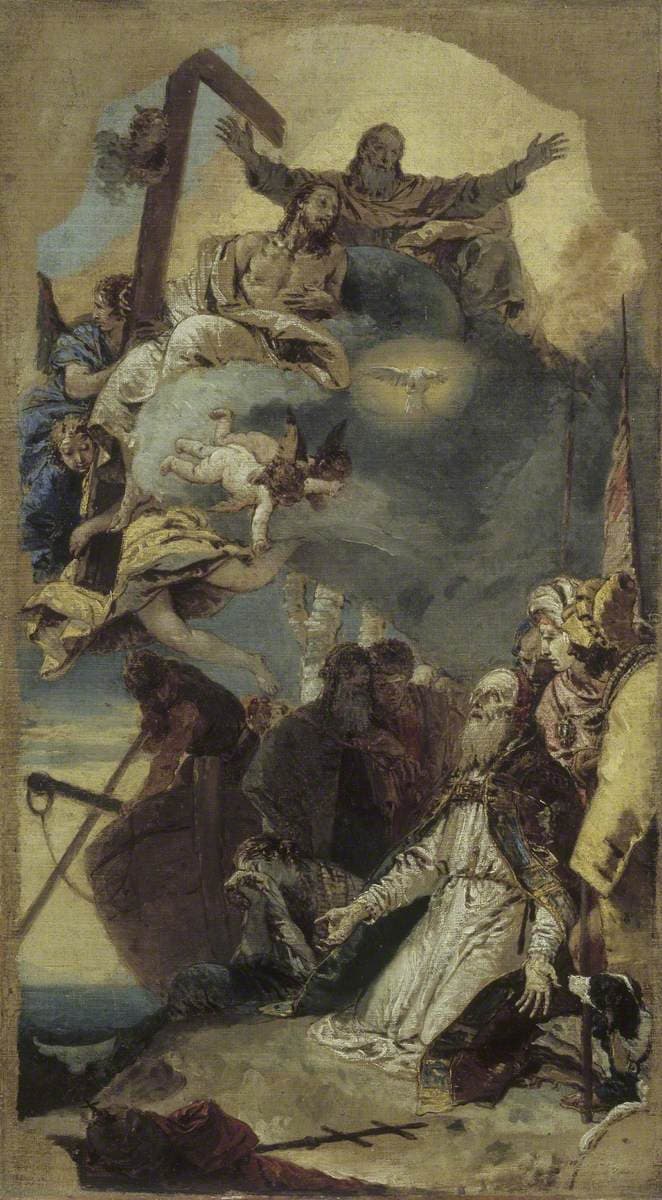
- With an anchor, from the legend of his drowning 1
Saint Clement wrote the earliest Christian letter outside the New Testament whose author we can name, and he wrote it because a congregation in Corinth had deposed its own clergy. 12 Of his life and death, the encyclopedia says, nothing is known. 1 What is known is that around the year 96 the bishop of Rome wrote to a church he had no obvious authority over and told them to stop - and that they kept the letter, and read it aloud for generations. 12
The first pope we can see
Chapman opens by placing him exactly: Clement is "the first of the successors of St. Peter of whom anything definite is known, and he is the first of the 'Apostolic Fathers'." 1 Franciscan Media agrees and adds what that title means - the Apostolic Fathers are those "who provided a direct link between the Apostles and later generations of Church Fathers." 2
The two sources appear to number him differently and do not. Franciscan Media calls him "the third successor of Saint Peter"; Chapman calls him the fourth pope. 12 Peter, then Linus, Cletus and Clement: the third man after Peter is the fourth to hold the office.
The early lists do disagree with each other, and Chapman lays out six of them in order. 1 Some put Clement immediately after Peter; Tertullian, writing about 199, says the Roman Church claimed "that Clement was ordained by St. Peter", and Jerome reports that in his day "most of the Latins" held the same. 1 Chapman notes that Jerome himself, in that same passage, "correctly states that Clement was the fourth pope." 1 He also disposes of a long-running confusion: "no critic doubts that Cletus, Anacletus, Anencletus, are the same person. Anacletus is a Latin error; Cletus is a shortened (and more Christian) form of Anencletus." 1 One man, three spellings, counted twice for centuries.
What nobody disputes is that he knew the people who had known Jesus. Irenaeus says Clement "saw the blessed Apostles and conversed with them, and had yet ringing in his ears the preaching of the Apostles and had their tradition before his eyes, and not he only for many were then surviving who had been taught by the Apostles." 1
The letter to Corinth
The occasion was a rebellion. Chapman: "The Church of Corinth had been led by a few violent spirits into a sedition against its rulers." 1 Franciscan Media describes the same thing from the other end: the letter "concerns a split that alienated a large number of the laity from the clergy." 2 A congregation had removed its own presbyters.
Irenaeus, writing less than a century later, records what Rome did: "Under this Clement no small sedition took place among the brethren at Corinth and the Church of Rome sent a most sufficient letter to the Corinthians, establishing them in peace, and renewing their faith, and announcing the tradition it had recently received from the Apostles." 1
Franciscan Media gives the argument of the letter in six words: "Deploring the unauthorized and unjustifiable division in the Corinthian community, Clement urged charity to heal the rift." 2 Not discipline first. Charity.
The letter was "preserved and widely read in the early Church", which is a mild way of saying it was treated almost as scripture in some places for a very long time. 2 Chapman calls it his one genuine writing, and notes that many others were later attributed to him that are not his. 1
One human detail survives in it. Chapman points out that the two men who carried the letter, Claudius Ephebus and Valerius Vito, bore names common among the freedmen of the imperial household, and that the letter describes them as "faithful and prudent men, who have walked among us from youth unto old age unblameably." 1 Two elderly Christians, probably former imperial slaves, carried it from Rome to Corinth on foot.
The anchor, and what it is worth
Chapman heads this section "Martyrdom" and begins: "Of the life and death of St. Clement nothing is known." 1 Then he tells the story anyway, sourced to "the apocryphal Greek Acts of his martyrdom." 1
In them, Clement converts Theodora, the wife of a courtier of Nerva, then the courtier himself, and four hundred and twenty-three other people of rank. Trajan banishes him to the Crimea, where he slakes the thirst of two thousand Christian prisoners by a miracle; the country is converted and seventy-five churches are built. "Trajan, in consequence, orders Clement to be thrown into the sea with an iron anchor. But the tide every year recedes two miles, revealing a Divinely built shrine which contains the martyr's bones." 1
Chapman then dates the story: "This story is not older than the fourth century." 1 Three hundred years after the events.
What happened next is where he becomes genuinely bracing. About 868, Cyril - the missionary to the Slavs - "when in the Crimea on the way to evangelize the Chazars, dug up some bones in a mound (not in a tomb under the sea), and also an anchor. These were believed to be the relics of St. Clement." 1 They were carried to Rome and placed by Adrian II in the high altar of the basilica of St. Clement. 1
And then: "The history of this translation is evidently quite truthful, but there seems to have been no tradition with regard to the mound, which simply looked a likely place to be a tomb. The anchor appears to be the only evidence of identity but we cannot gather from the account that it belonged to the scattered bones." 1 Cyril really did dig, and really did carry what he found to Rome. Whether it was Clement rests on an anchor that may not have been buried with the bones.
On the martyrdom itself Chapman is even-handed. Clement is first called a martyr by Rufinus about the year 400, three centuries on. 1 "Modern critics think it possible that his martyrdom was suggested by a confusion with his namesake, the martyred consul" - Flavius Clemens, executed by his cousin the Emperor Domitian. 1 But Chapman gives the counter-argument too: "the lack of tradition that he was buried in Rome is in favour of his having died in exile." 1 Nobody in Rome claimed his grave, which is itself a kind of evidence.
What is Saint Clement the patron saint of?
Saint Clement is the patron saint of mariners, marble workers and tanners. 2 The first is the anchor: a pope said to have been drowned with one became the saint that sailors invoke, and the anchor is how he is recognized in art. 12 That a patronage of the sea grew out of a fourth-century legend Chapman will not vouch for does not trouble the sailors, and should not.
Franciscan Media's page also fields the question of whether he is patron of Bohemia, which arises because of the mission of Cyril, who brought the relics west. 2 The connection runs through the man who dug, not the man who was buried.
Saint Clement's feast day
The feast of Saint Clement is November 23. Chapman states it in his opening lines: "His feast is celebrated 23 November." 1 Franciscan Media presents him on the same day. 2
A reader may find him on November 29 in older or non-Roman sources; the Roman date is the 23rd and both sources here give it. His death is placed "in the second year of Trajan" by the oldest chronology Chapman reconstructs, which puts it around the year 100 or 101. 1
Praying with Saint Clement
He is the saint for a church that is fighting with itself. That is not a metaphor for him; it is the only thing he is documented as having done. A congregation in Corinth threw out its clergy, and the bishop of Rome - who had no power to compel them and does not claim any in the letter - wrote and asked them to stop, on the grounds of charity. 12 They kept the letter. Somebody in Corinth thought it was worth copying.
The contrast between the letter and the legend is the useful thing about his entry. The legend is spectacular: four hundred and twenty-three noble converts, a miracle in the desert, seventy-five churches, an anchor, a shrine revealed by the tide once a year. 1 The letter is a man asking people to be reconciled. Chapman can vouch for the letter and not for one detail of the legend, and it is the letter that has done the work for nineteen hundred years.
There is also a lesson in how Chapman handles the relics. He does not hide them, explain them away, or pretend to more than he has. He says what Cyril found, says the mound "simply looked a likely place to be a tomb", and leaves the reader to weigh an anchor. 1 Devotion that can survive that kind of honesty is worth more than devotion that has to be protected from it.
What remains, stripped of everything doubtful: a man who had listened to the Apostles in person, who became bishop of Rome, and who used that position once, so far as we can prove, to write to a quarreling church about charity. 12 Two old freedmen carried it there. It is a small thing to have left, and the Church has been reading it ever since.
Saint Clement, pray for us.
Sources
Saints to turn to next
Others in this collection who are turned to for some of the same things.