Saint Columba of Iona
December 7, 521 - June 9, 597
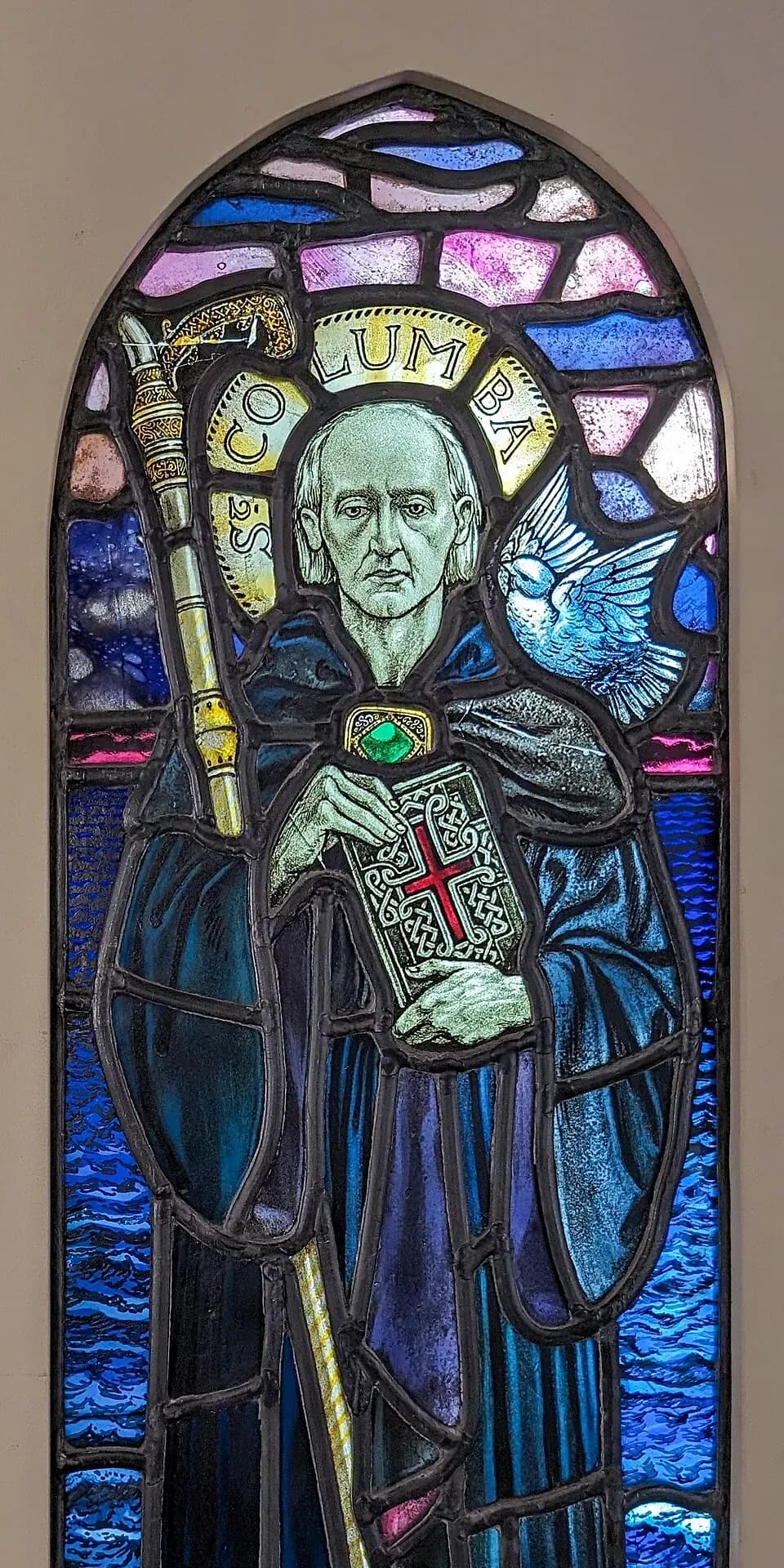
- Patron saint of
- Ireland, as one of its three patrons with Patrick and Brigid; Scotland; and Derry 234. Edmonds names him patron of the Scottish dioceses of Argyll and the Isles and of Dunkeld 1
- Known as
- The "Apostle of the Picts" 2
Saint Columba was an Irish abbot of royal blood who, in 563, crossed to Scotland with twelve companions in a boat of wicker and hides and founded the monastery of Iona. 1 From that small island he spent more than thirty years preaching to the Picts of the north, and EWTN News calls him the "Apostle of the Picts." 12 Why he left Ireland at all is the question his story has never settled.
A prince who became a monk
He was born at Gartan in County Donegal on December 7, 521, into the Clan O'Donnell, and on his father's side he was a great-great-grandson of Niall of the Nine Hostages. 1 His father was Fedhlimdh and his mother Eithne 1, and Fr John Walsh notes that both were of royal descent. 3 His baptismal name was Colum, "which signifies a dove, hence the latinized form Columba"; the Irish form, Colum Cille, adds "of the Churches." 1 Walsh renders it "dove of the church." 3
The priest who baptized him, Cruithnechan, became his tutor. 1 He went on to the monastic school of Movilla under Finnian, where he was made a deacon, then studied with an old bard named Gemman in Leinster, and then entered Clonard under a second Finnian. 1 There he became one of the twelve disciples later known as the Twelve Apostles of Ireland, and was ordained priest by Bishop Etchen of Clonfad. 12 Edmonds is blunt about a story that Finnian meant him to be made a bishop and that only priest's orders were conferred by mistake: competent authorities regard it "as the invention of a later age." 1
He was studying under Mobhi at Glasnevin when plague scattered the community in 544, and he went home to Ulster. 12 The next years saw the monasteries of Derry and Durrow, and by Edmonds's account Kells; Walsh says "possibly Kells." 13 Derry and Durrow, Edmonds writes, "were always specially dear to Columba." 1
Why he left Ireland
The oldest witnesses give a simple reason. Bede says he came from Ireland to preach the word of God. 1 Adomnan, who wrote his Life on Iona within a century of his death, gives the reason as a desire to be "a pilgrim for Christ." 13
Later writers tell a harder story. In it Columba secretly copied a psalter belonging to Finnian, King Diarmait ruled against him, and that ruling, together with the king's violation of sanctuary in the killing of a kinsman of Columba's, led him to rouse the northern clans to battle at Cooldrevny in 561. 1 Three thousand died. His confessor, Molaise, then sent him to win as many souls for Christ as lives had been lost, and never again to look on Ireland. 1 Our Sunday Visitor tells the psalter feud as fact. 4 Edmonds reports that some writers consider all of it "legends invented by the bards and romancers of a later age," since the earliest authorities do not mention it. 1
The scholars he cites divide sharply. Cardinal Moran accepted no motive but Adomnan's, "a desire to carry the Gospel to a pagan nation and to win souls to God," while Archbishop Healy thought Columba did incite the battle and called it "O felix culpa . . . which produced so much good both for Erin and Alba." 1 EWTN News leaves it there: "It is not clear why, in 563, Columba left Ireland." 2
One detail in the record sits awkwardly with the legend. Edmonds also says he "frequently visited Ireland," and both sources put him at the great assembly of Drumceatt, which Edmonds dates to 570 and Walsh to 575. 13
Iona and the Picts
He was in his forty-fourth year when he and his twelve companions landed at Iona on the eve of Pentecost, May 12, 563. 1 Irish authorities say the island was given by his kinsman Conall, king of Dalriada; Bede credits the Picts. 1 The monks built a church, a refectory and cells "of wattles and rough planks." 1
After some years among the Scots of Dalriada, he turned to the northern Picts. 12 With Comgall and Canice he went to the fortress of King Brude near Inverness and found the gates bolted against them. 1 Edmonds tells what followed as the tradition gives it: at the sign of the cross the bolts flew back, the king listened, and he was baptized. 1 EWTN News says the gates "are said to have miraculously opened." 2 Opposition came chiefly from the druids. 12
The thirty-two years that remained were spent preaching through the glens of northern Scotland, as far east as Aberdeenshire, and building churches and monasteries. 1 He met Saint Mungo at Glasgow, and in Dalriada he played a part in the choice of kings: Edmonds says he inaugurated Aidan as Conall's successor shortly before 570, and Walsh that he "played kingmaker in 574." 13 From Iona he governed communities in Ireland and Scotland that called him founder, and his successors as abbot, though only priests, held jurisdiction over the bishops of the northern Picts. 1 His disciples later made foundations at Lindisfarne in Northumbria and at Whitby, and Our Sunday Visitor says the monks trained at Iona "evangelized throughout Europe." 34
The scribe
Edmonds says he was "said never to have spent an hour without study, prayer, or similar occupations," and that at home he was often copying books. 1 "It is stated that he wrote 300 books with his own hand"; the Book of Durrow and the psalter called the Cathach are credited to him. 1 Walsh is more careful about the Cathach, the earliest surviving manuscript in Ireland: it "probably issued from his pen." 3 Of his Latin and Irish compositions the best known is the hymn Altus Prosator. 1
Adomnan describes him as "angelic in appearance, graceful in speech, holy in work," and says he was loved by all "for a holy joyousness that ever beamed from his countenance." 1 Edmonds reports that "it has been sometimes said that he was of an angry and vindictive spirit," and answers that the deeds which angered him were wrongs done to others. 1 Walsh lists what the biographer records him doing for people: taking up the plight of a hostage, rehabilitating a reformed robber, praying for a woman in childbirth, giving destitute men the means to feed themselves. 3
In June 597 he climbed the hill above the monastery and blessed it, attended Vespers, and when the bell rang for the midnight office went into the church ahead of the others. 1 He sank before the altar and died there, surrounded by his monks, a little after midnight between the 8th and 9th of June, in his seventy-seventh year. 13
What is Saint Columba the patron saint of?
Saint Columba is one of the three patron saints of Ireland, with Saint Patrick and Saint Brigid. 23 Our Sunday Visitor names him patron of Derry, Ireland and Scotland. 4 Edmonds, writing in 1908, says he is patron of two Scottish dioceses, Argyll and the Isles, and Dunkeld. 1
Two popes preaching in Glasgow placed him among the founders of Scottish Christianity. In 1982 John Paul II said that "Saint Ninian, Saint Columba and Saint Kentigern were the first to evangelise the pagans." 6 In 2010 Benedict XVI named the saints who carried on Ninian's work, "the greatest of whom must include Saint Columba and Saint Margaret." 5
Saint Columba's feast day
The feast of Saint Columba is June 9, the day of his death. 123 Edmonds records that it was kept in Scotland and Ireland, and that the Scottish province of Saint Andrews and Edinburgh had a Mass and Office proper to it. 1
He should not be confused with Saint Columban, a different Irish monk and missionary, as EWTN News puts it, "who lived slightly later and ended up in Italy." 2
Praying with Saint Columba
The question of why he left is still open, and that is part of what his life offers. If the later story is true, a man of royal blood and great gifts helped start a battle in which three thousand died, and spent the rest of his life far from home doing what he was told would answer for it. 1 If Adomnan is right, he went because he wanted to be a pilgrim for Christ. 13 The sources let both stand, and a reader can sit with either one.
Most of what is certain about him is work. He spent decades walking the glens of the north, and when he was home on Iona he was copying out books. 1 Edmonds writes that he is said never to have spent an hour without study or prayer, and on the eve of his death he was still at his transcription. 1
Edmonds does not hide that he was accused of an angry and vindictive spirit, or that he was supposed to have had a part in a battle. 1 He writes that whatever faults were in his nature, Columba overcame them; Walsh calls him a man "of outstanding gentleness" who nonetheless castigated miscreants while welcoming the sincerely contrite. 13 The sources put the temper and the gentleness in the same man.
His last day is told plainly. He blessed the monastery from the hill, went to Vespers, and reached the church before the others at the midnight bell. 1 He died at the altar with his monks around him. 1
Saint Columba of Iona, pray for us.
Sources
- 1.Columba Edmonds, "St. Columba," The Catholic Encyclopedia, Vol. 4 (New York: Robert Appleton Company, 1908).
- 2."Ireland's co-patron St. Columba celebrated June 9," EWTN News, June 9, 2013, updated September 26, 2025.
- 3.John R. Walsh, "St Columba (Columcille): Dove of the Church," Catholicireland.net, first published in The Word (Divine Word Missionaries), June 2004.
- 4."St. Columba," Our Sunday Visitor.
- 5.Pope Benedict XVI, Homily at Mass in Bellahouston Park, Glasgow, September 16, 2010.
- 6.Pope John Paul II, Homily at Mass in Bellahouston Park, Glasgow, June 1, 1982.
Saints to turn to next
Others in this collection who are turned to for some of the same things.