Saint Rose of Viterbo
About 1235 - 1251 or 1252
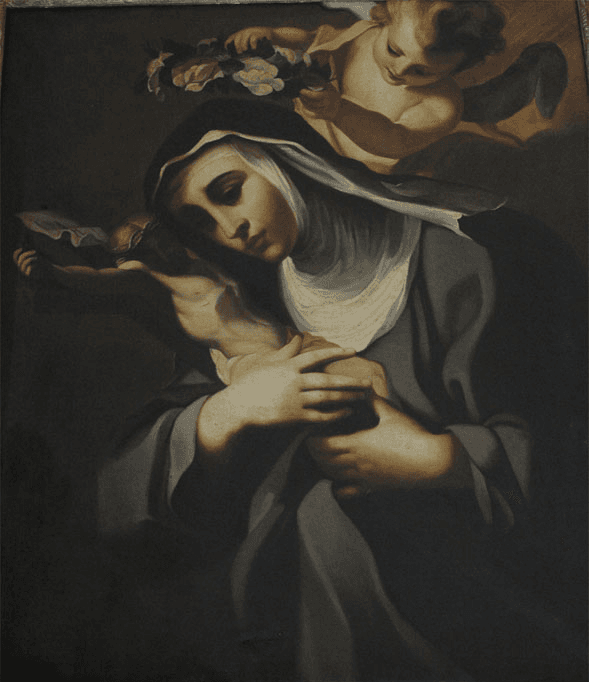
- Feast day
- September 4, when her body is carried in procession through Viterbo 1
- Became
- A Secular Franciscan as a child, and preached in the streets 2
- Was refused
- Entry to the monastery of St. Mary of the Roses, because she was poor 1
Saint Rose of Viterbo was a poor girl who preached penance in the streets of her own city while it was held against the pope, and the prefect decided she was dangerous enough to throw out. 1 She was about fifteen. She was allowed back when the politics changed, applied to the local monastery, and was refused because her family had no money. 1 She died at around seventeen in a cell in her father's house, and two hundred years later she was canonized. 12
What the record does not have
Cleary states the limit before anything else: "The chronology of her life must always remain uncertain, as the Acts of her canonization, the chief historical sources, record no dates. Those given above are accepted by the best authorities." 1 Every year on this page is a reconstruction, and the source says so.
The two sources part on the year of her death: Cleary gives March 6, 1252, and Franciscan Media says she died in 1251. 12 Both are printed. If Cleary's birth year of 1235 is right, she was sixteen or seventeen.
She was "born of poor and pious parents". 1 Franciscan Media's account of the childhood is the recognizable one: "Even as a child, Rose had a great desire to pray and to aid the poor. While still very young, she began a life of penance in her parents' house. She was as generous to the poor as she was strict with herself." 2 Cleary's is more extreme - at seven "she had already lived the life of a recluse, devoting herself to penances", and her health broke under it. 1
Cleary also reports that at three years old she raised her aunt from the dead. 1 It is in the article; it is reported here as being in the article.
A child preaching in a city under occupation
Cleary's account has the recovery and the commission together: she was cured, and told "to enroll herself in the Third Order of St. Francis, and to preach penance to Viterbo, at that time (1247) held by Frederick II of Germany and a prey to political strife and heresy." 1 Franciscan Media gives the age plainly: "At the age of 10, she became a Secular Franciscan and soon began preaching in the streets about sin and the sufferings of Jesus." 2
The politics are the point. Franciscan Media: "Viterbo, her native city, was then in revolt against the pope. When Saint Rose of Viterbo took the pope's side against the emperor, she and her family were exiled from the city." 2
Cleary explains why a child in the street was worth expelling. "Her mission seems to have extended for about two years, and such was her success that the prefect of the city decided to banish her. The imperial power was seriously threatened." 1 The authorities assessed a teenage girl preaching on street corners as a political risk and acted on it.
She and her parents were expelled in January 1250 and went to Sorriano. 1 Her family was punished with her.
Cleary then records a prophecy with a date attached on both ends: "On 5 December, 1250, Rose foretold the speedy death of the emperor, a prophecy realized on 13 December." 1 Frederick II did die on December 13, 1250.
The pyre
The strangest episode is at Vitorchiano, a town Cleary says had been "perverted by a famous sorceress." 1
"Rose secured the conversion of all, even of the sorceress, by standing unscathed for three hours in the flames of a burning pyre, a miracle as striking as it is well attested." 1
That is Cleary's assessment of the evidence, offered in 1912, and it is quoted as his. Franciscan Media does not mention the episode at all. 2 A reader is entitled to both facts: that the encyclopedia calls it well attested, and that the modern entry leaves it out entirely.
Refused
The papal side won and she came home. "With the restoration of the papal power in Viterbo (1251) Rose returned." 1 Franciscan Media: "When the pope's side won in Viterbo, Rose was allowed to return." 2
Then the rejection, and the two sources describe it differently. Cleary: "She wished to enter the monastery of St. Mary of the Roses, but was refused because of her poverty." 1 Franciscan Media: "Her attempt at age 15 to found a religious community failed, and she returned to a life of prayer and penance in her father's home." 2
One has her turned away from a house that already existed because she could not pay a dowry; the other has her trying to start one of her own and failing. This page does not choose between them.
What Cleary records next is the sentence that makes her. "She humbly submitted, foretelling her admission to the monastery after her death." 1 She accepted the refusal and said she would be admitted later anyway.
She spent the rest of her life - a year, perhaps two - in a cell in her father's house, and died there. 12
What is Saint Rose of Viterbo the patron saint of?
Neither source cited here gives her a patronage. 12 Cleary's article ends with the feast and the procession, and Franciscan Media's with the canonization; neither names a cause she is invoked for, and this page leaves it open.
The canonization itself took a long time. The process was opened in the year of her death by Innocent IV "but was not definitively undertaken until 1457" - more than two centuries later. 1 Franciscan Media gives the same year. 2
Saint Rose of Viterbo's feast day
The feast of Saint Rose of Viterbo is September 4. Cleary states it and says what happens on the day: "Her feast is celebrated on 4 September, when her body, still incorrupt, is carried in procession through Viterbo." 1
It is not the day she died - Cleary gives that as March 6. 1 The article does not explain the choice of September 4, and this page does not guess at one.
The procession is worth noticing against the rest of her story. The girl who was expelled from that city by its prefect, and turned away from its monastery for being poor, is carried through its streets once a year.
Praying with Saint Rose
She is the saint for being young and taken seriously in the worst way. Nobody patronized her. The prefect of Viterbo did not dismiss a teenage girl preaching in the street as a nuisance; he judged that "the imperial power was seriously threatened" and exiled her and her parents in January. 1 Being listened to is not always safe.
And then the refusal, which is the part that stings. She came back to the city she had been thrown out of for supporting the winning side, applied to the monastery, and was told no because her family was poor. 1 Not for lack of vocation, or fitness, or holiness - for money. The institution she had defended at the cost of exile would not have her.
What she said about it is the whole of her. She "humbly submitted, foretelling her admission to the monastery after her death." 1 She did not fight it, and she did not pretend it was just. She said she would be there eventually.
The last year or two of her life were spent in a room in her father's house, with nothing to show. 12 She was about seventeen. Everything she is remembered for had already happened by then, and none of it had worked out the way it should have.
Saint Rose of Viterbo, pray for us.
Sources
Saints to turn to next
Others in this collection who are turned to for some of the same things.