Saint Luke
First century
- Patron saint of
- Artists and painters, brewers, butchers, notaries, and physicians and surgeons 2
- Profession
- Physician. Paul calls him "the most dear physician" in Colossians 4:14 1
- Died
- Uncertain. At seventy-four in Bithynia or Boeotia, by the ancient Prologue; at eighty-four in Boeotia, by Vatican News. Whether he was martyred is disputed 13
- Symbol
- The calf or ox 1
Saint Luke is one of the most extensive writers in the New Testament: his Gospel and the Acts of the Apostles together run about as long as all fourteen of the epistles the 1913 Catholic Encyclopedia counts as Paul's. 1 He was a Greek physician and the only Gentile among the four evangelists, and in Acts he appears only as part of a "we." 12 That pronoun, slipping in and out of the narrative, is how we know where he was. In his last letter, with everyone else gone, Paul says simply, "Only Luke is with me." 1
A Greek doctor from Antioch
Tradition makes him a native of Antioch, the capital of Syria, on the word of Eusebius. 123 The 1913 Catholic Encyclopedia adds a detail it plainly enjoys: Acts gives the hometown of only one of the seven deacons, "Nicolas, a proselyte of Antioch," the kind of thing a writer mentions when the place is his own. 1
He was not Jewish. Writing to the Colossians, Paul lists the companions who are "of the circumcision" and then names Luke separately, among the others. 13 Cornelius Aherne, who wrote the encyclopedia article, thinks Luke's Greek settles the matter anyway. 1
Paul calls him "the most dear physician." 1 Aherne reports, as conjecture, that Luke may have studied medicine at Tarsus. 1 What can be tested is the vocabulary. Scholars from the eighteenth century on found terms in Luke and Acts that match the Greek medical writers, and William Hobart cataloged them in 1882. Harnack concluded: "It is as good as certain from the subject-matter, and more especially from the style, of this great work that the author was a physician by profession." 1
Where the "we" begins
Nobody knows how he became a Christian. 3 Acts is told in the third person until chapter 16, when Paul at Troas has a vision of a man from Macedonia begging for help, and the narrative suddenly reads, "immediately we sought to go on into Macedonia." 13 From there Luke crosses to Europe with Paul, about the year 51, by Vatican News' dating, and is at Philippi for the conversion of Lydia and her companions. He lodged in her house. 13
Then the "we" stops. Paul and Silas are beaten with rods and jailed at Philippi, and Luke is not with them in the cell; Aherne thinks he and Timothy escaped arrest "probably because they did not look like Jews." 13 When Paul moved on, Luke stayed, in all probability to carry on the work there. 1
The first person returns some seven years later in Acts 20, when Paul passes back through the region. 3 Luke goes with him to Jerusalem and is present for the uproar there, and for the moment Paul quiets the crowd from the steps of the fortress and speaks to them "in the Hebrew tongue." 1 During Paul's two years in custody at Caesarea, Franciscan Media says, Luke "had time to seek information and interview persons who had known Jesus." 2
"Only Luke is with me"
When Paul appealed to Caesar, Luke and Aristarchus sailed with him, through the storm and the wreck on Malta, and on to Rome. 1 He is in the greetings to the Colossians and to Philemon, in the translation Aherne quotes: "Mark, Aristarchus, Demas, and Luke my fellow labourers." 1
The last mention is the most quoted. Writing to Timothy near the end, Paul says that Demas has left him, "loving this world," and then: "Only Luke is with me." 13 Luke is named only three times in the whole New Testament, and Aherne points out that each time Mark is named alongside him. 1 Readers of this library's page on Mark will recognize the words that follow, where Paul asks for Mark to be brought to him. That passage, 2 Timothy 4, is the first reading at Mass on Luke's feast. 4
The Gospel and the Acts
The two books are one work in two volumes, both addressed to Theophilus, and Franciscan Media describes it as showing "the parallel between the life of Christ and that of the Church." 12
Much of what Christians know best comes only from him. Six of the twenty miracles he records appear in no other Gospel, among them the ten lepers and the raising of the widow of Naim's son. He alone has eighteen parables, including the Good Samaritan, the Prodigal Son, the Pharisee and the publican, and the rich man and Lazarus. 1 He gives "special prominence to the duty of prayer." 1 Vatican News draws attention to his concern "for the poor, and for victims of injustice, for repentant sinners," and to the Magnificat, which only he preserves. 3 Franciscan Media lists the names the Gospel has been given, including the Gospel of Mercy, of the Poor, of Prayer and the Holy Spirit, and of Joy. 2
When he wrote it is disputed. Franciscan Media says "probably between 70 and 85 A.D." 2 The 1913 encyclopedia reports that many writers place it during Paul's imprisonment at Caesarea, and it prints the Biblical Commission's decision of that year that it is "not lawful" to date the Gospel of Luke as late as the destruction of Jerusalem. 1 This page records both and does not choose.
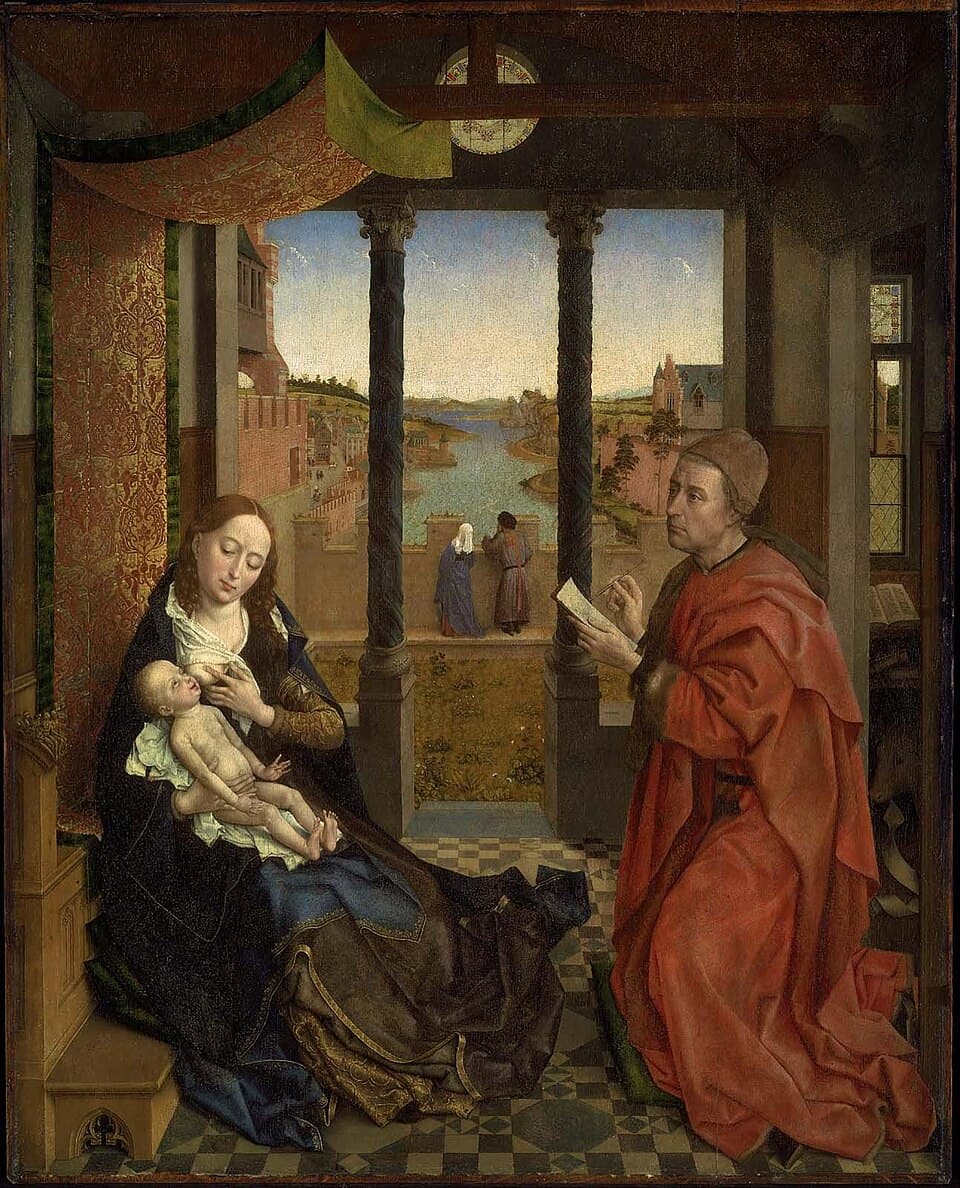
Did Saint Luke paint the Virgin Mary?
The tradition is old, though not as old as he is. Aherne says Luke is called a painter by the Menology of Basil II, from 980, and by Nicephorus Callistus in the fourteenth century. An image of the Virgin in the Roman basilica of Santa Maria Maggiore is ascribed to him and can be traced to 847; Aherne thinks it probably copies an image the Empress Eudoxia was said to have found in Jerusalem. 1
Neither source treats the story as proven. Aherne, following Plummer, puts it this way: "it is certain that St. Luke was an artist, at least to the extent that his graphic descriptions of the Annunciation, Visitation, Nativity, Shepherds. Presentation, the Shepherd and lost sheep, etc., have become the inspiring and favourite themes of Christian painters." 1 Vatican News reaches a similar place by another road. It notes how much of what we know of Mary comes from Luke, adding that "we might piously believe" she told him some of it herself, and says "it is very probably to this narrative and descriptive sensitivity that we owe the tradition of St Luke as a painter." 3
Two other traditions Aherne rejects outright: that Luke was one of the Seventy, as Epiphanius claimed, and that he was the companion of Cleophas on the road to Emmaus. His being a Gentile and his own prologue rule out both. 1
How he died, and where he lies
After Paul's death, almost everything known about Luke comes from an ancient prologue to his Gospel that Aherne dates back to Julius Africanus. It says that he was unmarried, that he wrote his Gospel in Achaia, and that he died at seventy-four in Bithynia, "filled with the Holy Ghost." Aherne thinks Bithynia is probably a copyist's mistake for Boeotia. 1 Vatican News gives a different age: "The oldest traditions say he died in Boeotia at age 84, where he had settled to write his Gospel." 3 Franciscan Media dates his death to about the year 84. 2
Neither source will say whether he was martyred. Aherne writes that "it is controverted whether he actually died a martyr's death"; Vatican News says "some sources speak of his martyrdom, while others say he lived to old age." 13
His relics have traveled. Aherne quotes Jerome that Luke was buried at Constantinople, where his bones were brought together with the relics of the apostle Andrew. 1 Vatican News places his body today in the Abbey of Santa Giustina in Padua, his skull in Saint Vitus Cathedral in Prague, and a rib in his original tomb at Thebes. 3 Neither source explains how the one led to the other.
What is Saint Luke the patron saint of?
Franciscan Media lists Saint Luke as patron of artists and painters, brewers, butchers, notaries, and physicians and surgeons. 2 Physician is Paul's own word for him, and Vatican News ties his reputation as an artist to the painter tradition described above. 13 The sources do not explain the brewers, butchers or notaries, and this page does not guess.
His symbol is the calf or ox, the animal of sacrifice, because his Gospel opens with Zachary the priest serving in the Temple. 1 Irenaeus, in the second century, already called Luke the calf. 1
Saint Luke's feast day
Praying with Saint Luke
Most of what he did, he did as someone else's companion. He stayed behind at Philippi when Paul left, went where Paul was sent, and was still there in Rome when the others had gone. 1 In the books he wrote, the "we" is his only signature. 1
He was also careful. By his own prologue he was not an eyewitness; having "diligently attained to all things from the beginning," he set in order what eyewitnesses had handed on. 1 Nineteenth-century critics made a habit of mocking his "blunders." The 1913 encyclopedia answers them with coins and inscriptions, the proconsul of Cyprus and the politarchs of Thessalonica, and reports that wherever archaeology could test his statements, "they have been found to be correct." 1
What he chose to keep is worth reading slowly. The lost son, the Samaritan on the road, the one leper of ten who came back to give thanks, the sinful woman who washed the feet of Jesus with her tears, and Mary's song about the hungry filled and the rich sent away. 13 The Gospel the physician wrote is crowded with the poor, with sinners taken back, and with people praying. 123
Nobody knows for certain how he died. 13 The last clear sight of him is in a prison in Rome, with one man who had nobody else left, staying.
Saint Luke, pray for us.
Sources
- 1.Cornelius Aherne, "Gospel of Saint Luke," The Catholic Encyclopedia, Vol. 9 (New York: Robert Appleton Company, 1910).
- 2."Saint Luke," Saint of the Day, Franciscan Media.
- 3."St. Luke, Evangelist, Physician, Patron of Artists," Saint of the Day, Vatican News.
- 4.Feast of Saint Luke, Evangelist, Daily Readings for October 18, 2025, United States Conference of Catholic Bishops.
Saints to turn to next
Others in this collection who are turned to for some of the same things.
- Saint Pius VJanuary 17, 1504 - May 1, 1572PrayerWork and vocationPoverty and simplicity
- Saint Pius XJune 2, 1835 - August 20, 1914PrayerPoverty and simplicityWork and vocation
- Saint Alphonsus Rodriguez1532 or 1533 - October 1617PrayerWork and vocation
- Saint Anthony of Paduac. 1195 - June 13, 1231Poverty and simplicityPrayer