Saint Pius V
January 17, 1504 - May 1, 1572
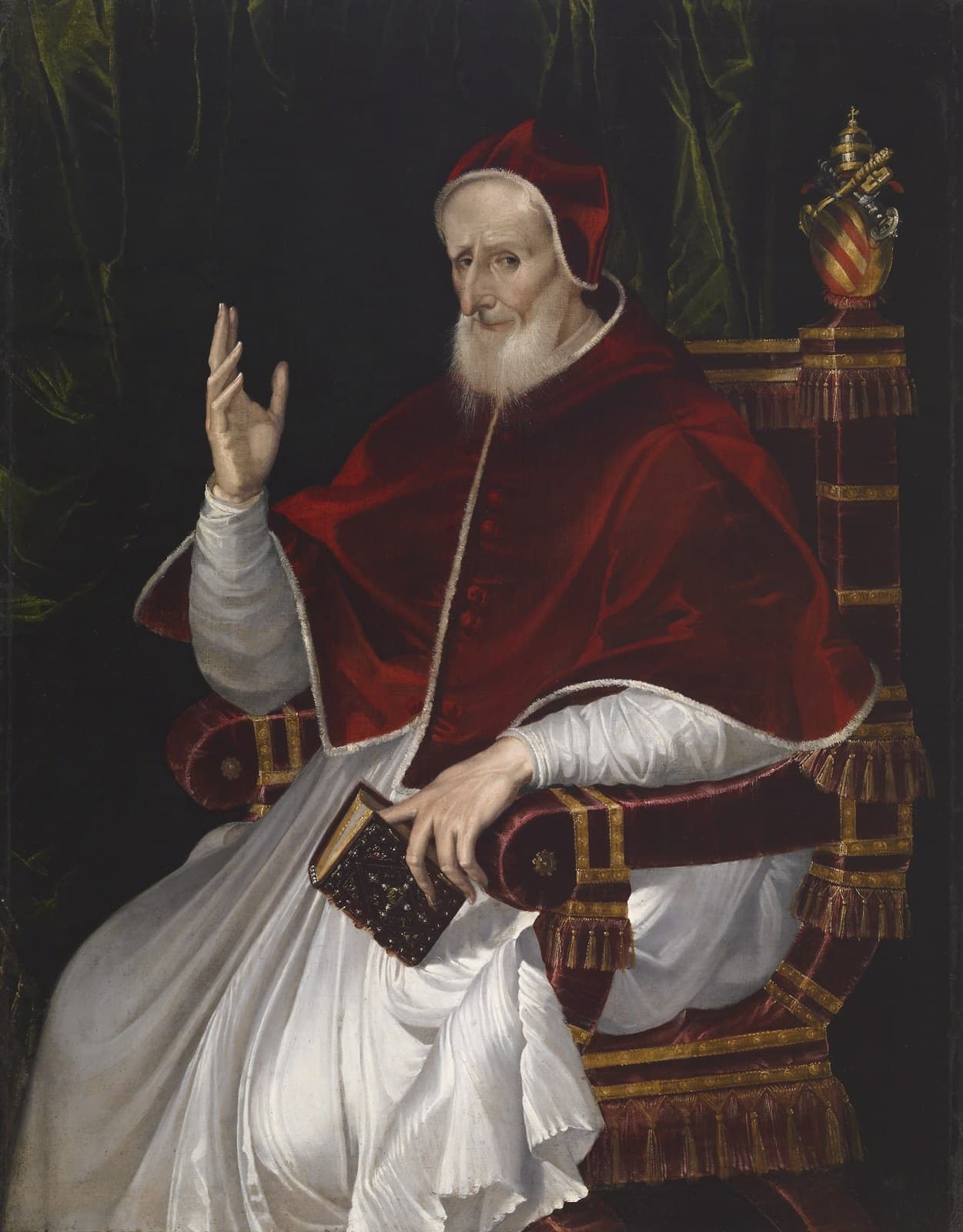
- Feast day
- April 30. He died on May 1, 1572 1
- Born
- Michele Ghisleri, at Bosco near Alessandria in Lombardy, January 17, 1504 1
- Pope
- Elected January 7, 1566, against his own tears and entreaties 1
- Job
- Implementing the Council of Trent, which had closed three years before he was elected 2
- Canonized
- By Clement XI in 1712, forty years after his death 1
Saint Pius V was a Dominican who had taught theology for sixteen years and run the Inquisition before he was elected pope in 1566, weeping and asking not to be. 1 His task was to make the Council of Trent actually happen: seminaries, a new missal, a new breviary, a new catechism, bishops made to live in their own dioceses. 2 He also excommunicated Elizabeth I, pressed the Inquisition hard, and assembled the fleet that broke the Turkish navy at Lepanto. 1 He kept his friar's habit throughout, which is the reason popes have worn white ever since. 2
Sixteen years teaching, then the Inquisition
He was born poor, into a noble family that had lost its money. "Being of a poor though noble family his lot would have been to follow a trade, but he was taken in by the Dominicans of Voghera, where he received a good education and was trained in the way of solid and austere piety." 1 He was ordained in 1528 and taught theology and philosophy for sixteen years. 1
Lataste's description of him as a friar is worth having, because everything he did later was done by this man: "He fasted, did penance, passed long hours of the night in meditation and prayer, traveled on foot without a cloak in deep silence, or only speaking to his companions of the things of God." 1
From 1556 the promotions came quickly - bishop of Sutri, then inquisitor of the faith in Milan and Lombardy, then cardinal and inquisitor general for all Christendom in 1557. 1 Twice he blocked a pope. He "offered an insurmountable opposition to Pius IV" over admitting a thirteen-year-old Medici to the College of Cardinals, and "it was he who defeated the project of Maximilian II, Emperor of Germany, to abolish ecclesiastical celibacy." 1
When Pius IV died he was elected "despite his tears and entreaties". 1
Making Trent real
Franciscan Media frames the job by comparison: "If we think popes had difficulties in implementing Vatican Council II, Pius V had even greater problems after Trent four centuries earlier." The council had met on and off for eighteen years and closed in 1563; he was elected in 1566 "and charged with the task of implementing the sweeping reforms called for by the Council." 2
The list of what he actually produced is specific and it is mostly books and institutions. "He ordered the founding of seminaries for the proper training of priests. He published a new missal, a new breviary, a new catechism, and established the Confraternity of Christian Doctrine classes for the young." 2 Lataste adds the disciplinary side: he "obliged his bishops to reside in their dioceses, and the cardinals to lead lives of simplicity and piety", reformed the Cistercians, and worked at clergy reform with his friend Charles Borromeo. 1
He was also simply severe about the running of Rome. He "banished luxury from his court, raised the standard of morality", relegated prostitutes to distant quarters, and forbade bullfights. 1
The hospitals and the beggar
The same article that records the Inquisition records this, and at greater length. "He began his pontificate by giving large alms to the poor, instead of distributing his bounty at haphazard like his predecessors." 1 Franciscan Media says he gave "money customarily used for the papal banquets to poor Roman converts", built hospitals and fed the hungry. 2
Lataste describes the habit rather than the policy: "In his charity he visited the hospitals, and sat by the bedside of the sick, consoling them and preparing them to die. He washed the feet of the poor, and embraced the lepers." 1 And then one anecdote, reported as a report: "It is related that an English nobleman was converted on seeing him kiss the feet of a beggar covered with ulcers." 1
He kept the Dominican discipline in office. "In spite of the heavy labours and anxieties of his office, he made at least two meditations a day on bended knees in presence of the Blessed Sacrament." 1 Franciscan Media makes the connection explicit: his "ceaseless papal quest for a renewal of the Church was grounded in his personal life as a Dominican friar." 2 The white cassock is the visible remnant of that - he simply declined to stop dressing as a friar. 2
The part the encyclopedia argues about
His pontificate's "great thought and the constant preoccupation", Lataste says, "seems to have been the struggle against the Protestants and the Turks." 1 What that meant in practice is set out without apology: he supported Catholics against Protestant princes in Germany, encouraged and funded the League in France, backed Spain in the Low Countries, and "In England, finally, he excommunicated Elizabeth, embraced the cause of Mary Stuart, and wrote to console her in prison." 1
Then the sentence where the article stops narrating and starts defending. "In the ardour of his faith he did not hesitate to display severity against the dissidents when necessary, and to give a new impulse to the activity of the Inquisition, for which he has been blamed by certain historians who have exaggerated his conduct." 1
That is Lataste's judgment, published in 1911, and it is quoted here as his rather than adopted. He does not say what the accusations are, name the historians, or describe what the severity consisted of. A reader should know both that the man ran the Inquisition and that the Catholic source cited on this page thinks he has been treated unfairly for it. Franciscan Media does not mention the Inquisition at all. 2
He also condemned the writings of Baius, "who ended by submitting", and met "vehement opposition from England's Queen Elizabeth and the Roman Emperor Maximilian II." 12
Lepanto
The campaign against the Ottoman fleet took years of diplomacy and money. He supported the Knights of Malta, paid to fortify Italian towns, sent monthly contributions to the Christians of Hungary, and in 1567 collected a tenth of the revenues of every convent for the purpose. 1 When Cyprus was attacked in 1570 "he never rested till he united the forces of Venice, Spain, and the Holy See." 1 Franciscan Media notes how close it came to not happening: "Only at the last minute was he able to organize a fleet." 2
His instruction to the commander is the detail worth keeping. He sent his blessing to Don John of Austria, "recommending him to leave behind all soldiers of evil life, and promising him the victory if he did so." 1
The battle was fought in the Gulf of Lepanto on October 7, 1571. 2 Lataste reports what happened in Rome that day: "he was working with the cardinals, when, suddenly, interrupting his work opening the window and looking at the sky, he cried out, 'A truce to business; our great task at present is to thank God for the victory which He has just given the Christian army'." 1 When the news arrived he wept. 1
He marked it liturgically rather than militarily: "In memory of this triumph he instituted for the first Sunday of October the feast of the Rosary, and added to the Litany of Loreto the supplication 'Help of Christians'." 1
He was still negotiating a wider alliance when he died, of gravel - kidney stones - "repeating 'O Lord, increase my sufferings and my patience!'" 1
What is Saint Pius V the patron saint of?
Neither source cited here gives him a patronage. 12 Lataste closes on his character - "He left the memory of a rare virtue and an unfailing and inflexible integrity" - and Franciscan Media closes on his Dominican observance; neither names a cause he is invoked for, and this page does not invent one. 12
The word "inflexible" in that sentence is doing honest work. It is offered as praise, and it is also an accurate description of a man who would not bend for an emperor, a queen, or the pope who wanted to make a boy a cardinal.
Saint Pius V's feast day
Praying with Saint Pius V
He is the saint for being handed a wrecked institution and a rulebook and told to reconcile them. Trent had produced eighteen years of decisions and nothing on the ground had changed. What he did about it was unglamorous and mostly bibliographic: a missal, a breviary, a catechism, seminaries, and an insistence that bishops actually live where they were sent. Most reform is like that. It looks like publishing and attendance registers.
The thing that holds the two halves of him together is that he did not change when the office did. He had been a friar who fasted, walked without a cloak and prayed at night, and as pope he still made two meditations a day on his knees, still went to the hospitals, still washed feet. 1 He kept the habit. The white cassock every pope since has worn is a five-hundred-year-old refusal to dress differently. 2
He is also a saint to read carefully rather than admiringly. The same man who sat with the dying pressed the Inquisition hard and excommunicated a queen, and the Catholic encyclopedia that tells you about the hospitals is also arguing with his critics in the same paragraph. 1 Nothing on this page resolves that, because the sources do not.
His last recorded words were not about the Turks or the council or England. "O Lord, increase my sufferings and my patience." 1 He asked for more of the hard thing, and for the capacity to bear it, in that order.
Saint Pius V, pray for us.
Sources
Saints to turn to next
Others in this collection who are turned to for some of the same things.