Saint Pius X
June 2, 1835 - August 20, 1914
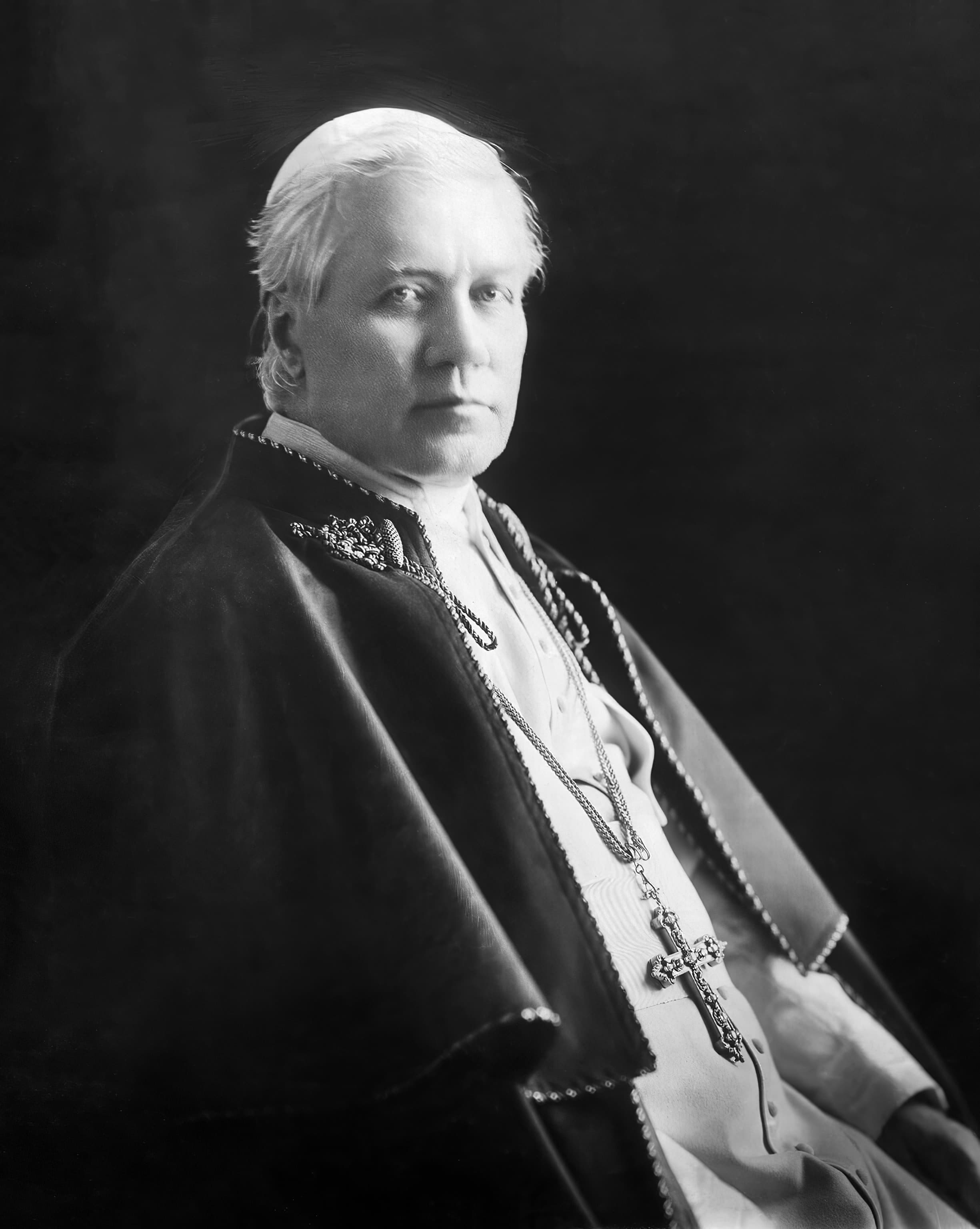
- Feast day
- August 21 2
- Born
- Giuseppe Sarto at Riese near Treviso, June 2, 1835, second of ten children. His father was a postman 12
- Motto
- "Instaurare omnia in Christo" - to restore all things in Christ 1
- Said
- "I was born poor, I lived poor, I will die poor" 2
- Canonized
- In 1954, forty years after his death 2
Saint Pius X was a postman's son who walked to school and back every day for four years, spent nine years as a curate doing an invalid pastor's work, and was elected pope at sixty-eight. 12 He hated the court he had inherited. "Look how they have dressed me up," he said in tears to an old friend. 2 What he changed was not politics but practice: he told Catholics to receive Communion often, and children as soon as they could understand it. 1 He had foreseen the war, and Franciscan Media says it killed him. 2
Walking to school
Benigni gives the circumstances without comment and they are enough. "His parents were Giovanni Battista Sarto and Margarita; the former, a postman, died in 1852, but Margarita lived to see her son a cardinal." 1 Franciscan Media adds that he was "the second of 10 children in a poor Italian family." 2
The education was pieced together. Private Latin lessons from the archpriest of his town, then four years at the gymnasium at Castelfranco Veneto, "walking to and fro every day", then a diocesan scholarship to the seminary at Padua. 1 He was ordained in 1858.
For nine years he was chaplain at Tombolo, "having to assume most of the functions of parish priest, as the pastor was old and an invalid." 1 He used the time to study Thomas and canon law, started a night school for adults, and preached in other towns when asked. 1 At Salzano from 1867 he restored the church and paid for the enlargement and upkeep of the hospital himself, and "especially distinguished himself by his abnegation during the cholera." 1
Mantua, Venice, and eighteen months of waiting
He was made Bishop of Mantua in 1884 - "then a very troublesome see" - and his response was to go and teach in his own seminary, dogmatic theology for several years and moral theology for another, handing copies of the "Summa theologica" to students too poor to buy one. 1 He sang Gregorian chant with the seminarians and sat in the confessional himself, which Benigni notes as an example rather than a duty. 1
Leo XIII made him a cardinal in 1893 and Patriarch of Venice three days later, and then the Italian government refused him the legal permission to take possession of the see, claiming a right of nomination it had inherited from the Austrian emperor. 1 He waited eighteen months. The dispute was fought out "with bitterness in the newspapers and in pamphlets", and the government retaliated by blocking other appointments until "the number of vacant sees grew to thirty." 1
Benigni adds the detail that makes the episode intelligible: "Its opposition had not been caused by any objection to Sarto personally." 1 He was simply the point at which a constitutional argument happened to land.
"Look how they have dressed me up"
He was elected on August 4, 1903, with fifty-five votes out of sixty, and crowned the following Sunday. 1 Franciscan Media records what he made of it. "Ever mindful of his humble origin, Pope Pius stated, 'I was born poor, I lived poor, I will die poor.'" 2
The papal court embarrassed him, and the two things he is reported as saying about it are not diplomatic. "Look how they have dressed me up," he said in tears to an old friend. And to another: "It is a penance to be forced to accept all these practices. They lead me around surrounded by soldiers like Jesus when he was seized in Gethsemani." 2
One of his first acts was to remove a piece of that apparatus permanently. Franciscan Media: he ended "the supposed right of governments to interfere by veto in papal elections - a practice that reduced the freedom of the 1903 conclave which had elected him." 2 He had watched it operate on his own election and abolished it.
Communion, and children
His motto was "instaurare omnia in Christo", to restore all things in Christ, and Benigni says his effort went "before all else" to "the promotion of piety among the faithful." 1 What that meant concretely is the reform he is remembered for.
In 1905 he advised all the faithful "to receive Holy Communion frequently and, if possible, daily", and dispensed the sick from the fasting rules so that they could receive twice a month or more. 1 Then, by the decree "Quam Singulari" of August 15, 1910, "he recommended that the first Communion of children should not be deferred too long after they had reached the age of discretion." 1
Franciscan Media opens its whole entry there: "Pope Pius X is perhaps best remembered for his encouragement of the frequent reception of Holy Communion, especially by children." 2 It was a reversal of a long practice of waiting, and it is the reason first Communion happens when it does.
The rest of his program was of a piece with it: a motu proprio on sacred music in 1903 restoring Gregorian chant, an encyclical in 1905 on the necessity of catechism for adults as well as children, a new catechism for Rome, regional seminaries to replace small failing ones, and instructions on the removal of parish priests where circumstances required it without a canonical cause. 1
The part the article is closest to
Benigni devotes his later pages to the campaign against what was called Modernism, and writes about it as a present emergency rather than a past event: "The pope has at heart above all things the purity of the faith", and Pius X "had pointed out the dangers of certain new theological methods, which, based upon Agnosticism and upon Immanentism, necessarily divest the doctrine of the faith of its teachings of objective, absolute, and immutable truth." 1
That is how the source presents it and it is reproduced here as the source's account. It is worth knowing that the account was written in 1911 by a curial writer, in the present tense, while the campaign was running and the pope was alive. 1 Benigni also records a 1906 encyclical warning bishops to be cautious in ordaining priests, because "there was frequently manifested among the younger clergy a spirit of independence that was a menace to ecclesiastical discipline." 1
Franciscan Media does not mention Modernism at all. 2 Where two sources differ this sharply in what they consider central, both selections are themselves information.
Peru, Messina, and the war
Franciscan Media makes a point of what he did without an encyclical to his name on social questions: "While Saint Pius X did not author a famous social encyclical as his predecessor had done, he denounced the ill treatment of indigenous peoples on the plantations of Peru, sent a relief commission to Messina after an earthquake, and sheltered refugees at his own expense." 2
In 1905, when France broke off its agreement with the Holy See and threatened to confiscate Church property unless the government were given control of Church affairs, "Pius X courageously rejected the demand." 2 He chose the loss.
On the eleventh anniversary of his election, Europe went to war. "Saint Pius X had foreseen it, but it killed him." 2 The words Franciscan Media records are not about diplomacy: "This is the last affliction the Lord will visit on me. I would gladly give my life to save my poor children from this ghastly scourge." 2 He died a few weeks after the fighting began, and was canonized in 1954. 2
What is Saint Pius X the patron saint of?
Neither source cited here gives him a patronage. 12 Benigni's article was written before his death and could not; Franciscan Media's entry ends with the canonization and does not raise it. This page leaves the question open rather than filling it in.
What he is plainly for is somebody who cannot get comfortable in a position they have been raised to, and who deals with it by changing what the position does rather than how it looks.
Saint Pius X's feast day
The feast of Saint Pius X is August 21. 2 He died on August 20, 1914, a few weeks after the outbreak of the First World War. 2
Benigni's encyclopedia article gives no feast day, for the straightforward reason that when it was written there was nothing to give: Pius X was alive, in office, and had just issued a decree the previous November. 1
Praying with Saint Pius X
He is the saint for being promoted past where you are comfortable and refusing to let it change you. The line to sit with is not the famous one about being born poor and dying poor. It is the one he said crying, to somebody who had known him before: "Look how they have dressed me up." 2 He was sixty-eight, he had been a curate, an archpriest, a bishop and a patriarch, and he still found the costume unbearable.
What he did about it is instructive. He did not stage humility; he changed the machinery. He abolished the government veto that had constrained the conclave that elected him, closed seminaries that were not working, told bishops to be slower about ordaining, and issued a decree that let children receive Communion as soon as they could understand what it was. 12 The pomp he could not get rid of. The practice he could.
The Communion reform is the thing that touched most lives and it is easy to underrate now that it is normal. He was telling ordinary people to come every day if they could, and to stop making their children wait years. 1 It is the opposite instinct from the one that makes religion a matter of qualification.
And at the end, with the war a few weeks old, what he said was about children again. "I would gladly give my life to save my poor children from this ghastly scourge." 2 It was the offer of a man who had already spent fifty years on other people's and had nothing else left to give.
Saint Pius X, pray for us.
Sources
Saints to turn to next
Others in this collection who are turned to for some of the same things.