Saint Marianne Cope
January 23, 1838 - August 9, 1918
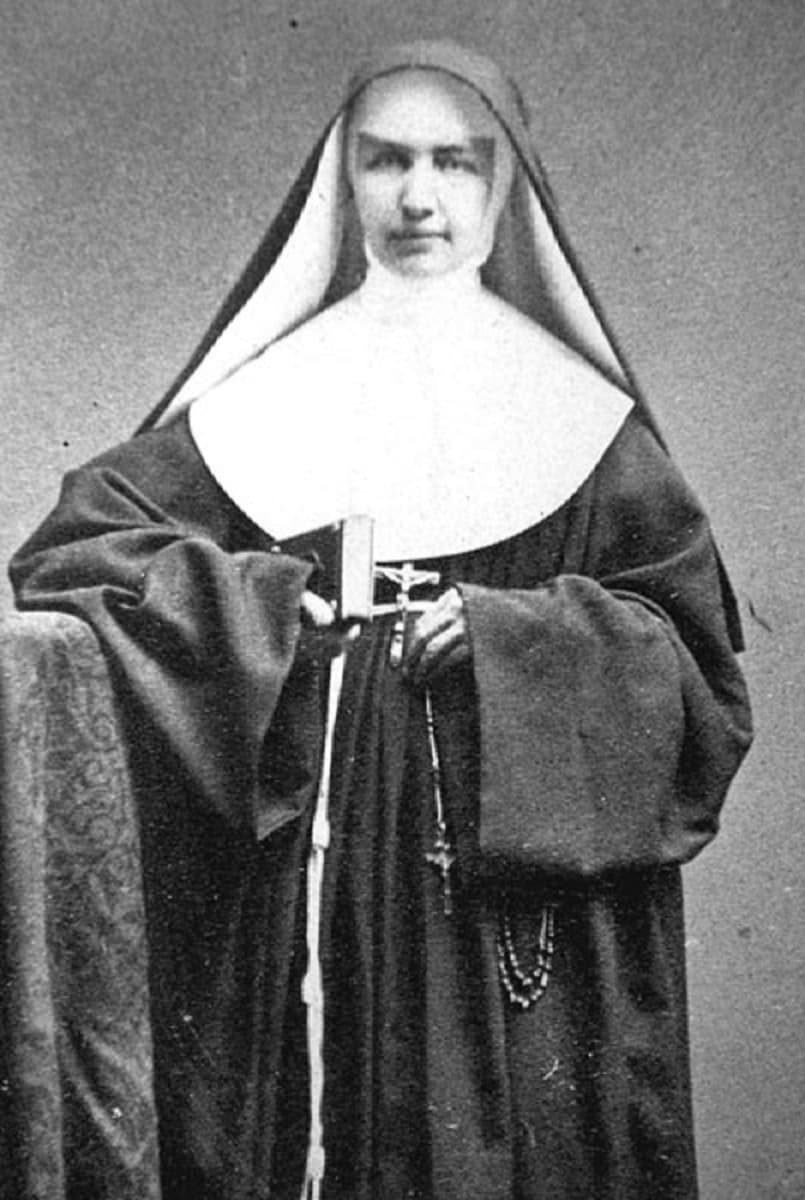
- Feast day
- January 23, which is also her birthday 2
- Born
- Barbara Koob, in Heppenheim, Hesse-Darmstadt, January 23, 1838; taken to the United States as an infant 12
- Before the convent
- She worked in a factory in Utica, New York, until 1862 2
- Asked and refused
- More than fifty religious communities were approached about Hawaii. Thirty-five sisters in her house volunteered at once 12
- Molokai
- She went in 1888, "effectively ending her contact with the outside world" 1
- Damien
- She nursed him as he died and took over his work among the men 1
Saint Marianne Cope was asked to run a receiving station for people suspected of having leprosy in Hawaii, after more than fifty religious communities in the United States and Canada had been asked first. 2 Benedict XVI put it in five words at her canonization: she embraced the call "after many others had refused." 1 Thirty-five sisters in her own house volunteered immediately. 2
Utica, and a factory
She was born Barbara Koob on January 23, 1838, in Hesse-Darmstadt, and named for her mother. 2 Benedict XVI gives the town as Heppenheim and notes she was "only one year old when taken to the United States." 1 The family settled in Utica, New York.
Franciscan Media records the part of her life that most accounts skip: "Young Barbara worked in a factory until August 1862, when she went to the Sisters of the Third Order of Saint Francis in Syracuse, New York." 2 She was twenty-four, and she had been a factory hand, not a student.
After profession the following November she began teaching at Assumption parish school. 2 She was superior in several places, twice novice mistress, and three separate times superior of St. Joseph's Hospital in Syracuse, "where she learned much that would be useful during her years in Hawaii." 2 She was elected provincial in 1877 and unanimously re-elected in 1881. 2
She was, in other words, a competent administrator in upstate New York with a hospital background and no reason to go anywhere.
The letter nobody answered
In 1883 the Hawaiian government was looking for someone to run the Kakaako Receiving Station, where people suspected of having leprosy were held. Franciscan Media gives the scale of the search: "More than 50 religious communities in the United States and Canada were asked." 2
Benedict XVI says what that means without saying the number: "Mother Marianne willingly embraced a call to care for the lepers of Hawaii after many others had refused." 1
Then the sentence that answers it: "When the request was put to the Syracuse sisters, 35 of them volunteered immediately." 2 Not one, and not after deliberation.
On October 22, 1883, Mother Marianne and six other sisters left for Hawaii and took charge of Kakaako outside Honolulu. 2 On Maui they founded Malulani Hospital and opened a home for girls whose parents had leprosy. 12
Molokai
Five years later she accepted an invitation to open a home for women and girls on Molokai itself - the settlement island, where the sick were sent and did not come back. Benedict XVI records what she knew she was doing: "bravely going there herself and effectively ending her contact with the outside world." 1
Father Damien was already there and already famous. The homily gives her role in three clauses: "There she looked after Father Damien, already famous for his heroic work among the lepers, nursed him as he died and took over his work among male lepers." 1
That last clause is the one to notice. She had gone to run a home for women and girls. When he died, she took the men as well.
Benedict XVI's judgment: "At a time when little could be done for those suffering from this terrible disease, Marianne Cope showed the highest love, courage and enthusiasm. She is a shining and energetic example of the best of the tradition of Catholic nursing sisters and of the spirit of her beloved Saint Francis." 1
She died on Molokai on August 9, 1918, thirty years after she arrived. 2 At her beatification in 2005, Cardinal Jose Saraiva Martins said of her love for the sick: "She saw in them the suffering face of Jesus. Like the Good Samaritan, she became their mother." 2
What is Saint Marianne Cope the patron saint of
She belongs to nurses and to those who care for people with diseases others will not go near, and to anyone working where outcomes are not available. 12 Benedict XVI names the condition exactly: "At a time when little could be done" for the disease. 1
She is also for administrators. Three terms running a hospital in Syracuse is what made her useful on Oahu, and nothing about that is romantic. 2
Saint Marianne Cope's feast day
The feast of Saint Marianne Cope is January 23, in the calendar for the dioceses of the United States. 2 It falls on her birthday rather than the day she died, which was August 9. 2
She was beatified on May 14, 2005, and canonized by Benedict XVI on October 21, 2012, in St. Peter's Square, alongside Kateri Tekakwitha. 12
Praying with Saint Marianne Cope
Fifty communities said no. 2 That is not a criticism of them - the request was to go and live with a contagious, disfiguring, incurable disease on an island you would not leave - it is the context that makes the thirty-five mean anything. Somebody has to be the fifty-first letter.
The thing she brought was not courage in the abstract. It was three terms as superior of a hospital. 2 She could run a ward, order supplies, manage sisters and handle a government. The heroism and the competence arrived in the same person, and the second is why the first accomplished anything.
Molokai is where the account stops being about capability. She went knowing it ended her contact with the outside world, and it did, for thirty years. 1 Nobody was going to visit. There was no term of service.
And then Damien died and she took his work as well. 1 She had arrived with a defined job - women and girls - and quietly absorbed the rest of it because there was nobody else. That is the shape of most real service: not a single decision to be brave, but a first yes that keeps being asked to mean more than it did.
Saint Marianne Cope, pray for us.
Sources
Saints to turn to next
Others in this collection who are turned to for some of the same things.
- Saint Mary MacKillopJanuary 15, 1842 - August 8, 1909CourageWork and vocationSuffering and illness
- Saint Camillus de Lellis1550 - July 14, 1614Suffering and illnessWork and vocation
- Saint Peter Claver1581 - September 8, 1654Suffering and illnessCourage
- Saint Agathac. 230 - c. 251CourageSuffering and illness