Saint Peter Claver
1581 - September 8, 1654
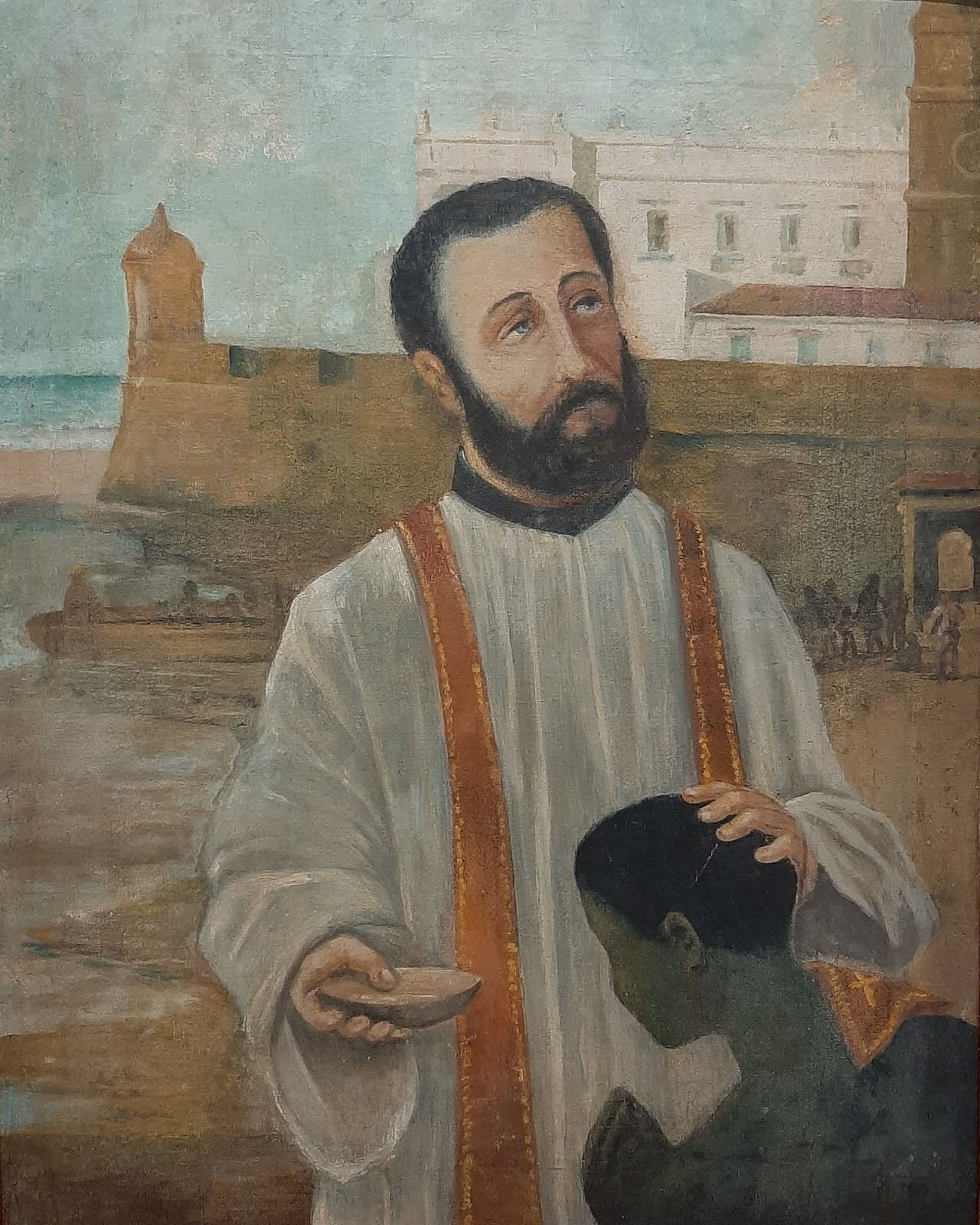
- Feast day
- September 9 1
- Born
- At Verdú in Catalonia in 1581, the son of a farmer 1
- Worked at
- Cartagena, the chief slave market of the New World, for forty-four years 1
- Was accused of
- Profaning the sacraments by giving them "to creatures who scarcely possessed a soul" 1
Saint Peter Claver spent forty-four years at Cartagena, the largest slave market in the Americas, going out on the pilot boat to meet each ship and going down into the hold. 12 He called himself "the slave of the negroes forever" and signed it that way. 12 The people of the city thought he was a fanatic, fashionable women would not enter a church where he had gathered the people he baptized, and his own superiors listened to the complaints. 1 He died after four years of illness in which, Franciscan Media says, he was "largely neglected." 2
Sent by a doorkeeper
He was a Catalonian farmer's son who took his first degrees at Barcelona and entered the Jesuits at twenty. 1 The person who sent him to America was not a superior.
"While he was studying philosophy at Majorca in 1605, Alphonsus Rodriguez, the saintly door-keeper of the college, learned from God the future mission of his young associate, and thenceforth never ceased exhorting him to set out to evangelize the Spanish possessions in America." 1 The porter of the college kept telling a student where his life was going until the student went.
Suau adds a fact that closes the circle: "Alphonsus Rodriguez was canonized on the same day as Peter Claver." 1 The doorkeeper and the man he sent were raised to the altars together in 1888.
Claver landed at Cartagena in 1610 and was ordained there in 1615. 12 He never went home. Franciscan Media's first sentence says he "left his homeland forever." 2
What Cartagena was
Suau describes the trade as a decision rather than a condition: the colonists "afforded the spectacle of one of those social crimes which are entered upon so lightly." They needed labor for the soil and the mines, judged the Indigenous population unable to survive the mines, "and it was determined to replace them with negroes brought from Africa." 1
The economics are set out without euphemism. "By its position in the Caribbean Sea, Cartagena became the chief slave-mart of the New World. A thousand slaves landed there each month. They were bought for two, and sold for 200 écus. Though half the cargo might die, the trade remained profitable." 1
Franciscan Media's figures differ and are worth having beside them: "Ten thousand slaves poured into the port each year after crossing the Atlantic from West Africa under conditions so foul and inhuman that an estimated one-third of the passengers died in transit." 2 Twelve thousand a year against ten; half the cargo against a third. Neither source explains its numbers, and both describe the same fact.
Both also record that the Church had condemned it and that the condemnation did nothing. Franciscan Media: the trade "was condemned by Pope Paul III and later labeled 'supreme villainy' by Pope Pius IX", and "it continued to flourish." 2 Suau: "Neither the repeated censures of the pope, nor those of Catholic moralists could prevail against this cupidity." 1
And then the sentence that frames everything Claver did. "The missionaries could not suppress slavery, but only alleviate it, and no one worked more heroically than Peter Claver." 1 That is his own encyclopedia stating the ceiling on the work.
The hold
He had a predecessor. Franciscan Media: "Saint Peter Claver's predecessor, Jesuit Father Alfonso de Sandoval, had devoted himself to the service of the slaves for 40 years before Claver arrived to continue his work." 2 Suau calls Sandoval "a wonderful missionary" and says Claver was trained in his school. 1 Eighty-four years of two men's lives went into this port.
Claver did not wait on the quay. "Every month when the arrival of the negroes was signalled, Claver went out to meet them on the pilot's boat, carrying food and delicacies." 1 Franciscan Media: "As soon as a slave ship entered the port, Peter Claver moved into its infested hold to minister to the ill-treated and exhausted passengers." 2
What he brought is listed specifically enough to be useful: "medicines, food, bread, brandy, lemons, and tobacco." 2 Lemons against scurvy, brandy and tobacco because they were what a person wanted.
Suau describes the method rather than the theology. The people in the hold "arrived crazed and brutalized by suffering and fear. Claver went to each, cared for him, and showed him kindness, and made him understand that henceforth he was his defender and father." 1 Franciscan Media puts the content of the instruction in one clause: he "assured his brothers and sisters of their human dignity and God's love." 2
The language problem he solved by delegation. He "assembled at Cartagena a group of interpreters of various nationalities, of whom he made catechists." 1 He could not speak to them, so he found people who could and trained them.
And he kept at it after the ships. On Sundays in Lent he gathered them, "inquired concerning their needs, and defended them against their oppressors." 1
What the city thought of him
The slave merchants were the obvious enemies and Suau says explicitly they were not the only ones. 1
The charge against him was theological. "The Apostle was accused of indiscreet zeal, and of having profaned the Sacraments by giving them to creatures who scarcely possessed a soul." 1 That sentence records what respectable Catholic Cartagena believed about the people Claver was baptizing.
The social version of it was simpler. "Fashionable women of Cartagena refused to enter the churches where Father Claver assembled his negroes." 1
And it worked on his own order. "The saint's superiors were often influenced by the many criticisms which reached them." 1 He did not have institutional backing; he had a job and a reputation for being excessive.
Franciscan Media notes how he handled the other side of colonial society when he traveled: on country missions "he avoided, when possible, the hospitality of the planters and owners and lodged in the slave quarters instead." 2 He declined to be a guest of the people who owned his congregation.
Four years in a room
The end is the hardest part of the entry. "After four years of sickness, which forced the saint to remain inactive and largely neglected, Saint Peter Claver died on September 8, 1654." 2 The man who had met every ship for forty-four years spent his last four years unable to move and mostly forgotten by the city he had worked in.
Then it changed overnight. "The city magistrates, who had previously frowned at his solicitude for the black outcasts, ordered that he should be buried at public expense and with great pomp." 2 The authorities who had disapproved of him gave him a state funeral.
Suau records the reputation the city had arrived at before the end: he became "the prophet and miracle worker of New Granada, the oracle of Cartagena, and all were convinced that often God would not have spared the city save for him." 1
He was beatified in 1850 and canonized in 1888. 1 Both sources give the number of people he instructed and baptized as more than three hundred thousand. 12
What is Saint Peter Claver the patron saint of?
Saint Peter Claver is the patron of Catholic missionary work among Black people. Suau gives the date: "On 7 July, 1896, he was proclaimed the special patron of all the Catholic missions among the negroes." 1 Franciscan Media attributes the declaration to Leo XIII, the pope who had canonized him eight years earlier. 2
It is a patronage of the exact work he did, named in the terms of the century that named it.
Saint Peter Claver's feast day
Praying with Saint Peter Claver
He is the saint for work that cannot fix the thing that is wrong. His own encyclopedia says it in one line: "The missionaries could not suppress slavery, but only alleviate it." 1 He did not end the trade, did not try to, and had no means to. He met the ships. For forty-four years he went down into the hold with lemons and brandy and medicine and told people who had just survived the Atlantic that he was their defender. 12
It is possible to read that as insufficient, and the honest response is that it was. It is also the only thing on offer to one Jesuit in Cartagena in 1620, and he did it every month for over four decades while the people around him thought he was disgracing the sacraments.
The opposition is the part to keep. Not the merchants - they had money at stake and their hostility explains itself. It was respectable Catholics, who said he was profaning the sacraments "by giving them to creatures who scarcely possessed a soul", and the women who would not attend a church he had used, and his own superiors who listened to them. 1 He was told, by his own Church, in his own city, that the people he served were not fully people.
Suau says he was "timid and lacking in self-confidence" and became "a daring and ingenious organizer" anyway. 1 That is not a description of a naturally brave man. It is a description of somebody who found a way to do it regardless.
And then four years in a bed, neglected, in the city that later buried him at public expense. 2 He did not get the recognition while he could use it. Almost nobody does.
Saint Peter Claver, pray for us.
Sources
Saints to turn to next
Others in this collection who are turned to for some of the same things.
- Saint Louis de MontfortJanuary 31, 1673 - April 28, 1716Poverty and simplicityCourageSuffering and illness
- Saint LawrenceDied August 10, 258CouragePoverty and simplicitySuffering and illness
- Saint Mary MacKillopJanuary 15, 1842 - August 8, 1909CouragePoverty and simplicitySuffering and illness
- Saint Marianne CopeJanuary 23, 1838 - August 9, 1918CourageSuffering and illness