Saint Camillus de Lellis
1550 - July 14, 1614
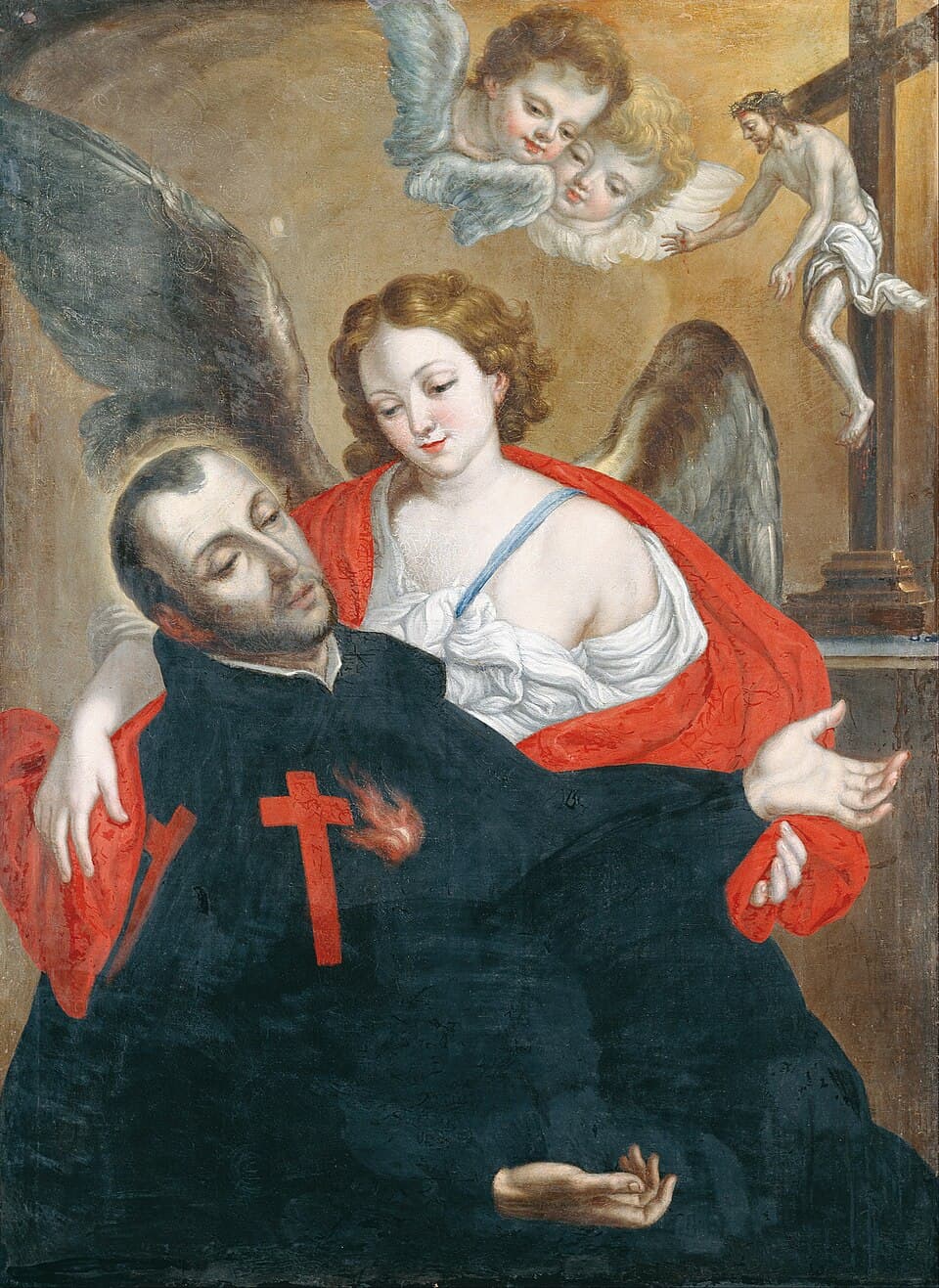
- Patron saint of
- Hospitals, nurses, health care workers and the sick, per Franciscan Media 2
- Born
- Bucchianico in the Abruzzo, 1550, son of a professional soldier 1
- Dismissed by
- The hospital he would later direct, for quarrelsomeness and gambling; and the Capuchins twice, for the sore on his leg 12
- Founded
- The Fathers of a Good Death in 1584, vowed to the plague-stricken. Made a religious order by Gregory XIV in 1591 1
- Ill for
- Forty-six years, by Campbell's count, and he would let no one nurse him 1
Saint Camillus de Lellis was a soldier and a compulsive gambler who in the winter of 1574 lost everything he owned at cards - his savings, his weapons, and, Franciscan Media says, "literally down to his shirt." 2 He had already been thrown out of a hospital for being quarrelsome. 1 He ended by founding an order of men vowed to nurse plague victims, insisting on clean wards and trained staff, and sending his brothers onto quarantined galleys nobody else would board. 12
Neglected, enlisted, and broke
He was born at Bucchianico in the Abruzzo in 1550, son of an officer who had served in both the Neapolitan and the French armies. 1 Campbell disposes of his childhood in eleven words: "His mother died when he was a child, and he grew up absolutely neglected." 1 Franciscan Media says the father neglected him and that he "grew up with an excessive love for gambling." 2
At seventeen he developed the affliction that shaped the rest of his life - Franciscan Media calls it a disease of his leg, Campbell "abscesses in both his feet" - and it never healed. 12 Campbell says it afflicted him for forty-six years. 1
He became a soldier, in the service of Venice and afterward of Naples, until his regiment was disbanded in 1574. 1 And he gambled. Campbell: "While in the service he became a confirmed gambler, and in consequence of his losses at play was at times reduced to a condition of destitution." 1
He went to Rome and took work at the San Giacomo Hospital for Incurables, and Campbell is honest about the motive: he went "chiefly by the hope of a cure" for his feet. 1 Franciscan Media says he was there "as both patient and servant." 2 It lasted nine months. "He was dismissed from the hospital on account of his quarrelsome disposition and his passion for gambling." 12
The winter of 1574
Then came the night that gets quoted. Franciscan Media: "in the winter of 1574, when he was 24, Camillus de Lellis gambled away everything he had - savings, weapons, literally down to his shirt." 2 A discharged soldier with a suppurating leg, standing in the cold with nothing.
He took work with the Capuchins at Manfredonia, working on a building they were putting up. 1 Campbell says the gambling "still pursued him, until a discourse of the guardian of the convent so startled him that he determined to reform." 1 Franciscan Media says he "was one day so moved by a sermon of the superior that he began a conversion that changed his life." 2 Neither source claims a vision. A man heard a sermon and stopped.
What followed was five years of being turned away. He entered the Capuchin novitiate and was dismissed because of the sore on his leg. 2 He went back to San Giacomo, returned to the Capuchins, and was dismissed again for the same reason. 2 Campbell records an earlier refusal by the Franciscans as well. 1 The obstacle was never his sincerity. It was that no order would accept a man who could not be cured.
So he went back to the hospital that had thrown him out. After a temporary improvement he became a nurse there, and Campbell says he won "the admiration of the institution by his piety and prudence" and was appointed its director. 1 Franciscan Media: "his dedication was rewarded by his being made superintendent." 2 The quarrelsome gambler was now running the place.
Against his friend's advice
His first attempt to found an order of lay infirmarians was blocked. 1 On the advice of his friends - among them his spiritual director, Philip Neri - he decided instead to become a priest, and at thirty-two began learning Latin at the Jesuit College in Rome. 1 He was ordained at thirty-four. 2
Then he did something Franciscan Media flags plainly: "Contrary to the advice of his friend, Camillus left San Giacomo and founded a congregation of his own." 2 Philip Neri told him not to. He did it anyway.
The order was the Fathers of a Good Death, established in 1584, whose members "bound themselves by vow to devote themselves to the plague-stricken", and whose work "was not restricted to the hospitals, but included the care of the sick in their homes." 1 Sixtus V confirmed it in 1586 and ordered a general superior elected every three years; Camillus was naturally the first, and was succeeded by an Englishman named Roger. 1 Gregory XIV erected it into a religious order with the privileges of the mendicants in 1591, and Clement VIII confirmed that in 1592. 1
What his men actually did
The particulars are unusual and worth setting out, because they are not devotional.
Franciscan Media: "Charity was his first concern, but the physical aspects of the hospital also received his diligent attention. Camillus insisted on cleanliness and the technical competence of those who served the sick." 2 In the 1580s, insisting that nurses be competent and wards be clean was a practical program, not a pious sentiment.
His men were bound to serve prisoners, plague victims, and the dying in private homes. 2 Some went with troops fighting in Hungary and Croatia in 1595, "forming the first recorded military field ambulance." 2
At Naples they boarded galleys carrying plague that had been refused permission to land. 2 Campbell records the result: two of the community "won the glory of being the first martyrs of charity of the congregation, by dying in the fleet which had been quarantined off the harbour, and which they had visited to nurse the sick." 1
And one detail that belongs to no devotional tradition at all: "He discovered that there were people being buried alive, and ordered his brothers to continue the prayers for the dying 15 minutes after apparent death." 2 He turned a liturgical practice into a safeguard against premature burial.
Forty-six years of it
His own body never improved. Campbell: the infirmity that had kept him out of the Capuchins "continued to afflict Camillus for forty-six years, and his other ailments contributed to make his life one of uninterrupted suffering, but he would permit no one to wait on him, and when scarcely able to stand would crawl out of his bed to visit the sick." 1
He resigned as superior general in 1607 in order to have more time for the sick and the poor, having by then founded houses in cities across Italy. 1
Franciscan Media gives the last of it: "In his last illness, he left his own bed to see if other patients in the hospital needed help." 2 Campbell says he died at sixty-four "while pronouncing a moving appeal to his religious brethren", on 14 July 1614, and was buried near the high altar of the church of St. Mary Magdalen in Rome. 1
What is Saint Camillus de Lellis the patron saint of?
Saint Camillus de Lellis is the patron saint of hospitals, nurses, health care workers and the sick. 2 Franciscan Media notes that he holds the patronage jointly with Saint John of God. 2
It is one of the better-earned patronages in this library, and the reason is not that he was kind to patients. It is that he was a patient - for forty-six years, with a wound that disqualified him from the religious life he wanted - and then ran the ward. 12 He also has an unofficial claim on gamblers and on people rebuilding after they have lost everything, which needs no explaining to anybody who has done it.
Saint Camillus de Lellis's feast day
The feast of Saint Camillus de Lellis is July 18, which is the day Franciscan Media, an American publisher, presents him on. 2 Campbell gives his death as 14 July 1614, and a reader will find that date attached to him too. 1 Both are in circulation and this page gives the observance as July 18 while recording the death as the 14th, rather than quietly collapsing the two.
Praying with Saint Camillus
The useful thing about him is the order of events. He did not reform and then become useful. He was dismissed for quarrelsomeness, went back, was dismissed from two novitiates for a medical condition, went back again, and was eventually put in charge of the institution that had fired him. 12 Every door he went through was one he had already been thrown out of.
His gambling is recorded by both sources without euphemism, and so is the night it ended - not in a conversion experience but in total loss, followed some months later by a sermon that startled him. 12 The sequence is worth noticing by anyone waiting to feel differently before acting. He was already ruined when he heard it.
What he built was practical. Clean wards, competent staff, care that followed the sick into their own homes, brothers who boarded plague ships, a fifteen-minute pause before burial. 2 None of that is sentimental, and all of it came from a man who knew from the inside what it is to be the patient nobody wants to handle.
And it never got easier for him. Forty-six years of an open wound, "uninterrupted suffering" in Campbell's phrase, and a refusal to let anyone nurse him - crawling out of bed to visit other people's sickbeds when he could not stand. 1 In his last illness he got up to check on the other patients. 2 That is the whole of him in one gesture.
Saint Camillus de Lellis, pray for us.
Sources
Saints to turn to next
Others in this collection who are turned to for some of the same things.
- Saint John of GodMarch 8, 1495 - March 8, 1550ConversionSuffering and illness
- Saint Marianne CopeJanuary 23, 1838 - August 9, 1918Suffering and illnessWork and vocation
- Saint Aloysius GonzagaMarch 9, 1568 - June 21, 1591Suffering and illnessConversion
- Saint Alphonsus Rodriguez1532 or 1533 - October 1617Work and vocationSuffering and illness