Saint John of God
March 8, 1495 - March 8, 1550
- Patron saint of
- Hospitals, nurses, the sick, heart patients, firefighters, booksellers and printers, per Franciscan Media 2
- Feast day
- March 8 - the day he was born and the day he died 1
- Born
- Montemor-o-Novo, Portugal, 8 March 1495 1
- Died
- Granada, 8 March 1550, on his fifty-fifth birthday 1
- Committed
- To an asylum after repenting publicly in the streets. Rudge: "he was dealt with as a madman" 12
- His order
- The Brothers Hospitallers, formed by his helpers about twenty years after his death 2
Saint John of God was forty before his life made any sense. 2 He had been a shepherd, a soldier twice, a bookseller and a man who walked to Africa intending to trade himself for Christian captives. 12 Then a sermon undid him, he was committed to an asylum as a lunatic, and the preacher who had undone him told him to stop beating himself and go take care of somebody. 12 He rented a house in Granada and carried the sick to it on his back. 1
Forty years of not settling
He was born at Montemor-o-Novo in Portugal on 8 March 1495. 1 At nine he followed a Spanish priest to Oropeza and was left in the charge of the chief shepherd there, who came to value him "through his punctuality and fidelity to duty, as well as his earnest piety." 1
Rudge then gives a reason for his first enlistment that no hagiographer would invent: "to escape his master's well-meant, but persistent, offer of his daughter's hand in marriage, John took service for a time in the army of Charles V" - and when the offer was renewed, he enlisted again, this time for a regiment going to Austria to fight the Turks. 1 He joined an army twice to avoid a marriage proposal.
Franciscan Media says flatly that he "had given up active Christian belief while a soldier." 2
Afterward he went home and learned that his mother had died young, "which had followed close upon his mysterious disappearance." 1 He was a shepherd at Seville, then at Gibraltar, on his way to Africa "to ransom with his liberty Christians held captive by the Moors" - he intended to sell himself. 1 Franciscan Media adds that he hoped to be martyred, and that he "was soon advised that his desire for martyrdom was not spiritually well based." 2
So he came back and did something much odder and more useful. Rudge: "brief as had been the time since the invention of the printing-press, he inaugurated the Apostolate of the printed page, by making the circuit of the towns and villages about Gibraltar, selling religious books and pictures, with practically no margin of profit, in order to place them within the reach of all." 1 Franciscan Media calls it "the relatively prosaic activity of a religious goods store." 2 He was a colporteur before anyone had a word for it, deliberately not making money.
The asylum
At Granada he heard Blessed John of Avila preach, and it broke him open. He gave away everything he owned and "went through the streets of the city, beating his breast and calling on God for mercy." 1 Franciscan Media: he "one day engaged in a public beating of himself, begging mercy and wildly repenting for his past life." 2
The city drew the obvious conclusion. "For some time his sanity was doubted by the people and he was dealt with as a madman." 1 Franciscan Media: "Committed to a mental hospital for these actions." 2 The man now invoked as patron of hospitals was confined in one, against his will, as a lunatic.
What got him out was a piece of advice, and it is the hinge of his life. Franciscan Media renders it: he was advised "to be more actively involved in tending to the needs of others rather than in enduring personal hardships. John gained peace of heart, and shortly after left the hospital to begin work among the poor." 2 Rudge says the same from the other side: "the zealous preacher obliged him to desist from his lamentations and take some other method of atoning for his past life." 1
One correction is owed here. Franciscan Media names the visitor as "Saint John of God" - that is, as the man himself - which cannot be right. The preacher whose sermon had started it was John of Avila, and Rudge identifies him as the one who intervened. 12 Two saints named John in a single paragraph is an easy way to go wrong, and a reader meeting the sentence cold should know.
The substance survives the slip, and it is worth stating plainly: what cured him was being told to stop punishing himself and go look after somebody else.
The house at Granada
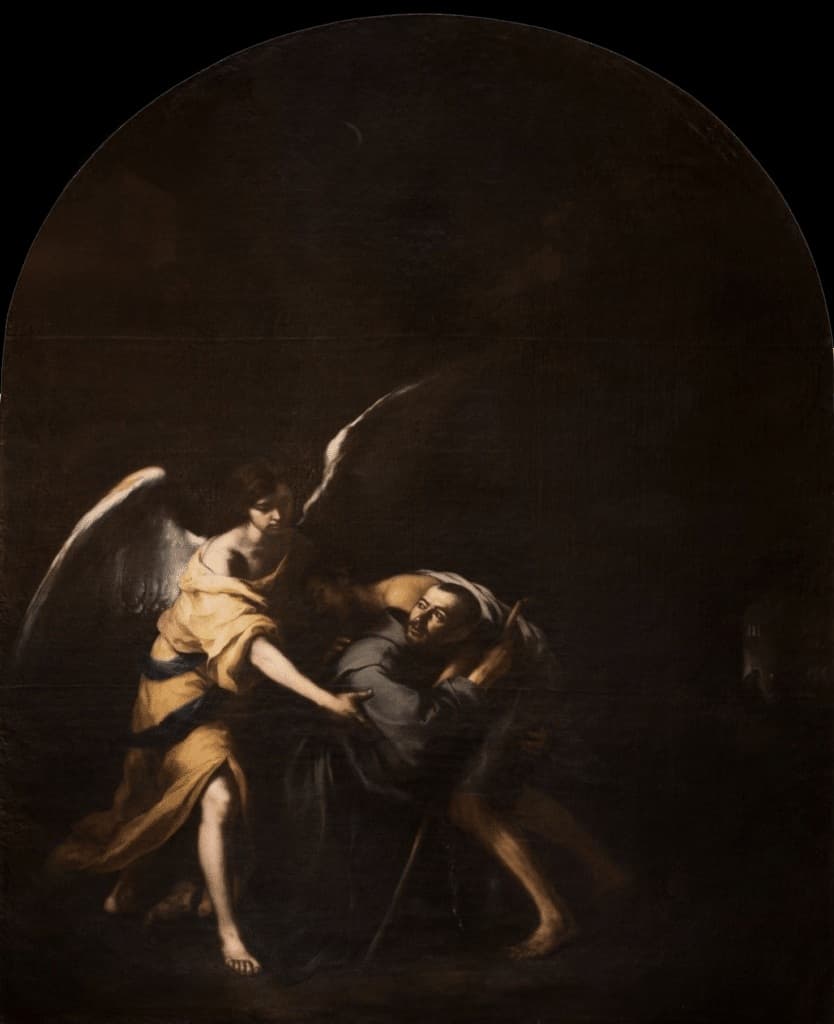
After a pilgrimage to Guadalupe he came back to Granada and started. Rudge: "he gave himself up to the service of the sick and poor, renting a house in which to care for them and after furnishing it with what was necessary, he searched the city for those afflicted with all manner of disease, bearing on his shoulders any who were unable to walk." 1
He went out and looked for patients, and carried the ones who could not walk. That is what Murillo painted.
For a while he did it alone: "soliciting by night the needful supplies, and by day attending scrupulously to the needs of his patients and the care of the hospital." 1 Franciscan Media: "at first doing his own begging." 2 Then people began backing him - "many people began to back him up with money and provisions. Among them were the archbishop and marquis of Tarifa." 2
Two details show what he was like. He gave his cloak away to every beggar he met, so often that the Bishop of Tuy "had made for him a habit" - one that his followers later adopted as their religious dress - and formally imposed on him the name he had been given in a vision, John of God, "for all time." 1 A bishop had to design him a uniform to stop him giving his coat away.
And his first two companions, Antonio Martin and Pedro Velasco, were "once bitter enemies who had scandalised all Granada with their quarrels." 1 He reconciled two men the whole city had been gossiping about, and they became his staff.
The end, and what came after
Franciscan Media describes what was underneath the visible work: "Behind John's outward acts of total concern and love for Christ's sick poor was a deep interior prayer life which was reflected in his spirit of humility. These qualities attracted helpers." 2
He lasted ten years. "Saint John of God became ill after 10 years of service, but tried to disguise his ill health." 2 When he could not hide it any longer he did the responsible thing: "He began to put the hospital's administrative work into order and appointed a leader for his helpers." 2 A man who had been a wanderer for forty years died leaving the books in order and a successor named.
"He died under the care of a spiritual friend and admirer, Lady Ana Ossorio." 2 It was 8 March 1550 - his fifty-fifth birthday. 1
About twenty years later his helpers organized themselves into the Brothers Hospitallers, "now a worldwide religious order." 2 He never founded it. They did, out of what he had left them.
What is Saint John of God the patron saint of?
Saint John of God is the patron saint of hospitals, nurses, the sick and heart patients, and also of firefighters, booksellers and printers. 2
The hospitals and the nursing are obvious and earned. The booksellers and printers come from the years around Gibraltar, when he walked from village to village selling religious books at almost no profit so that ordinary people could afford them. 1 It is a patronage nobody would guess and it rests on something he actually did.
He is also, and this is the one most worth knowing, a patron for people who have been mentally ill. He was locked up as a madman and released into a vocation. 12 Anyone who has been treated as a case rather than a person has a saint who was, and who went on to build the kind of place he had been confined in, run differently.
Saint John of God's feast day
The feast of Saint John of God is March 8. 12 Rudge records that he was born on 8 March 1495 and died on 8 March 1550 - the same date at both ends of his life, and the date the Church keeps. 1 That coincidence is rare enough to be worth stating.
He is not to be confused with Saint John of Avila, the preacher who set his conversion in motion and then intervened to redirect it, nor with the many other Johns of the sixteenth century. 1
Praying with Saint John of God
The advice that cured him is the most useful sentence in his life, and it was given to a man in an asylum: stop enduring personal hardships and go tend to somebody else's needs. 2 That is not a dismissal of his distress. It is a redirection of it, and it worked - he "gained peace of heart" and walked out. 2 Anyone stuck in a loop of self-reproach has been given the same instruction by somebody, and here it is with a canonization attached.
His first forty years are a comfort to people whose lives have not cohered. A shepherd, a soldier who enlisted to dodge a marriage, a man who walked toward Africa meaning to sell himself, a bookseller who deliberately made no profit. 12 None of it was preparation in any sense he could have seen. He was middle-aged, unsettled and, by Franciscan Media's account, no longer practicing his religion. 2
What he did when he finally started was physical. He went out into the city, found people, and carried them home on his back. 1 Not a program, not an appeal - one man and whoever he could lift. The organization came afterward, built by other people, twenty years after he was dead. 2
And the last thing he did was administrative. Ill, dying, and trying to hide it, he put the hospital's paperwork in order and appointed somebody to take over. 2 It is an unglamorous ending and it is why the work outlasted him. The saint who carried the sick on his shoulders also made sure the accounts balanced before he let go.
Saint John of God, pray for us.
Sources
Saints to turn to next
Others in this collection who are turned to for some of the same things.
- Saint Alphonsus LiguoriSeptember 27, 1696 - August 1, 1787Anxiety and mental healthConversion
- Saint DymphnaTraditionally seventh centuryAnxiety and mental healthSuffering and illness
- Saint Patrickc. 415 - 493ConversionSuffering and illness
- Saint Thomas Becketc. 1118 - December 29, 1170ConversionSuffering and illness