Saint Dymphna
Traditionally seventh century
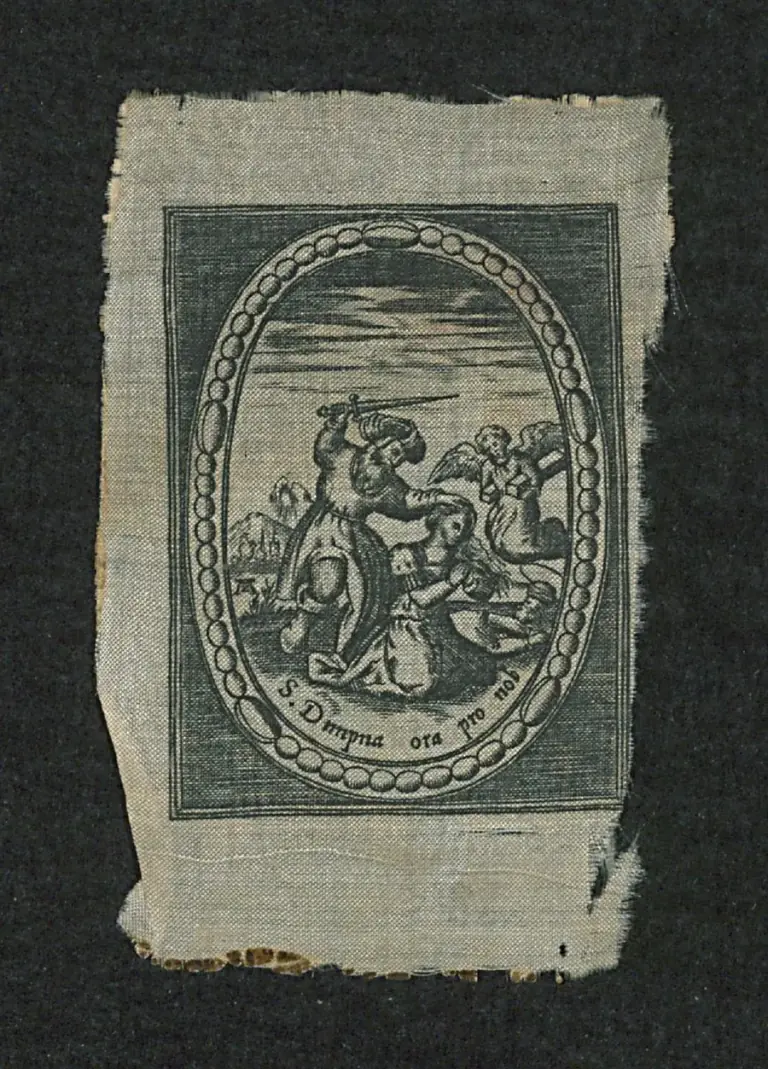
- Patron saint of
- Those who suffer from mental illness, anxiety and emotional distress 2
- Shrine
- Geel, in Belgium, where her church was rebuilt in 1532 1
- Historical record
- The 1913 Catholic Encyclopedia judges her legend "without any historical foundation" 1
- Physical evidence
- Two ancient sarcophagi at Geel; a brick in one bears the letters DYMPNA 1
Saint Dymphna is the patron of people suffering from mental illness, anxiety and emotional distress - and almost nothing about her life can be established as history. That is worth saying plainly on a page like this. What is documented is the devotion, the shrine at Geel, and the extraordinary thing the town built around her: a way of caring for the mentally ill, in ordinary homes, that has lasted for centuries.
What the legend says
The account comes from a narrative written in the thirteenth century. In it, Dymphna is the daughter of a pagan Irish king and a Christian mother. After her mother's death her father, deranged by grief, resolves to marry his own daughter. She flees with a priest, Gerebernus, to Geel in what is now Belgium. Her father finds them, kills the priest, and beheads her. 1 Catholic Answers gives her age as about fifteen. 2
What can and cannot be concluded
The 1913 Catholic Encyclopedia does not treat that narrative as history. It states that the account "is without any historical foundation," that it merely repeats a widespread folktale motif about the king who wanted to marry his own daughter, and that "we can conclude nothing from it as to the history of St. Dymphna and the time in which she lived." 1 It adds that she cannot be shown to be the same person as St. Damhnat of Ireland. 1
What does exist is physical. Two ancient stone sarcophagi survive at Geel, and a brick found in one of them bears the letters DYMPNA. The article suggests that this discovery "was perhaps the origin of the veneration" - that is, the relic may have come first and the story afterwards. 1
None of this makes the devotion false. It makes the biography unavailable, which is a different thing, and it is the honest position.
Geel
What grew at Geel is remarkable and entirely documented. A colony for the mentally ill developed around the shrine, at times housing fifteen hundred people. Rather than being confined, they lodged in the homes of the townspeople, took part in farm work, were treated kindly, and were watched over without being made conscious of it. The 1913 article records that the practice "produces good results." 1
The old church of Saint Dymphna burned in 1489; its replacement was consecrated in 1532 and still stands. 1 Catholic Answers notes that Geel "has developed a reputation as a place of compassionate care for those struggling with psychological disorders." 2
Geel was practicing family-based community care for mental illness while most of Europe was chaining people up. Whatever is or is not true about the girl, the town is the miracle.
What is Saint Dymphna the patron saint of?
Saint Dymphna's feast day
Praying with Saint Dymphna
Dymphna is the saint people reach for when the trouble is in their own head. Mental illness, and also the smaller weights that never get a name or a diagnosis. 2 There is no threshold you have to clear before you are allowed to ask.
Geel is the part of her story that holds up. A whole town took the mentally ill into its houses, gave them work on the farms, and looked after them without making them feel watched. 1 Not more prayer instead of care. Homes, work, and ordinary kindness, for centuries.
So if you are the one doing the looking after, that is the tradition you are standing in. It rarely feels holy at three in the morning. It is anyway.
This page has been blunt that her story cannot be verified 1, because you deserve better than a comfortable version. The devotion is real, the shrine is real, and Geel is real. Ask her anyway.
Saint Dymphna, pray for us.
Sources
Saints to turn to next
Others in this collection who are turned to for some of the same things.
- Saint BibianaDates unknown; by legend martyred at Rome about 360-363Suffering and illnessAnxiety and mental health
- Saint Catherine of Genoa1447 - September 15, 1510Anxiety and mental healthSuffering and illness
- Saint Jane Frances de ChantalJanuary 28, 1572 - December 13, 1641Suffering and illnessAnxiety and mental health
- Saint John of GodMarch 8, 1495 - March 8, 1550Anxiety and mental healthSuffering and illness