Saint Bibiana
Dates unknown; by legend martyred at Rome about 360-363
- Historical record
- A basilica "of the holy martyr Bibiana, which contained her body," consecrated by Pope Simplicius (468-483) 1
- The legend
- Scourged to death under Julian the Apostate; the encyclopedia says it "has no historical claim to belief" 12
Saint Bibiana is a Roman martyr whose church has stood on the Esquiline Hill since the fifth century and whose life is almost entirely unknown. 14 The one early record of her is a line saying that Pope Simplicius consecrated a basilica that held her body. 1 The story usually told about her, of a girl scourged to death under Julian the Apostate, came later, and the 1907 Catholic Encyclopedia says it "has no historical claim to belief." 1 Her day is December 2. 45
One line in the book of the popes
J.P. Kirsch, in the Catholic Encyclopedia, starts from the only firm ground there is. The earliest mention of Bibiana "in an authentic historical authority" is in the Liber Pontificalis, the old collection of papal biographies. Its life of Pope Simplicius, who reigned from 468 to 483, says that he "consecrated a basilica of the holy martyr Bibiana, which contained her body," near a building the text calls the palatium Licinianum. 1 Kirsch adds: "This basilica still exists." 1
From that he draws one conclusion, that in the fifth century her remains rested inside the city walls. Then he stops. "We have no further historical particulars concerning the martyr or the circumstances of her death; neither do we know why she was buried in the city itself." 1
The Church's present calendar of saints is just as sparing. The Roman Martyrology entry for December 2 says only that she was a martyr at Rome and that Pope Saint Simplicius dedicated a basilica under her name on the Esquiline Hill. It adds nothing about her family, her judge or her death. 4
What the legend says
The legend makes her the daughter of Flavian, a former prefect, and his wife Dafrosa, with a sister named Demetria. The family is Christian and falls under Julian the Apostate. 12 Catholic Culture introduces its version with the words "A legend states," and EWTN marks part of its own with "According to tradition." 23
The tellings differ on nearly every death but hers. In the encyclopedia's summary Flavian is banished, and Dafrosa and Demetria die natural deaths and are buried by Bibiana in their own house. 1 EWTN has the father "severely scourged and exiled," dying of his wounds, and the mother and sister dying naturally. 3 Catholic Culture has Flavian branded on the face with a hot iron and exiled, Dafrosa beheaded, and Demetria falling dead in court after the sisters had spent five months shut in their house, stripped of their possessions, fasting and praying. 2
Bibiana is then handed to a woman who is to wear down her faith, and who fails. 23 EWTN names the governor who pressed her as Apronianus and says she "was then tied to a column and whipped with leaded scourges." 3 Catholic Culture: "Bibiana was scourged to death with whips that were loaded with lead." 2 Her body was left in the open for the animals, which would not touch it, and after two days a priest named John buried her beside her mother and sister in the family house. 123
The sources that tell the story do not agree on its year. Catholic Culture gives about 361 on one page and 363 on another, and EWTN gives 360. 236
Why the story was told
Kirsch does not leave the legend standing. It "sprang up" in later times, he says, is connected with the Acts of the martyrs John and Paul, "and has no historical claim to belief." 1 He also suggests what it was for. The house in the story becomes a church, and the church is the one on the Esquiline: "It is evident that the legend seeks to explain in this way the origin of the church and the presence in it of the bodies" of the three women. The accounts in the ninth-century martyrologies, he notes, are drawn from the same legend. 1
In other words the church came first and the story after. A real grave was honored in Rome by the 400s. Who lay in it, beyond her name and the title of martyr, was no longer known when people began to ask. 1
The church on the Esquiline
The basilica Simplicius consecrated is still her church. 13 EWTN describes it as standing on the Esquiline Hill, rebuilt in the seventeenth century "with a facade designed by Gian Lorenzo Bernini," and says that her relics are kept there with those of her mother and sister. 3 Vatican News lists her as "St. Bibiana, Roman Patron, her church on the Esquilino." 5
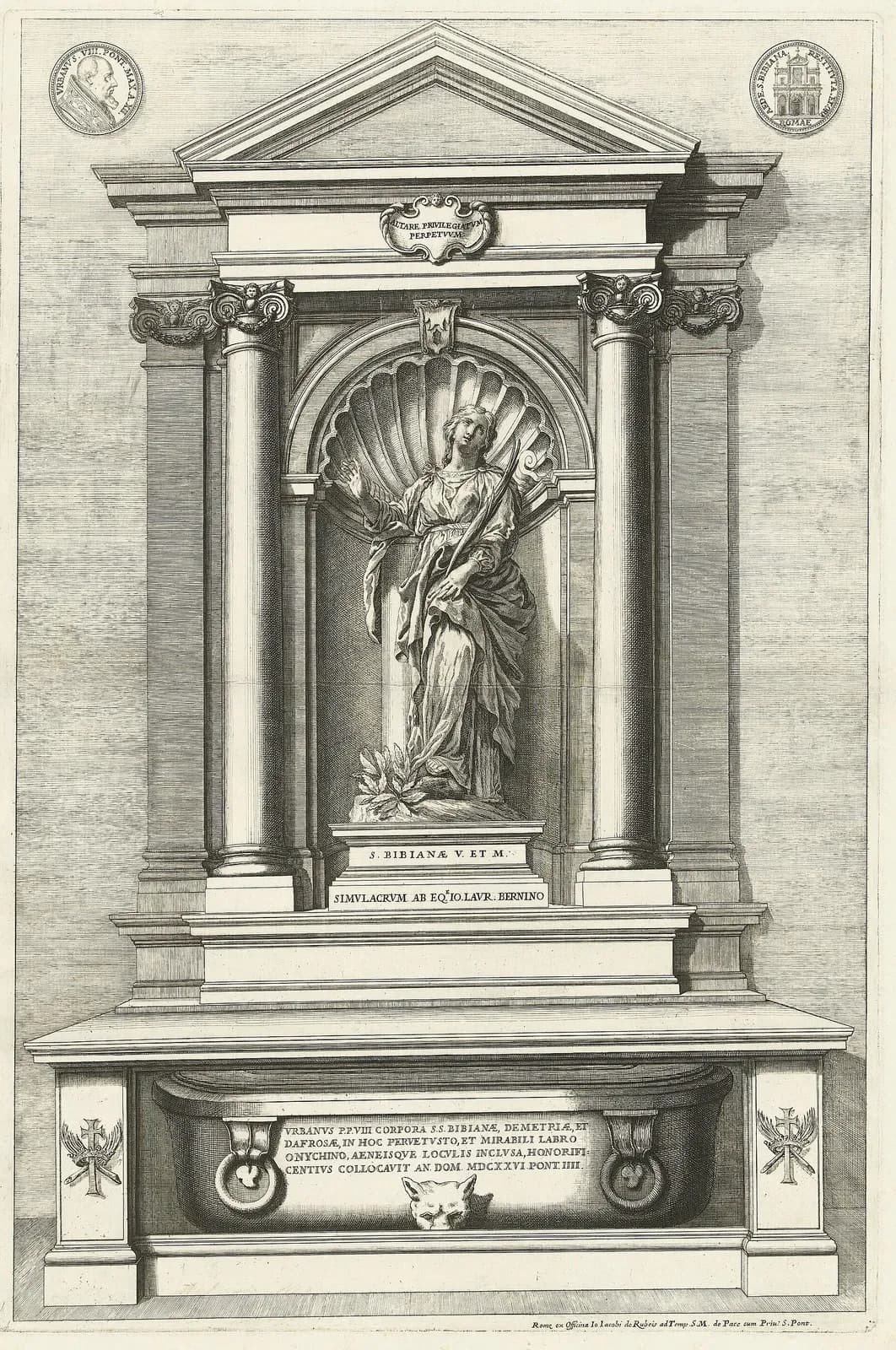
Bernini also carved a statue of her, which EWTN calls famous and describes as showing her "beside a column, looking up with an anguished, yet hopeful expression." 3 The engraving on this page, made in Rome late in the same century, records that statue in a niche above her altar: she leans on the column of her scourging with a palm in her hand. Catholic Culture lists the pillar and the scourge among her symbols, and counts her with Cecilia and Agnes as one of "the three virgin martyrs particularly venerated in Rome." 2
What is Saint Bibiana the patron saint of?
EWTN calls Saint Bibiana the patron saint "of epilepsy, headaches, insanity, mental illness, torture victims, parishes, and single lay women." 3 Catholic Culture's list has most of the same. 2 EWTN gives a reason, and it is a reason drawn from the legend: "Because of her own sufferings, especially the tortures and mental anguish, she came to be invoked by those with seizures, mental illness, and headaches." It describes the patronage as reflecting "the traditions and devotions that grew around her over centuries." 3 The encyclopedia names no patronage at all. 1
Saint Bibiana's feast day
Saint Bibiana's feast is December 2. The Roman Martyrology commemorates her on that day, Vatican News lists her on it, and Catholic Culture places "St. Bibiana, Virgin and Martyr" among the day's other commemorations from the Martyrology. 245 An earlier Catholic Culture page notes that December 2 is also her feast in the 1962 Missal. 6 The Catholic Encyclopedia article does not mention a feast. 1
Praying with Saint Bibiana
People bring Bibiana headaches, seizures and troubles of the mind, and the saint they are praying to is someone about whom the Church can state one fact. 13 That deserves saying on a page like this. The patronage rests on a story, and the story, by the encyclopedia's account, cannot be relied on. 1
What can be relied on is older than the story. Christians in Rome kept the grave of a woman named Bibiana, called her a martyr, and built over her a church that a pope consecrated and that still stands. 14 None of that depends on the legend.
Catholic Culture's note for her day is that she "lost everything except her faith," and it suggests praying for anyone grieving the loss of a home, a job, their health or the people they love. 2 The detail comes from the legend. The suggestion stands without it.
Saint Bibiana, pray for us.
Sources
- 1.Johann Peter Kirsch, "St. Bibiana," The Catholic Encyclopedia, vol. 2 (New York: Robert Appleton Company, 1907).
- 2.Liturgical Year, December 2, 2025, "St. Bibiana, Virgin and Martyr," Catholic Culture (Trinity Communications).
- 3."St. Bibiana," Daily Saint, EWTN Mission (Eternal Word Television Network).
- 4.Santo del giorno, 2 dicembre, from the Roman Martyrology, Conferenza Episcopale Italiana (in Italian).
- 5."St. Bibiana, Roman Patron, her church on the Esquilino," Saint of the Day, 2 December, Vatican News (Dicastery for Communication).
- 6.Liturgical Year, December 2, 2010, Catholic Culture (Trinity Communications).
Saints to turn to next
Others in this collection who are turned to for some of the same things.
- Saint Denis of ParisMartyred at Paris about 275, or in 258 by another accountCourageSuffering and illness
- Saint DymphnaTraditionally seventh centuryAnxiety and mental healthSuffering and illness
- Saint Hugh of Grenoble1053 - April 1, 1132CourageSuffering and illness
- Saint Agathac. 230 - c. 251CourageSuffering and illness