Saint Denis of Paris
Martyred at Paris about 275, or in 258 by another account
- Patron saint of
- France, according to Franciscan Media 3; Catholic Culture adds Paris, and invocation against headaches, frenzy, strife, rabies and diabolical possession 56
- Born
- In Italy; the time and place are not known 1
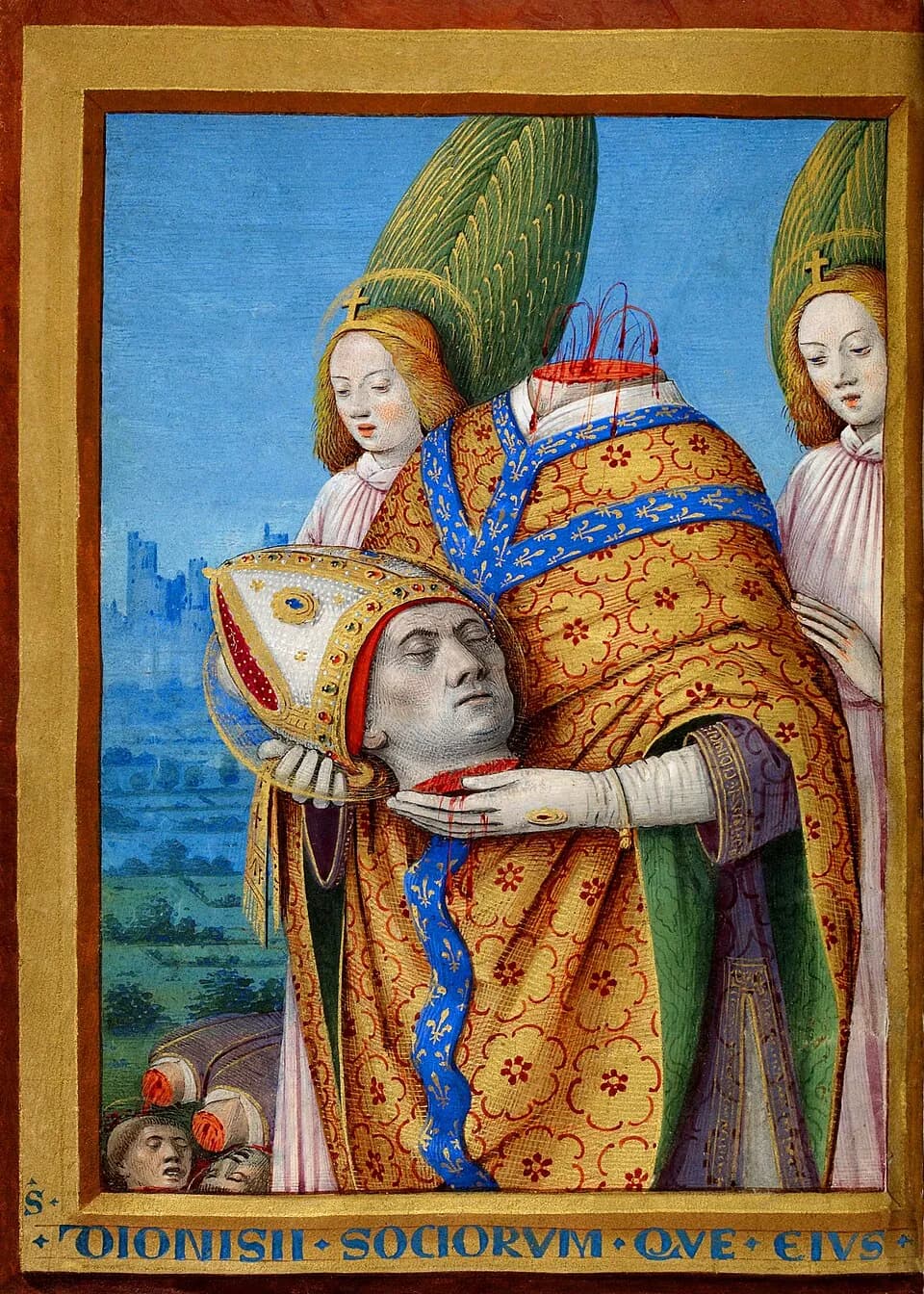
Saint Denis was a third-century missionary bishop who preached at Paris, was beheaded there with a priest named Rusticus and a deacon named Eleutherius, and became the patron of France. 13 He is the saint painted with his own head in his hands, because of a legend that his body rose after the execution and carried it away. 1 For most of the Middle Ages he was also believed to be the Athenian convert of Saint Paul and the author of a celebrated body of mystical writings, an error the 1913 Catholic Encyclopedia calls "serious." 12 His feast is October 9. 13
A mission to Gaul
Very little about Denis is secure. The 1913 Catholic Encyclopedia says he was born in Italy and that "nothing is definitely known of the time or place, or of his early life." 1 Its author, Joseph Stiglmayr, takes the one fixed point to be his commission: Pope Fabian, who reigned from 236 to 250, sent him "with some other missionary bishops to Gaul on a difficult mission." 1 The Church there had been badly damaged by the persecution of the emperor Decius, and the new bishops were to rebuild it. 1
Catholic Culture gives the year as 250 and the number of his fellow bishops as six. 56 Loyola Press, following Gregory of Tours, says only that Denis was sent "with other bishops to preach the Good News of Jesus to the people of Gaul." 7
Denis came with two companions the encyclopedia calls inseparable, the priest Rusticus and the deacon Eleutherius. 1 They settled on the island in the Seine, near where Paris now stands. There Denis built a church and arranged for the liturgy to be celebrated regularly, and his preaching brought, in the encyclopedia's words, "countless conversions." 1 Loyola Press says simply that he "organized the Church there." 7
The martyrdom, and what can be known of it
The oldest account of Denis is a Passio of Saints Dionysius, Rusticus and Eleutherius, written at the end of the sixth century or the beginning of the seventh and wrongly credited to the poet Venantius Fortunatus. 1 The encyclopedia warns that it "is interwoven with much legend," and draws from it only a short outline. 1
In that outline, the success of the mission angered the pagan priests, who stirred up the people and pressed the governor, Fescenninus Sisinnius, to stop the new teaching by force. 1 Denis and his two companions were arrested, refused to give up their faith, and were beheaded after many tortures. 1 Later accounts, the encyclopedia notes, multiplied the sufferings: scourging, prison, the rack, wild beasts, the stake, and finally the sword. 1 Gregory of Tours is much briefer. He records only that Denis, bishop of Paris, suffered various punishments for the name of Christ and ended his life by the sword. 1
The sources do not agree on the date. The encyclopedia places the execution "about 275." 1 Franciscan Media calls 258 the best hypothesis, saying Denis was "beheaded in the persecution under Emperor Valerius in 258," and Catholic Culture also gives 258. 35 Franciscan Media puts the death on Montmartre, which it glosses as the "mountain of martyrs." 3 Catholic Culture names the place as Catulliacum, now the town of Saint-Denis, though later on the same page it also mentions Montmartre. 5
The bishop who carried his head
The image most people know is of a bishop standing upright with his own mitered head in his hands. The encyclopedia explains it as a legend: "after his execution the corpse rose again and carried the head for some distance." 1 Franciscan Media calls it "one of the legends," in which Denis, martyred on Montmartre, carried his head to a village northeast of the city. 3 Catholic Culture describes it as one of many legends about his torture and death. 5 None of the three presents it as history.
What followed the martyrdom is better attested, though the sources tell it differently. According to the encyclopedia, a devout woman named Catulla saw that the three martyrs were given an honorable burial, and a small shrine was raised over their graves. 1 It was later replaced by a basilica fine enough that Venantius Fortunatus wrote verses about it. 1 Franciscan Media credits Saint Genevieve with building a basilica over the tomb at the beginning of the sixth century. 3 This page does not choose between the two accounts.
From the reign of King Dagobert in the seventh century, the church and the Benedictine monastery beside it were steadily enriched, and devotion to Denis became, as the encyclopedia puts it, "by degrees a national devotion." 1 Loyola Press adds that French kings were later buried in the abbey built over his grave. 7
Three men named Dionysius
In the Latin sources Denis is Dionysius, as in the title of the Passio and in Gregory of Tours, and for centuries his story was merged with those of two other men of that name. 17 The first was Dionysius the Areopagite, the member of the Athenian court who was converted by Saint Paul's preaching in Acts 17:34. 2 The second was the anonymous author of the "Areopagitic writings," mystical treatises that claimed to come from Paul's convert. 2 Stiglmayr, who also wrote the encyclopedia's article on that author, concluded that he belonged "at the very earliest to the latter half of the fifth century" and was probably a Syrian. 2
Medieval readers took all three to be one man. The encyclopedia says the identification was "doubtless effected as early as the eighth or perhaps the seventh century," but that it took "deep root" only through a life of the saint written in 836 by Hilduin, abbot of Saint-Denis, at the request of the emperor Louis the Pious. 1 The Areopagitic writings had been at Saint-Denis since 827, part of a gift from the Byzantine emperor Michael II to Louis the Pious, and Hilduin had them translated into Latin. 12 Loyola Press dates the merging to the ninth century and says it caused a revival of devotion to Denis. 7
The encyclopedia is plain that the result was "an error," and a "serious" one, and that the national devotion to Denis owed a good deal to it. 1 The scholar Launoy first raised doubts, and the Bollandist de Bye rejected the identification entirely. 1 Loyola Press notes that modern scholars favor Denis of Paris as the saint of this feast. 7
What is Saint Denis the patron saint of?
Franciscan Media names Saint Denis the patron saint of France. 3 Catholic Culture adds Paris, and lists him as invoked against headaches, frenzy, strife, rabies and diabolical possession. 5
Catholic Culture also counts him among the Fourteen Holy Helpers, a group of saints invoked together in the Middle Ages, especially during the Black Plague of 1346 to 1349. 56 In that list Denis is "invoked against diabolical possession and headaches" and is "pictured carrying his head in his hands." 6 Franciscan Media and the encyclopedia say nothing about headaches.
Saint Denis's feast day
The feast of Saint Denis and his companions is October 9. 1347 Vatican News lists "Sts. Denis, Bishop, and Companions, Martyrs of Paris" on that day. 4
Catholic Culture's calendar lists it as an optional memorial, and for 2026 shows it alongside two others on the same day: Saint John Leonardi and Saint John Henry Newman. 5 The same page notes that England and Wales keep Newman's day as a feast, while other places may celebrate an optional memorial. 5
Praying with Saint Denis
What is left of Denis once the legends are set aside is short: a bishop sent from Rome to a Church that persecution had damaged, a church built on an island in a river, a great many converts, and a death by the sword shared with a priest and a deacon. 1 Franciscan Media admits that almost nothing is known of him, and reflects that the deep impression he made on his own time points to a life of unusual holiness, and that the Church has never forgotten him. 3
The two companions are worth noticing. Rusticus and Eleutherius have no stories of their own in these sources, only their orders and their deaths, yet the Church has kept their names beside his for well over a thousand years. 15
The headless bishop is the strangest thing about him, and the sources tell it as legend without apology. 13 Later centuries also gave him a borrowed identity, one that made him greater than he was and that scholars then had to take apart. 12 The devotion survived the correction. Denis is still kept on October 9 as the martyr of Paris, which is what Gregory of Tours says he was. 15
Saint Denis of Paris, pray for us.
Sources
- 1.Joseph Stiglmayr, "St. Denis," The Catholic Encyclopedia, Vol. 4 (New York: Robert Appleton Company, 1908).
- 2.Joseph Stiglmayr, "Dionysius the Pseudo-Areopagite," The Catholic Encyclopedia, Vol. 5 (New York: Robert Appleton Company, 1909).
- 3."Saint Denis and Companions," Saint of the Day, Franciscan Media.
- 4."9 October," Saint of the Day, Vatican News.
- 5."October 09, 2026," Liturgical Calendar, Catholic Culture.
- 6."Fourteen Holy Helpers," Liturgical Year: Activities, Catholic Culture.
- 7."Saint Denis," Saints Stories for All Ages, Loyola Press, excerpted from Christ Our Life by the Sisters of Notre Dame of Chardon, Ohio.
Saints to turn to next
Others in this collection who are turned to for some of the same things.
- Saint Claude de la Colombiere1641 - February 15, 1682Suffering and illnessCourage
- Saint Louis de MontfortJanuary 31, 1673 - April 28, 1716CourageSuffering and illness
- Saint Agathac. 230 - c. 251CourageSuffering and illness
- Saint AgnesDied in the third or early fourth centuryCourageSuffering and illness