Saint Agnes
Died in the third or early fourth century
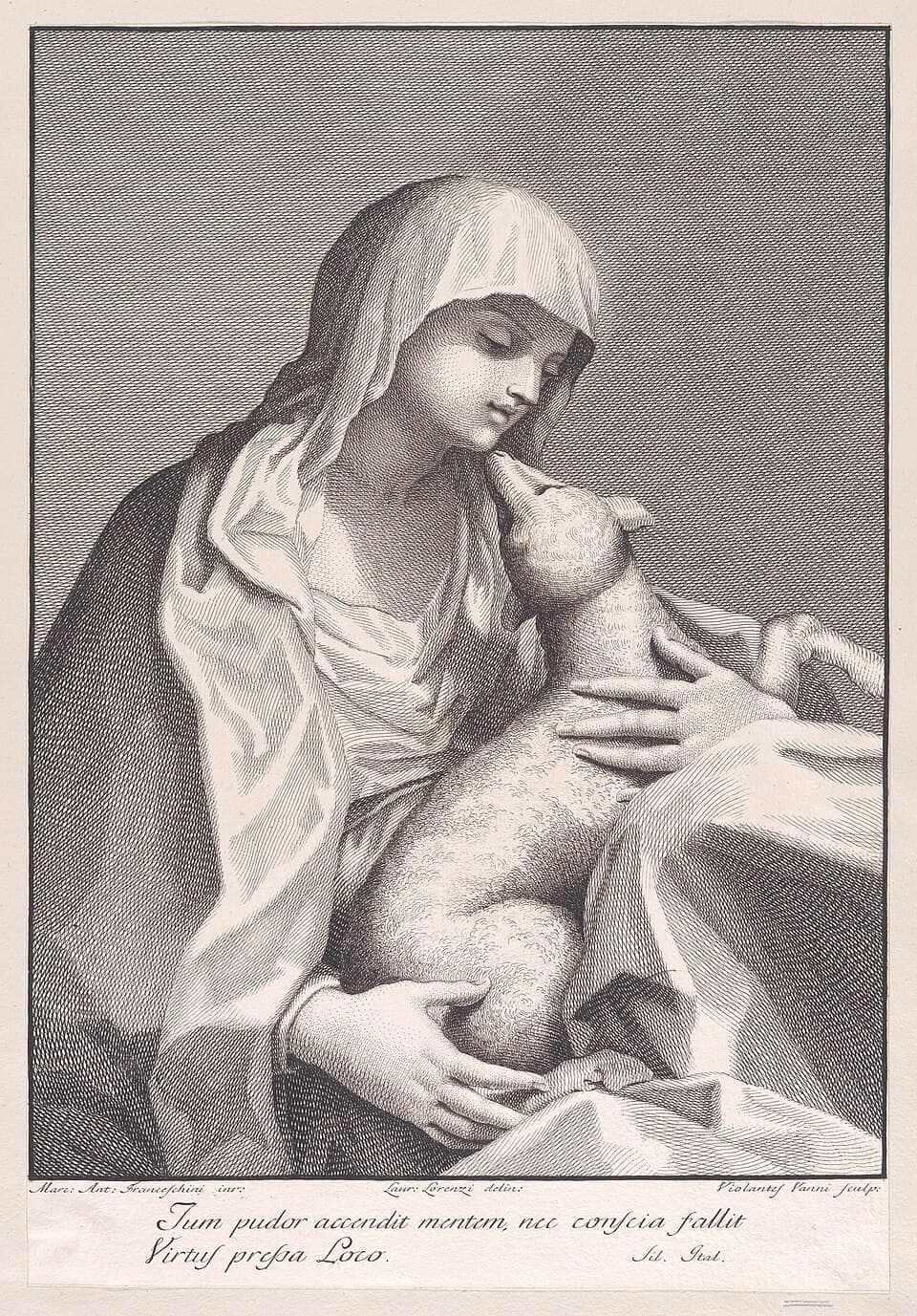
- Patron saint of
- Girls and Girl Scouts, per Franciscan Media 3
- Died
- At Rome. Kirsch: formerly placed about 304, now argued to fall in the third century; Franciscan Media gives c. 258 13
- Buried
- On the Via Nomentana, where a catacomb and then a basilica grew up around her tomb 1
- Earliest witnesses
- Ambrose, Pope Damasus and the poet Prudentius, all of the late fourth century 1
- The Acts
- Later, from the first half of the fifth century, in one Latin and two Greek versions 1
- Emblem
- A lamb, "the symbol of her virginal innocence," since the Middle Ages 1
Saint Agnes was a Roman girl of twelve or thirteen who was put to death for being a Christian, and the Church has kept her feast on January 21 since at least the year 354. 13 That she was a child is the one detail on which every early account agrees. 1 How she died, and in which persecution, the oldest witnesses already told differently by the end of the fourth century, and the story most people know comes from Acts written after that. 1
What the oldest witnesses say
Kirsch opens his encyclopedia article with a superlative: "Of all the virgin martyrs of Rome none was held in such high honour by the primitive church, since the fourth century, as St. Agnes." 1 Three writers stand behind that reputation, and he names them as the oldest witnesses to her martyrdom: Ambrose of Milan, Pope Damasus, and the poet Prudentius. 1
Ambrose wrote about her in the opening book of his treatise on virginity, addressed to his sister Marcellina, and he wrote it on her feast. "It is the birthday of St. Agnes," he begins, meaning the anniversary of her martyrdom, "let men admire, let children take courage, let the married be astounded, let the unmarried take an example." 2 He is careful about what he knows. "She is said to have suffered martyrdom when twelve years old," he writes, and the Latin Kirsch quotes has traditur, it is handed down. 12 Beyond her age Ambrose's rhetorical account gives, in Kirsch's summary, "nothing except her execution by the sword." 1
Damasus tells it another way, in a metrical panegyric engraved on marble at her grave. In his lines, Agnes declared herself a Christian as soon as the imperial edict against Christians was published, and suffered martyrdom by fire with great steadfastness, concerned less with the pain than with covering her body with her loose hair from the eyes of the crowd. 1 Damasus also pictures her running to her death from the lap of her mother or her nurse. 1 When Kirsch wrote in 1907, the original marble of that inscription could still be seen at the foot of the stairs down to her tomb. 1
Prudentius follows Ambrose more closely, but he adds an episode. The judge threatened to hand her over to a brothel and carried out the threat; a young man who looked at her with lust fell to the ground blind and lay as though dead. 1 Kirsch is unusually open to this one. Ambrose speaks of a "double martyrdom," of modesty and of religion, and Kirsch thinks he and Damasus may be pointing to the same danger, so that Prudentius "may have drawn at least the substance of this episode from a trustworthy popular legend." 12
What cannot be known
Put those three side by side and the difficulty is plain. Kirsch draws the conclusion himself: "It is clear, however, from the diversity in the earliest accounts that there was extant at the end of the fourth century no accurate and reliable narrative, at least in writing, concerning the details of her martyrdom." 1 Franciscan Media puts it more briefly. "Almost nothing is known of this saint except that she was very young," it says, and it lists the possible modes of death as beheading, burning and strangling. 3
The Acts of her martyrdom came later, in the first half of the fifth century, and survive in a Latin text and two Greek ones. 1 They elaborate the brothel episode further and settle the question of fire or sword by having the flames leave her untouched before she is beheaded. 1 Franciscan Media's version, introduced with "Legend has it," has her refuse a crowd of suitors, one of whom reported her to the authorities; in its telling the man who looked at her lustfully had his sight restored by her prayer. 3
Even the date is in question. Kirsch records that her death used to be assigned to the persecution of Diocletian, around 304, but that arguments drawn from the Damasus inscription now place it in one of the third-century persecutions after that of Decius. 1 Franciscan Media gives her death as about 258. 3
The one point nobody disputes is her youth. Ambrose says twelve; Augustine, in a sermon, says thirteen. 1 Kirsch, who doubts a great deal elsewhere, is plain about this: "We have no reason whatever for doubting this tradition. It indeed explains very well the renown of the youthful martyr." 1
The grave on the Via Nomentana
Her body was laid in a tomb of its own on the Via Nomentana, outside the walls of Rome, and a larger catacomb grew up around it and took her name. 1 The slab that originally covered her, inscribed Agne sanctissima, is probably the one now in the museum at Naples. 1 Constantina, a daughter of Constantine, built a basilica over the grave, and Franciscan Media records the same. 13 Pope Honorius rebuilt it entirely in the seventh century, and Kirsch says it has remained unaltered since. 1
The mosaic in the apse of that church shows the martyr amid flames, with a sword at her feet. 1 Whoever designed it did what Kirsch does, and kept both accounts.
The lambs of Saint Agnes
Since the Middle Ages she has been painted with a lamb, which Kirsch calls "the symbol of her virginal innocence." 1 The lamb is also the center of the ceremony most connected with her today. On her feast two lambs are blessed, and from their wool are made the pallia that the pope gives to metropolitan archbishops. 15
The custom is still kept. On January 21, 2026, the Holy See Press Office recorded that two lambs had been presented to the Pope in the Chapel of Urban VIII that morning, to be blessed on her memorial in her basilica on the Via Nomentana. 5 The pallium is a narrow band of white wool marked with six black silk crosses, and the archbishops receive theirs from the Pope on June 29, the solemnity of Saints Peter and Paul. 5
Benedict XVI explained what the wool is meant to say when he gave the pallium in 2011. It is woven "from the wool of lambs blessed on the feast of Saint Agnes," he said, and "thus it reminds us of the Shepherd who himself became a lamb, out of love for us." 6
What is Saint Agnes the patron saint of?
Franciscan Media lists Saint Agnes as patron saint of girls and of Girl Scouts. 3 It is a small patronage for a martyr this old and it follows from the one thing about her that is certain, which is that she was a girl when she died. 13 Neither source names any other patronage for her, and this page does not add one.
Saint Agnes's feast day
The feast of Saint Agnes is January 21. 14 The date is very old. The Depositio Martyrum, the Roman list of martyrs' feasts preserved in the collection of Furius Dionysius Philocalus and dated 354, assigns her to that day and adds that her grave lay near the Via Nomentana. 1 The earliest sacramentaries give the same date, and Kirsch notes that the Latin Church still kept it in his day. 1 Vatican News lists her on January 21 as Saint Agnes, Virgin and Martyr, and the Holy See Press Office called the day her liturgical memorial in 2026. 45
Praying with Saint Agnes
This is the story of a child who was killed. Ambrose, who praised her at length, did not soften that. "The more hateful was the cruelty, which spared not so tender an age," he wrote, and then asked, "Was there room for a wound in that small body?" 2 He was preaching to admire her courage, and he still counted what it cost.
Ambrose also describes the crowd at her death: "All wept, she alone was without a tear." 2 He may have known this from tradition or composed it as a preacher; there is no way now to tell, and Kirsch is clear that the details were uncertain by Ambrose's own time. 1 What the line does capture is that the people around her saw a girl too young to be there, and wept, and could not stop it.
Franciscan Media draws one lesson from her, that holiness "does not depend on length of years, experience, or human effort." 3 That is true, and it is still possible to hold it alongside grief. Rome went on remembering her every January, from the calendar of 354 to the lambs blessed in her basilica this year, without ever making her death into something less than it was. 15
Franciscan Media names her the patron of girls, and so a parent may come to her on behalf of a daughter. 3 Her story does not promise that daughter safety, and it would be dishonest to read it that way. What it holds is a girl of twelve or thirteen whom the Church has never let go of, and a name that has been said over the young for sixteen centuries.
Saint Agnes, pray for us.
Sources
- 1.Johann Peter Kirsch, "St. Agnes of Rome," The Catholic Encyclopedia, Vol. 1 (New York: Robert Appleton Company, 1907).
- 2.Ambrose of Milan, Concerning Virgins, Book I, trans. H. de Romestin, E. de Romestin and H.T.F. Duckworth, Nicene and Post-Nicene Fathers, Second Series, Vol. 10 (Buffalo, NY: Christian Literature Publishing Co., 1896).
- 3."Saint Agnes," Saint of the Day, Franciscan Media.
- 4."St. Agnes, Virgin and Martyr," Saint of the Day, 21 January, Vatican News.
- 5."Presentation of the lambs on the memorial of Saint Agnes, Virgin and Martyr," Holy See Press Office, Daily Bulletin, January 21, 2026.
- 6.Benedict XVI, Homily on the Solemnity of the Holy Apostles Peter and Paul, Holy Mass and Imposition of the Pallium on Metropolitan Archbishops, June 29, 2011.
Saints to turn to next
Others in this collection who are turned to for some of the same things.