Saint Apollonia
Died c. 249
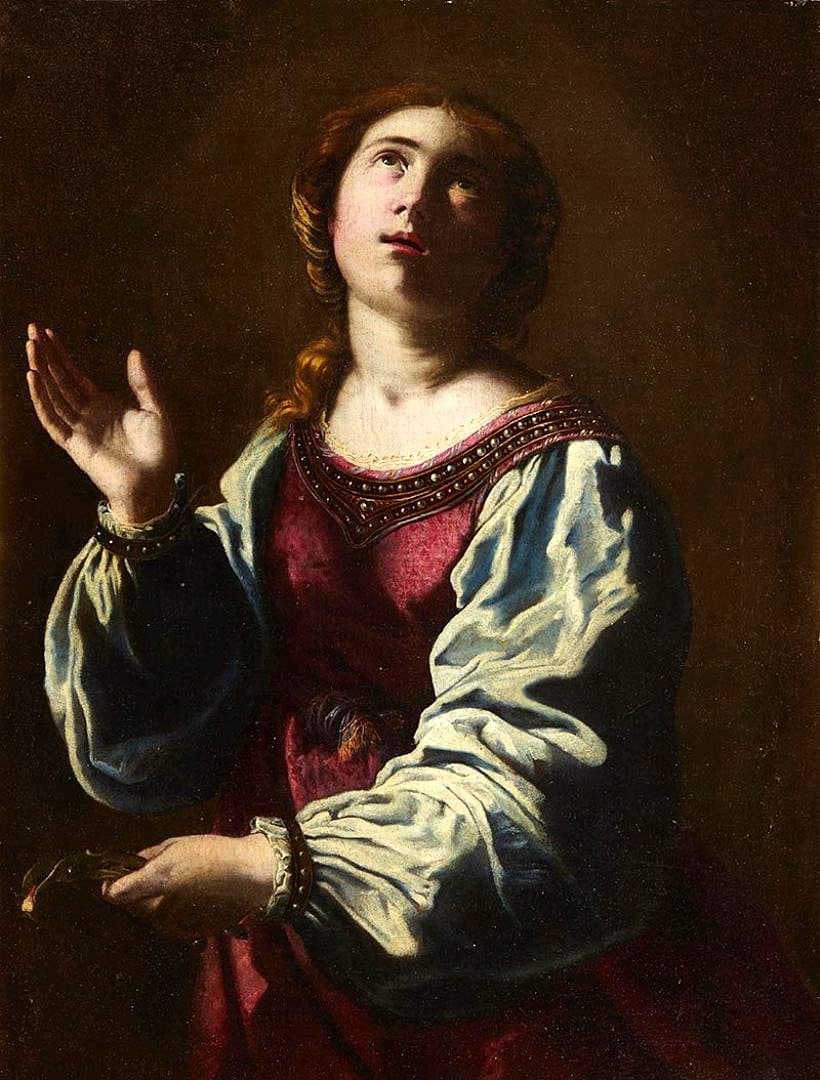
- Patron saint of
- Dentists, and relief from toothache, per Franciscan Media 2
- Feast day
- February 9, which Kirsch gives as the Roman Church's date; Franciscan Media presents her on February 12 12
- Died
- Alexandria, at the end of 248 or the beginning of 249, before the persecution of Decius 1
- What Dionysius calls her
- Parthenos presbytis - which Kirsch reads as deaconess rather than simply an aged virgin 1
- In art
- Shown with pincers holding a tooth 1
Saint Apollonia had her teeth broken out by a mob at Alexandria, was given the choice of blaspheming or burning, asked for a moment to think - and jumped into the fire. 12 Her story is unusually well sourced for a third-century martyr: it comes from a letter by the bishop of her own city, written while it was happening. 1 It also raises a question Augustine declined to answer.
A letter from the bishop who was there
Most early martyrs reach us through Acts written centuries later. Apollonia does not. Dionysius, Bishop of Alexandria from 247, wrote an account of what his people suffered in a letter to Fabius of Antioch, and Eusebius preserved long extracts of it. 1 That is a contemporary source, from the same city, by a man with no reason to invent.
The setting was not an imperial persecution but a riot. Kirsch dates it to the end of 248 or the beginning of 249, before Decius, during the festivities for the first thousand years of the Roman Empire, when "the agitation of the heathen populace rose to a great height," a poet prophesied disaster, and the mob turned on the Christians "whom the authorities made no effort to protect." 1 Franciscan Media describes the same sequence. 2
Two others died first. Kirsch names them as Metras and Quinta - Franciscan Media gives the man as Metrius - an old man tortured and stoned, and a woman scourged and stoned after refusing to worship the idols. 12 Houses were pillaged. Most Christians fled the city, abandoning what they owned. 12
Then, in Dionysius's words as Kirsch gives them, "At that time Apollonia the parthenos presbytis was held in high esteem." 1 Kirsch pauses on the phrase, because it decides who she was: he reads it as meaning "not a virgin advanced in years, but a deaconess." 1 Franciscan Media calls her "an old deaconess." 2
The moment she asked for
The mob seized her and, in the account Dionysius gives, "by repeated blows broke all her teeth." 1 They then built a pile of faggots outside the city gates and threatened to burn her alive unless she repeated impious words after them - either a blasphemy against Christ or an invocation of their gods. 1
She asked them to wait a moment. Franciscan Media describes her "acting as if she was considering their requests." 2 Then she jumped into the fire. 12
That is the whole of what the contemporary evidence says, and it is more than most third-century martyrs leave behind.
The question Augustine would not settle
Kirsch does not walk past the obvious difficulty. He places Apollonia among "that class of early Christian martyrs who did not await the death they were threatened with, but either to preserve their chastity, or because confronted with the alternative of renouncing their faith or suffering death, voluntarily embraced the latter in the form prepared for them." 1 And he notes that "in the honour paid to her martyrs the Church made no distinction between these women and others." 1
Then he hands the question to Augustine, who takes it up in the first book of the City of God while discussing suicide. Augustine states the problem without flinching: certain holy women in persecution "plunged into the water with the intention of being swept away by the waves and drowned, and thus preserve their threatened chastity. Although they quitted life in this wise, nevertheless they receive high honour as martyrs in the Catholic Church and their feasts are observed with great ceremony." 1
His response is a refusal to decide. "This is a matter on which I dare not pass judgment lightly. For I know not but that the Church was divinely authorized through trustworthy revelations to honour thus the memory of these Christians. It may be that such is the case. May it not be, too, that these acted in such a manner, not through human caprice but on the command of God, not erroneously but through obedience, as we must believe in the case of Samson? When, however, God gives a command and makes it clearly known, who would account obedience thereto a crime or condemn such pious devotion and ready service?" 1
Kirsch adds the observation that probably settles it in practice: "The narrative of Dionysius does not suggest the slightest reproach as to this act of St. Apollonia; in his eyes she was as much a martyr as the others, and as such she was revered in the Alexandrian Church." 1 The bishop who was there, writing at the time, saw nothing to explain away.
Afterward
Her feast spread from Alexandria to the West. 1 Franciscan Media records that "there were many churches and altars dedicated to her." 2 Kirsch notes one at Rome that no longer exists, though the little square where it stood is still called Piazza Sant' Apollonia. 1
A later legend gave a similar martyrdom to an Apollonia said to be a Christian virgin of Rome under Julian the Apostate. Kirsch dismisses it in one line: "There was, however, but one martyr of this name, i.e. the Saint of Alexandria." 1 This page follows him and does not repeat it.
What is Saint Apollonia the patron saint of?
Saint Apollonia is the patron saint of dentists and of relief from toothache. 2 The reason is direct and grim: Kirsch says she "is popularly invoked against the toothache because of the torments she had to endure," and notes that art shows her holding pincers with a tooth in them. 1 Franciscan Media lists dentists and relief from toothache. 2 Unlike many patronages in this library, this one rests on an incident a contemporary bishop actually recorded, not on a later legend. 1
Saint Apollonia's feast day
The feast of Saint Apollonia is February 9. Kirsch states it as a fact about the calendar: "The Roman Church celebrates her memory on 9 February." 1 Franciscan Media heads its page for her February 12, which is the day it presents her on. 2 The two are reported here rather than reconciled, since a reader who meets her on the twelfth elsewhere should be able to see where that comes from. Whichever day is kept, the martyrdom itself is dated to the turn of 248 into 249. 1
Praying with Saint Apollonia
The moment worth sitting with is the pause. She asked them to wait, and they waited, and she used the time to walk into the fire rather than to say the words. 12 Franciscan Media notes that she acted as if she were considering it. Whatever else that is, it is not a woman swept along by a mob or overcome by panic. It was deliberate, and she made it look like hesitation so that it could be.
The Church has never entirely resolved what to do with that, and the honest thing is to say so. Augustine looked straight at the question, raised Samson, allowed that such women might have acted under a command rather than an impulse, and then declined to rule. 1 A reader who finds this troubling is in the company of one of the Church's greatest minds, who also found it troubling.
What settles it for most people is Dionysius. He was her bishop, he was in the city while it happened, he wrote it down within living memory, and he shows no discomfort at all. 1 She was a martyr to him exactly as the others were. That judgment is older than the debate about it.
The patronage is almost absurdly small next to the death - teeth, dentists, the ache that keeps somebody awake. 2 But it is the kind of thing people actually suffer, and there is something fitting in a woman who lost her teeth to a mob being the one they ask. The great martyrdoms do not always yield great patronages, and this library has found that the mismatch is usually a sign the devotion grew from below rather than being assigned from above.
Saint Apollonia, pray for us.
Sources
Saints to turn to next
Others in this collection who are turned to for some of the same things.