Saint Jane Frances de Chantal
January 28, 1572 - December 13, 1641
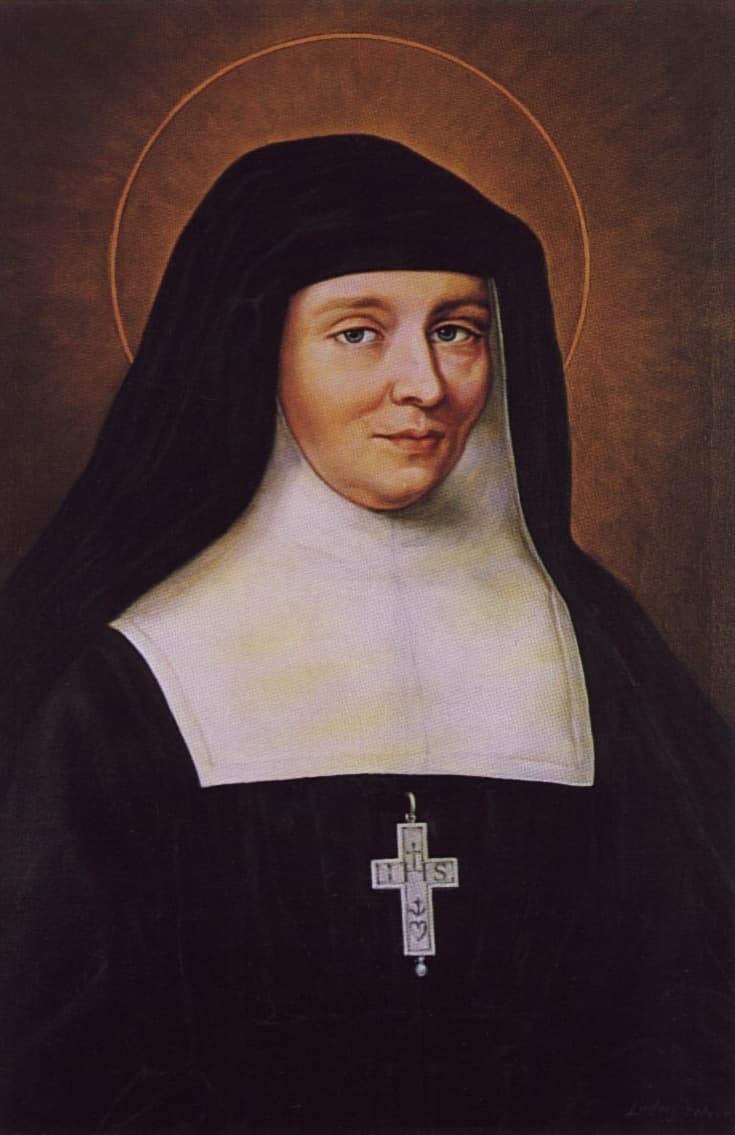
- Feast day
- August 12. The 1910 encyclopedia gives August 21, the date appointed at her canonization 1
- Widowed
- At twenty-eight, when her husband was accidentally shot while out shooting 1
- Founded
- The Visitation, with Francis de Sales. Thirteen houses by 1622, eighty-six when she died 1
- Destroyed
- Most of Francis de Sales's letters to her, after his death 1
- Endured
- Interior darkness for the last nine years of her life, lifting three months before she died 1
Saint Jane Frances de Chantal was widowed at twenty-eight when her husband was shot by accident, and spent seven years afterward in the household of a father-in-law who would have disinherited her children if she had refused to come. 12 She founded an order with Francis de Sales for women no other community would take - too old, too sick, too worn out. 2 Her son lay across the doorway to stop her going, and she stepped over him. 1 The last nine years of her life were spent in spiritual darkness that lifted three months before she died. 1
Bourbilly
Her mother died when she was eighteen months old and her father raised her - "head of parliament at Dijon", Franciscan Media says, and Pernin adds that he led the royalist party during the League. 12 She grew into "a woman of beauty and refinement, lively and cheerful in temperament." 2
She married the Baron de Chantal in 1592 and took over a household "which was on the brink of ruin", restored order and "brought back prosperity." 1 Franciscan Media notes what she added at the castle: she "restored the custom of daily Mass, and was seriously engaged in various charitable works." 2
The line Pernin preserves from those years is the best thing in the article. Reproached, while her husband was away at court or with the army, for dressing too plainly, she answered: "The eyes which I must please are a hundred miles from here." 1
Francis de Sales later summed her up in a sentence Pernin quotes: "In Madame de Chantal I have found the perfect woman, whom Solomon had difficulty in finding in Jerusalem." 1
Widowed, and then the seven years
The baron "was accidentally killed by a harquebus while out shooting in 1601." 1 Franciscan Media says she "sank into deep dejection for four months" at her family home. 2 Pernin: "Left a widow at twenty-eight, with four children, the broken-hearted baroness took a vow of chastity." 1 The two sources count her children differently - Franciscan Media says six were born and three died in infancy; Pernin says four survived her husband. 12
Then came the part that was not grief but coercion. Franciscan Media states the threat plainly: "Her father-in-law threatened to disinherit her children if she did not return to his home. He was then 75, vain, fierce, and extravagant." 2 Pernin puts it as a legal necessity - "In order to safeguard her children's property, she was obliged to go and live at Monthelon in the home of her father-in-law, who was ruled over by an arrogant and wicked servant." 1
She stayed seven years. "This was real servitude, which she bore patiently and gently for seven years. At last her virtue triumphed over the ill will of the old man and house keeper." 1 Franciscan Media's version is drier and says the same thing: she "managed to remain cheerful in spite of him and his insolent housekeeper." 2
The director she had already seen
Pernin records that in her prayers after the bereavement "she besought God to send her a guide and God, in a vision, showed her the spiritual director He held in reserve for her." 1 During Lent 1604, visiting her father at Dijon, she heard Francis de Sales preaching at the Sainte Chapelle: "She recognized in him the mysterious director who had been shown her, and placed herself under his guidance." 1
Franciscan Media notes what he actually did first, which was to slow her down. He was "softening some of the severities imposed by her former director", and when she wanted to become a nun immediately "he persuaded her to defer this decision." 2 She took a vow instead to remain unmarried and to obey him. 2
What followed was a correspondence between two saints, and most of it does not exist. "Unfortunately, the greater number of letters are no longer in existence, as she destroyed them after the death of the holy bishop." 1 She burned them herself.
Stepping over her son
Before she could leave she settled her children. She provided for her fourteen-year-old son Celse-Bénigne's education and left him with her father and her brother, the Archbishop of Bourges, and took her two remaining daughters with her. 1
He did not accept it. "Celse-Bénigne, impetuous like those of her race, barred his mother's way by lying across the threshold." 1
Pernin gives the exchange exactly. "Mme de Chantal stopped, overcome: 'Can the tears of a child shake her resolution?' said a holy and learned priest, the tutor of Celse-Bénigne. 'Oh! no', replied the saint, 'but after all I am a mother!' And she stepped over the child's body." 1
The article moves straight on to the founding of the order. This page does not, because the sentence deserves to be sat with. She did not deny that it was terrible. She said she was a mother, and went.
An order for the women nobody would take
The point of the Visitation was who it would admit. Pernin: "Its aim was to receive, with a view to their spiritual advancement, young girls and even widows who had not the desire or strength to subject themselves to the austere ascetical practices in force in all the religious orders at that time." 1 Franciscan Media is more specific about the exclusions it was answering: it was to be "a haven for those whose health, age, or other considerations barred them from entering the already established communities." 2
The original design was not cloistered. "There would be no cloister, and they would be free to undertake spiritual and corporal works of mercy." 2 The name came from the virtues of Mary at the Visitation - humility and meekness. 2
That plan did not survive. "The usual opposition to women in active ministry arose and Francis de Sales was obliged to make it a cloistered community following the Rule of Saint Augustine." 2 Pernin does not mention this at all; his account goes straight from the aim to the canonical establishment at Annecy on Trinity Sunday, June 6, 1610. 1 Franciscan Media dates the beginning later, saying the congregation of three women began when she was forty-five - which would be 1617, seven years after the date Pernin gives. 12 Both stand here.
Francis de Sales wrote his "Treatise on the Love of God" for them. 2 The growth is easy to state: thirteen houses when he died in 1622, eighty-six when she died, one hundred and sixty-four by her canonization. 1
Pernin's comparison of the two founders is worth keeping, because it does not make her the junior partner. "If a gentle kindness, vivified and strengthened by a complete spirit of renunciation, predominates in St. Francis de Sales, it is firmness and great vigour which prevails in St. Jane Frances; she did not like to see her daughters giving way to human weakness." 1
The losses, and the darkness
Franciscan Media lists them without pause, which is the right way to read them: "Francis de Sales died; her son was killed; a plague ravaged France; her daughter-in-law and son-in-law died." 2
Pernin supplies the son's story. Celse-Bénigne - the boy from the threshold - "was an incorrigible duellist. She prayed so fervently that he was given the grace to die a Christian death on the battle-field", in the campaign against the Isle of Ré in 1627. 1 He left a daughter who became the Marquise de Sévigné. 1
In the plague she did not withdraw. "She encouraged the local authorities to make great efforts for the victims of the plague, and she put all her convent's resources at the disposal of the sick." 2
And underneath it, for years, there was nothing. Franciscan Media: "During a part of her religious life, Jane Frances de Chantal had to undergo great trials of the spirit - interior anguish, darkness, and spiritual dryness." 2 Pernin is more exact about the duration: "To family troubles God added interior crosses which, particularly during the last nine years of her life, kept her in agony of soul from which she was not freed until three months before her death." 1
Nine years, and it lifted with three months to go. Meanwhile "queens, princes, and princesses flocked to the reception-room of the Visitation", and wherever she traveled to make a foundation the crowds gave her ovations. Her comment on that, confused, was: "These people do not know me; they are mistaken." 1
She died on December 13, 1641, at Moulins, while traveling on a visitation of the order's convents. 12
What is Saint Jane Frances de Chantal the patron saint of?
Neither source cited here gives her a patronage. 12 Pernin closes on her writings and Franciscan Media on her death; neither names a cause she is invoked for, and this page does not supply one.
What she is for is not really in doubt: widowhood, being obliged to live somewhere you are not wanted, and the stretches of religious life in which nothing is felt at all.
Saint Jane Frances de Chantal's feast day
The feast of Saint Jane Frances de Chantal is August 12.
The 1910 encyclopedia gives a different date and explains where it came from: "She was beatified in 1751, canonized in 1767, and 21 August was appointed as her feast day." 1 That was correct when it was printed. The modern calendar keeps August 12.
Neither date is the day she died, which was December 13. 1 Neither source explains the choice, and this page does not guess at one.
Praying with Saint Jane Frances
She is the saint for obligations that hold you somewhere you did not choose. Seven years in the house of a vain, fierce old man and an insolent housekeeper, because leaving would have cost her children their inheritance. 12 Pernin calls it "real servitude" and does not pretend she enjoyed it; what he records is that she bore it "patiently and gently", and that after seven years the old man and the housekeeper gave in.
The threshold is the hardest thing in this library. There is no reading of it that makes it comfortable. She did not argue that her son was wrong to lie there, or that she did not mind; she said "after all I am a mother", and stepped over him anyway. 1 Anyone who has had to do a thing that was right and also cruel will recognize the sentence, and the fact that she said it out loud.
And then the nine years of darkness. 1 It came at the end, after the order was founded and successful, after Francis de Sales was dead and her son was dead and the plague had come and gone - not as a trial on the way to holiness but as the condition of most of her last decade. People came in crowds to see her while it was going on, and she said they were mistaken about her. 1 It lifted three months before she died.
She is a useful saint precisely because the consolation is so late and so short. If the interior life is dry and has been for years, she is not an argument that it will improve soon. She is the record of somebody who kept founding convents in the meantime.
Saint Jane Frances de Chantal, pray for us.
Sources
Saints to turn to next
Others in this collection who are turned to for some of the same things.
- Saint Bridget of Swedenc. 1303 - July 23, 1373Marriage and familySuffering and illness
- Saint Catherine of Genoa1447 - September 15, 1510Anxiety and mental healthSuffering and illness
- Saint DymphnaTraditionally seventh centuryAnxiety and mental healthSuffering and illness
- Saint Elizabeth of Portugal1271 - July 4, 1336Marriage and familySuffering and illness