Saint John Francis Regis
January 31, 1597 - December 1640
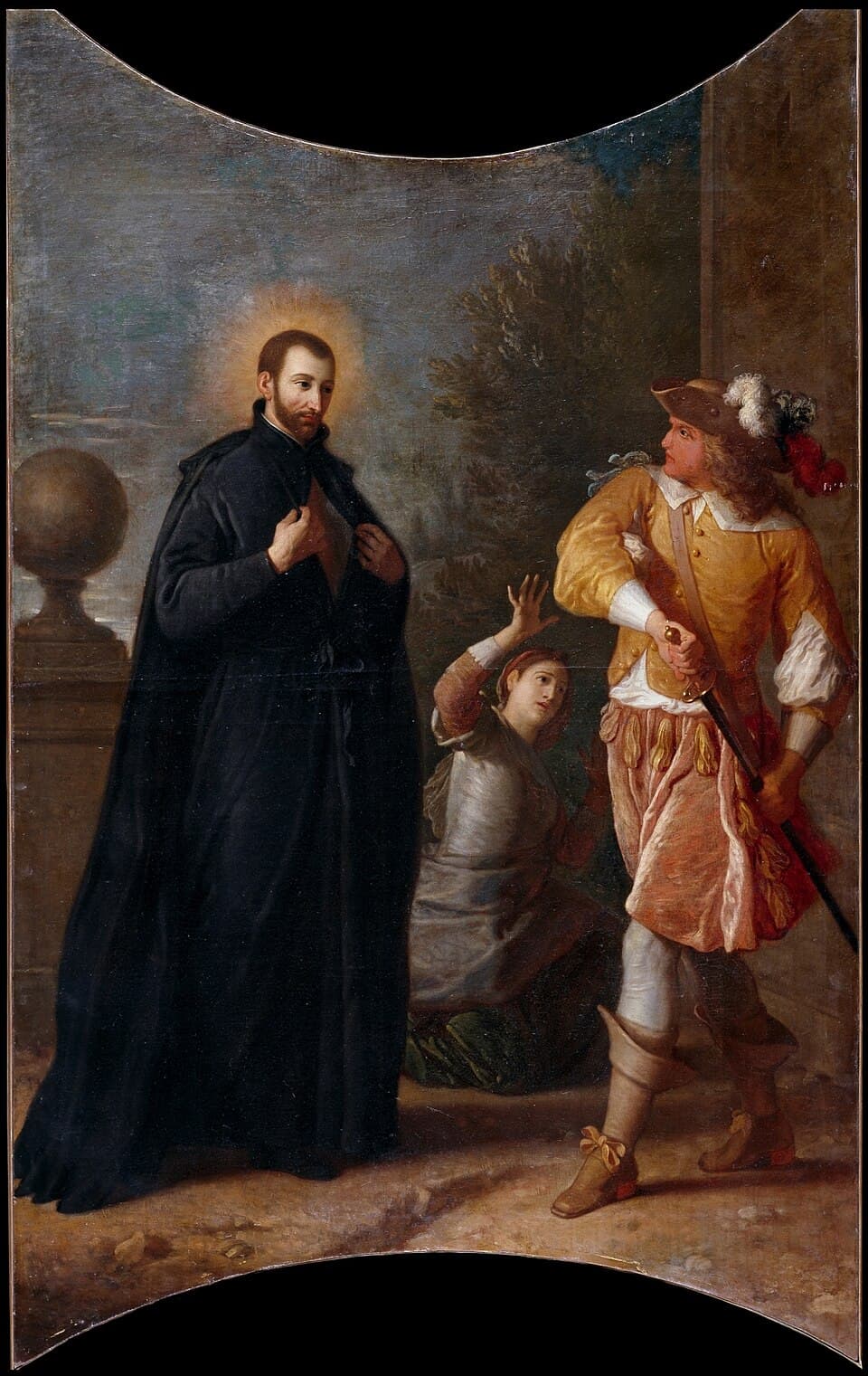
- Patron saint of
- Neither source assigns a patronage. He is invoked by social workers and by women leaving prostitution 12
- Feast day
- June 16 2
- Born
- 31 January 1597 at Fontcouverte in Languedoc, son of a rich merchant 1
- Died
- At la Louvesc in the mountains of the Ardeche. Van Ortroy gives 30 December 1640; Franciscan Media gives December 31 12
- Asked for instead
- Six months a year on the missions - and chose the winter months, in the mountains 1
- Canonized
- In 1737, nearly a century after his death 2
Saint John Francis Regis wanted to be sent to Canada and was told no. 12 So he asked to spend six months of every year on mission in the mountains of the Ardeche, and asked for the winter months. 1 He spent the other half of the year in the cities getting women out of prostitution, which is how he came to have pistols pointed at him by men who did not want them to leave. 1
A boy who could not bear to be told off
He was born on 31 January 1597 at Fontcouverte in Languedoc. His father Jean was a rich merchant, recently ennobled for his part in the Wars of the League; his mother came of the landed nobility. 1
Van Ortroy records something about the child that most hagiography would leave out because it is not flattering: his "sole fear was lest he should displease his parents or his tutors. The slightest harsh word rendered him inconsolable, and quite paralyzed his youthful faculties." 1 A boy so sensitive to disapproval that a sharp word could stop him working. Keep it in mind; it comes back at the end of his life.
At fourteen he was sent to the Jesuit college at Beziers, where his "good humour, frankness, and eagerness to oblige everybody soon won for him the good-will of his comrades." 1 Franciscan Media says he "was so impressed by his Jesuit educators that he himself wished to enter the Society of Jesus." 2 He entered the novitiate at Toulouse on 8 December 1616, aged nineteen.
He then spent twelve years in the ordinary machinery of the order - rhetoric at Cahors, philosophy at Tournon, six years teaching grammar at three different colleges. 1 And during all of it, on feast days, "he loved to visit the towns and villages of the neighbourhood, and there give an informal instruction." 1 He was practicing.
He found theology so slow that he asked his superiors to shorten it, and they agreed - at a price. Because he had not done the full course, "in conformity with the statutes of his order", he was never admitted to the solemn profession of four vows. 1 He said his first Mass on Trinity Sunday 1631 and remained, formally, a Jesuit of lesser rank for the rest of his life.
As fresh as a rose
Plague was raging in Toulouse when he was ordained, and "the new priest hastened to lavish on the unfortunate victims the first-fruits of his apostolate." 1 From 1632 his superiors put him to the missions, and that was the work of his last ten years. 1
Franciscan Media describes his preaching by contrast with the fashion: "While the formal sermons of the day tended toward the poetic, his discourses were plain. But they revealed the fervor within him and attracted people of all classes." 2 Mornings in the confessional or at the altar; "afternoons were reserved for visits to prisons and hospitals." 2
Van Ortroy preserves one exchange that gives the man entire. Coming home one evening after a hard day, a fellow Jesuit asked him, laughing, "Well, Father Regis, speaking candidly, are you not very tired?" He answered: "No, I am as fresh as a rose." 1
And then what he did next: "He then took only a bowl of milk and a little fruit, which usually constituted both his dinner and supper, and finally, after long hours of prayer, lay down on the floor of his room, the only bed he knew." 1
The winter half of the year
The Bishop of Viviers, seeing what he could do, put him to work across a diocese in ruins. Franciscan Media describes the state of it: with "many prelates absent and priests negligent, the people had been deprived of the sacraments for 20 years or more." 2 For three years Regis went ahead of the bishop, preaching missions in advance of his visits. 2
What he actually wanted was Canada, "which at that time was one of the missions of the Society of Jesus where one ran the greatest risks." 1 He was refused. 12
So he negotiated. He "finally sought and obtained from the general permission to spend six months of the year, and those the terrible months of winter, on the missions of the society." 1 Franciscan Media: "he was to live out his days working for the Lord in the wildest and most desolate part of his native France. There he encountered rigorous winters, snowdrifts and other deprivations." 2 Denied the dangerous mission he wanted, he picked the hardest half of the one he was given.
His reputation reached ahead of him. Franciscan Media tells of a man arriving at Saint-Andeol who found a crowd outside a church and was told they were waiting for "the saint" who was coming to preach. 2
The other half, and the pistols
The rest of each year went to what Van Ortroy calls "the most thankless labour in the cities, especially to the rescue of public women, whom he helped to persevere after their conversion by opening refuges for them, where they found honest means of livelihood." 1
Note the second half of that sentence. He did not merely persuade women to leave prostitution; he opened houses where they could earn a living, because otherwise there was nowhere for them to go. "This most delicate of tasks absorbed a great part of his time and caused him many annoyances." 1
It also made enemies of the men who profited. "Dissolute men often presented a pistol at him or held a dagger to his throat. He did not even change colour, and the brightness of his countenance, his fearlessness, and the power of his words caused them to drop the weapons from their hands." 1
There was opposition from inside the Church as well. Some priests, "who felt their own manner of life rebuked, determined to ruin him, and therefore denounced him to the Bishop of Viviers." The plot was cunning enough that the bishop believed it for a while - "But it was only a passing cloud." 1
And there was the opposition that actually hurt. Van Ortroy is unusually frank: "He was more sensitive to that opposition which occasionally proceeded from those who should have seconded his courage. His superiors, as his first biographers candidly state, did not always share his optimism, or rather his unshaken faith in Providence, and it sometimes happened that they were alarmed at his charitable projects and manifested to him their disapproval. This was the cross which caused the saint the greatest suffering, but it was sufficient for him that obedience spoke: he silenced all the murmurs of human nature, and abandoned his most cherished designs." 1
A knife at his throat did not change his color. His own superiors telling him his plans were too ambitious was the thing he found hardest to bear - and he obeyed them.
La Louvesc
Franciscan Media: "In the autumn of 1640, Father Regis sensed that his days were coming to a conclusion. He settled some of his affairs and prepared for the end by continuing to do what he did so well: speaking to the people about the God who loved them." 2
He died "in the depth of winter, at la Louvesc, a poor hamlet of the mountains of Ardeche, after having spent with heroic courage the little strength that he had left." 1 He was forty-three.
The two sources give different days. Van Ortroy says 30 December 1640. Franciscan Media says "On December 31, he spent most of the day with his eyes on the crucifix. That evening, he died," and gives his last words: "Into thy hands I commend my spirit." 12
One more thing belongs here because a reader will run into it. Seventy-two years after his death, a French cleric with a grievance against the Jesuits circulated a story that Regis had been expelled from the Society, and that the letter of dismissal arrived a few days too late. Van Ortroy is short with it: "This calumny will not stand the slightest examination", and he names where the refutation can be found. 1 He was canonized in 1737. 2
What is Saint John Francis Regis the patron saint of?
Neither Van Ortroy nor Franciscan Media assigns Saint John Francis Regis a patronage. 12 What he is turned to for follows directly from what he did.
He is invoked by people working with women leaving prostitution, and by those running refuges and halfway houses of any kind - because that is precisely what he built, and because he understood that a conversion without a livelihood behind it does not hold. 1
He is also a patron for missionaries sent somewhere other than where they asked to go. He wanted Canada and got the Ardeche in winter, and he made the second into the equivalent of the first. 12
Saint John Francis Regis's feast day
The feast of Saint John Francis Regis is June 16. 2 It does not fall on the anniversary of his death, which was at the very end of December - a date already crowded by the octave of Christmas.
The day of that death is itself disputed. Van Ortroy gives 30 December 1640 and Franciscan Media describes him dying on the evening of December 31. 12 The difference is one day and neither source acknowledges the other; both are recorded here.
The hamlet where he died, la Louvesc in the Ardeche, is still a place of pilgrimage on his account - which is a considerable afterlife for a village Van Ortroy describes simply as poor and in the mountains. 1
Praying with Saint John Francis Regis
The refusal is the heart of him. He asked for Canada, where Jesuits were being killed, and was told no; he did not sulk and he did not settle. He asked instead for the worst six months of the year in the worst country available to him, and took it for the rest of his life. 12 Wanting a heroic assignment is common. Making the unheroic one into the same thing is not.
The detail about the refuges is the most practical thing on this page. He did not treat a woman's conversion as the end of the work; he treated it as the beginning of a housing and employment problem, and he solved that too. 1 Anyone doing this kind of work now will recognize the sequence and the expense, and will recognize the superiors who thought the projects were too ambitious.
That last point is worth sitting with, because it is the least comfortable. The suffering that Van Ortroy says hurt him most was not the pistols; it was his own order telling him no, repeatedly, about plans he believed in. 1 And he obeyed - he "abandoned his most cherished designs". Not because he agreed, but because obedience had spoken. A reader is entitled to find that hard. The sensitive boy who could be stopped by a harsh word grew into a man who could face a drawn dagger and still be undone by a disapproving letter from Rome, and who kept going regardless.
"I am as fresh as a rose", said at the end of an exhausting day, before a bowl of milk and a night on the floor. 1 It is a joke, and it is also the whole of his spirituality: cheerfulness maintained deliberately, in conditions that did not warrant it, because the people he was going to meet the next morning deserved a cheerful man.
Saint John Francis Regis, pray for us.
Sources
Saints to turn to next
Others in this collection who are turned to for some of the same things.
- Saint CajetanOctober 1480 - August 7, 1547Work and vocationPoverty and simplicityConversion
- Saint Bonifacec. 675 - June 5, 754Work and vocationConversion
- Saint Charles de FoucauldSeptember 15, 1858 - December 1, 1916ConversionPoverty and simplicity
- Saint Francis BorgiaOctober 28, 1510 - September 30, 1572ConversionWork and vocation