Saint Cajetan
October 1480 - August 7, 1547
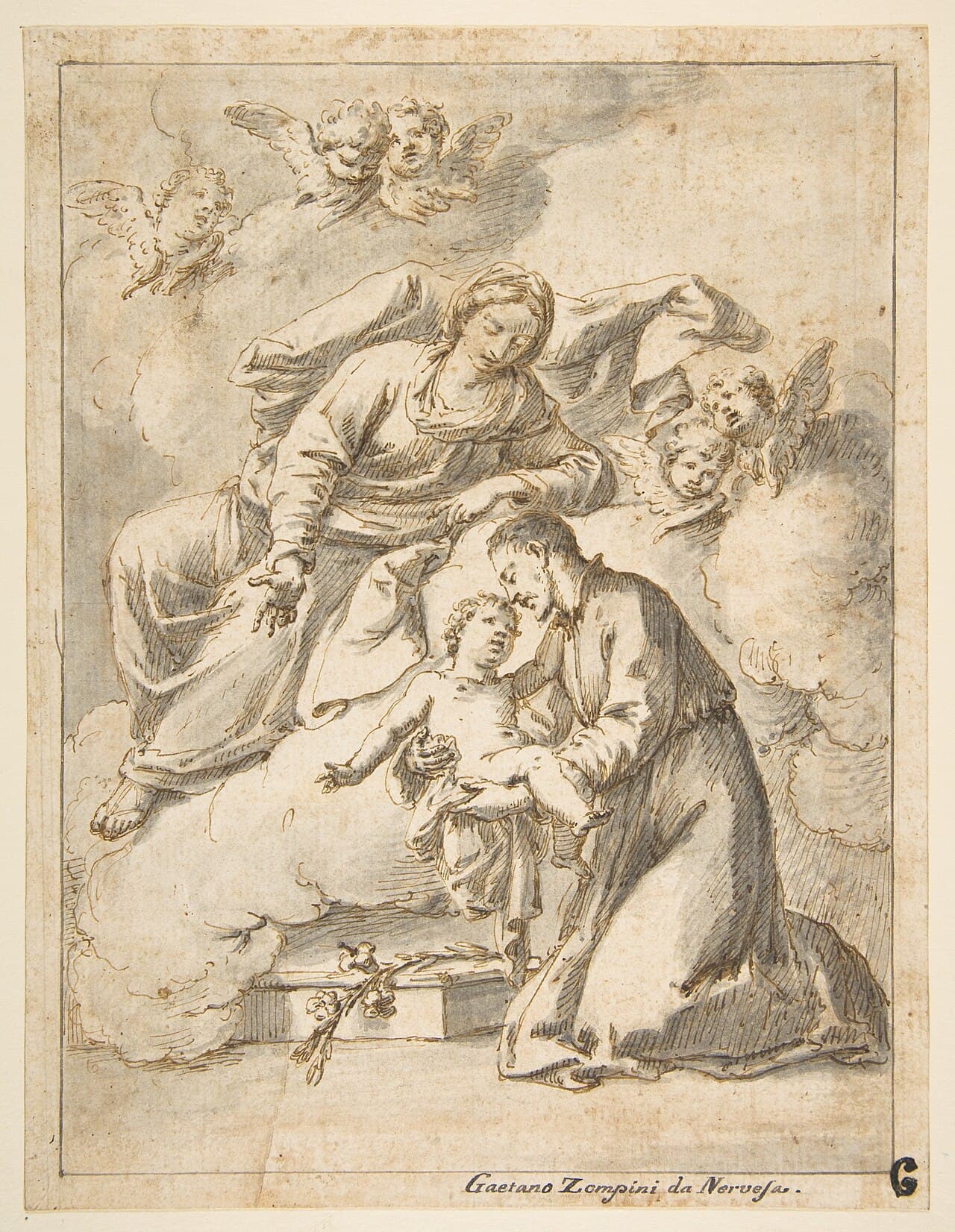
- Patron saint of
- Neither source assigns a patronage. He is invoked by the unemployed and by job seekers 12
- Feast day
- August 7. Keating: "His feast is kept on the 7th of August" 1
- Born
- Vicenza, in Venetian territory, October 1480 1
- And a pawnshop
- A monte di pieta at Naples, lending to the poor. It became the Bank of Naples 2
Saint Cajetan was a lawyer with a career in the papal court who was not ordained until he was thirty-six. 12 He founded a hospital for the incurable, joined a religious community so poor and disreputable that his friends told him he was disgracing his family, and set up a pawnshop in Naples that lent to the poor to keep them away from moneylenders. 2 That pawnshop became the Bank of Naples. 2
A career in the curia
He was born at Vicenza in October 1480 and, "under the care of a pious mother", took his degree as doctor of both civil and canon law at Padua in his twenty-fourth year. 1 Franciscan Media's framing is the useful one: "Like most of us, Saint Cajetan seemed headed for an 'ordinary' life - first as a lawyer, then as a priest engaged in the work of the Roman Curia." 2
In 1506 he went to Rome as a prothonotary apostolic in the court of Julius II, and "took an important share in reconciling the Republic of Venice with that pontiff." 1 A young canon lawyer doing serious diplomatic work.
Keating then records something that reads strangely for a man later canonized: "Though remarkable for his intense love of God, he did not advance to the priesthood till 1516." 1 He had been at the heart of the Church's government for a decade without being a priest. He was thirty-six when he was ordained.
One note on the dates. Keating writes that Cajetan withdrew from the court "on the death of Julius in 1523" - and Julius II died in 1513. Something in that sentence is wrong, and since there is no way to tell which part, this page gives neither year rather than picking one or repeating an impossibility. 1
What his friends thought of him
After ordination he joined the Oratory of Divine Love, "a group devoted to piety and charity", and is credited by Keating with founding it. 12
When his mother died he was recalled to Vicenza, and there he founded a hospital for incurables - Franciscan Media places that hospital at Venice and dates it to his forty-second year, so the sources differ on the city. 12 Either way, what he built was a house for people no one could cure.
And then the episode that says most about him. "At Vicenza, he joined a 'disreputable' religious community that consisted only of men of the lowest stations of life - and was roundly censured by his friends, who thought his action was a reflection on his family. He sought out the sick and poor of the town and served them." 2
A doctor of both laws, formerly of the papal court, joined a confraternity of the lowest sort of men, and the people who cared about him told him he was embarrassing his relatives. The quotation marks around disreputable are Franciscan Media's.
Sick in head and members
What moved him most was not the hospital. Keating: "his zeal was more deeply moved by the spiritual diseases that, in those days of political disorder, infected the clergy of all ranks." 1 Franciscan Media puts the diagnosis in the language of the time: the greatest need "was the reformation of a Church that was 'sick in head and members.'" 2
His answer was structural, and Keating names the precedent: "like St. Augustine in earlier times, he strove to reform them by instituting a body of regular clergy, who should combine the spirit of monasticism with the exercises of the active ministry." 1 Not monks withdrawn from the world and not secular priests without a rule - both at once.
He returned to Rome in 1523 and the congregation was canonically erected by Clement VII in 1524. 1 There were five of them. "One of his four companions was Giovanni Pietro Caraffa, Bishop of Chieti (in Latin Theate), afterwards Paul IV, who was elected first superior, and from whose title arose the name Theatines." 1 The order is named after a bishopric held by a man who later became one of the severest popes of the century.
"The order grew but slowly." 1 Then, in 1527, the troops of Charles V sacked Rome. "During the sack of Rome in 1527 the Theatines, then twelve in number, escaped to Venice after enduring many outrages from the heretic invaders." 1 Twelve men, three years in, their house wrecked. 2
Franciscan Media places them historically: "The Theatines were outstanding among the Catholic reform movements that took shape before the Protestant Reformation." 2 Before. They were not a reaction to Luther; they were already under way.
The fund of piety
At Venice he met Jerome Emiliani and "assisted him in the establishment of his Congregation of Clerks Regular" - the order that became the Somaschi, founded for orphans. 1 Two founders of two orders, both displaced, helping each other set up.
In 1533 he founded a house at Naples, "where he was able to check the advances of Lutheranism." 1 And there he did the thing he is least remembered for and which outlasted everything else.
He founded a monte di pieta - Franciscan Media translates it, "mountain or fund of piety" - "one of many charitable, nonprofit credit organizations that lent money on the security of pawned objects. The purpose was to help the poor and protect them against usurers." 2 A pawnshop run at no profit, so that a poor family with something to pledge did not have to go to a moneylender.
Then the sentence: "Saint Cajetan's little organization ultimately became the Bank of Naples, with great changes in policy." 2
With great changes in policy. Franciscan Media says it drily and means it. A charitable fund set up to keep the poor out of the hands of lenders turned, over centuries, into one of Europe's oldest banks.
The last four years
He was back at Venice in 1540, extending the work to Verona and his native Vicenza, and then returned to Naples. 1
Keating describes the end in a sentence that is almost entirely interpretation, and it is worth quoting because of how far it goes: "He passed the last four years of his life, a sort of seraphic existence, at Naples where he died finally of grief at the discords of the city, suffering in his last moments a kind of mystical crucifixion." 1
Died of grief at the discords of the city. Naples in the 1540s was in turmoil, and his biographer believed it killed him.
He died in 1547. Urban VIII beatified him in 1629 and Clement X canonized him in 1671, a hundred and twenty-four years later. 1
What is Saint Cajetan the patron saint of?
Neither Keating nor Franciscan Media assigns Saint Cajetan a patronage. 12 He is widely invoked by the unemployed and by people looking for work - in Argentina his shrine draws enormous crowds of job seekers on his feast - and this page notes that as devotion rather than as something its sources record.
What the sources do support is narrower and better. He is a patron for anyone trying to build an alternative to a predatory financial arrangement: he did not only denounce usurers, he opened a place the poor could borrow from instead. 2 The same instinct runs through Bernardine of Siena, who preached the Monti di Pieta into existence a century earlier.
He also belongs to people who come to their vocation late. He was ordained at thirty-six after a decade of doing something else well. 12
Saint Cajetan's feast day
The feast of Saint Cajetan is August 7. Keating states it outright - "His feast is kept on the 7th of August" - and Franciscan Media presents him on the same day. 12
His birth is given only as October 1480, without a day; Keating gives the death as 1547 at Naples without a date. 1 Franciscan Media's dates supply 7 August for the death, which is why the feast falls where it does. 2
He is not to be confused with Cardinal Cajetan, the Dominican theologian who examined Luther at Augsburg in 1518 and who was his contemporary. The two are different men who shared a name.
Praying with Saint Cajetan
The censure from his friends is the part to sit with. He joined a community of poor men and the people closest to him told him he was reflecting badly on his family. 2 That is a specific kind of pressure - not persecution, not hostility, but embarrassment on your behalf from people who love you - and it stops more good work than opposition does.
His lateness is a comfort. Ten years in the papal court as a canon lawyer, ordained at thirty-six, the order founded at forty-four, the Naples house at fifty-three, the monte di pieta after that. 12 Nothing he is remembered for happened before middle age.
The pawnshop is the most practical thing in this library. He understood that denouncing usury does nothing for a family that needs money this week, and that the only answer to a bad lender is a better one. 2 So he opened it. Everything about that is unglamorous and it is the reason there was still an institution in Naples four hundred years later - even if, as Franciscan Media notes with admirable restraint, the policies had changed somewhat by then.
And the end is worth not tidying. His biographer says he died of grief at the discords of his city. 1 Whether or not that is medically meaningful, it is what the people who knew him believed: that a man who had spent forty years trying to mend things was finally undone by watching one place tear itself apart.
Saint Cajetan, pray for us.
Sources
Saints to turn to next
Others in this collection who are turned to for some of the same things.
- Saint John Francis RegisJanuary 31, 1597 - December 1640Work and vocationPoverty and simplicityConversion
- Saint Bernardine of SienaSeptember 8, 1380 - May 20, 1444ConversionWork and vocation
- Saint Francis BorgiaOctober 28, 1510 - September 30, 1572ConversionWork and vocation
- Saint Jerome Emiliani1481 or 1486 - February 8, 1537ConversionPoverty and simplicity