Saint Francis of Paola
March 27, 1416 - April 2, 1507
- Patron saint of
- Sailors 3
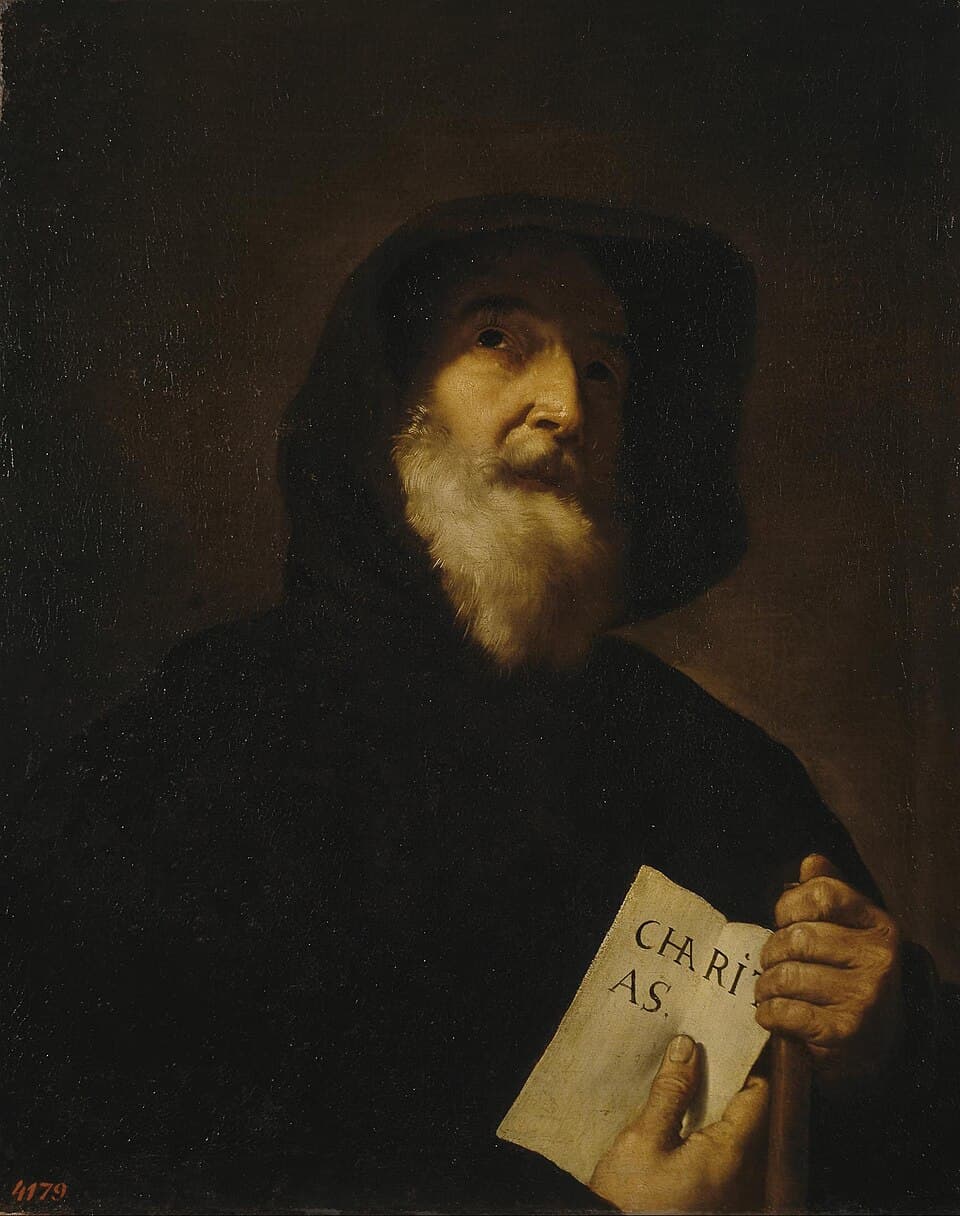
Saint Francis of Paola spent his youth alone in a cave on the coast of Calabria, and ended his life as adviser to three kings of France. 13 He founded the Minims, an order that took its name from the Latin for "the least" and added a fourth vow to the usual three: a Lent that never ends. 134 Franciscan Media lists him as the patron saint of sailors, and his feast is April 2, the day he died in 1507. 13
A vow made over a cradle
He was born at Paola, in Calabria, in 1416; Vatican News and Franciscan Media give the date as March 27. 123 The 1909 Catholic Encyclopedia says his parents were childless for some years after their marriage and prayed especially to Saint Francis of Assisi, and that Francis was the eldest of the three children who followed. 1
While he was still in the cradle, a swelling threatened the sight of one of his eyes. 1 His parents turned to Francis of Assisi again and vowed that, if he recovered, their son would spend a whole year wearing the Franciscan habit in a convent of the order. 12 The encyclopedia records that the child "was immediately cured," and calls the arrangement "a not uncommon practice in the Middle Ages." 1
The encyclopedia puts his entry into the Franciscan convent at thirteen, prompted by a vision of a friar; Vatican News says he was fifteen and names the house as San Marco Argentano, near Cosenza. 12 Afterward he went on pilgrimage with his parents. Vatican News lists Assisi, Monte Cassino, Rome, Loreto and Monte Luco, and reports that the splendor of the papal court in Rome troubled him: "Our Lord was not like that." 2
The cave by the sea
Back at Paola he lived alone, first on a quiet corner of his father's land and then in a cave on the seacoast, where the encyclopedia says he stayed for about six years in prayer and penance. 1 Franciscan Media says his first followers arrived before he was twenty. 3 The encyclopedia dates it to 1435, when two companions joined him and he had three cells and a chapel built for them, "in this way the new order was begun." 1
Vatican News says the community received diocesan approval in 1452 for an oratory, monastery and church; the encyclopedia puts the large monastery at about 1454, built with the permission of Pyrrhus, Archbishop of Cosenza. 12 People came to help, and "even the nobles carried stones and joined in the work," in the encyclopedia's words; Vatican News says the nobility of Paola worked as simple laborers. 12
In 1467, Vatican News says, Pope Paul II sent an envoy to Paola for news of the hermit. The envoy made his report and then joined the community. 2
The least in the household of God
In 1474 Pope Sixtus IV approved the community as the Hermits of Saint Francis of Assisi. 123 The later name is the one that stuck. Francis wanted his brothers to be known as the least of all religious, and the word for that is Minims. 13 The encyclopedia and Vatican News say it was Pope Alexander VI who changed the name when he approved their rule; Franciscan Media says Francis himself made the change, in 1492. 123 The definitive rule was approved by Pope Julius II in 1506, on July 28 according to Vatican News, together with rules for the nuns and the lay third order. 12
Their life was hard by any standard. They lived in great poverty and, on top of the vows of poverty, chastity and obedience, bound themselves to what Franciscan Media calls "a perpetual Lenten fast" and the encyclopedia "perpetual abstinence." 13 The encyclopedia names humility as "the distinguishing mark of the order," and says they were "to seek to live unknown and hidden from the world." 1 Speaking to the Minims' general chapter in 2000, Pope John Paul II said the friars were "still committed to the 'fourth vow of perpetual Lent'" nearly five centuries after their founder's death. 4
Bread at Galatro and a cloak on the water
His reputation grew on reports of miracles. 1 Vatican News tells of a famine year, 1464, when laborers going to look for work met him at Galatro. He asked them for bread; they had none. He told them to look in their saddlebags, where they found fresh bread that "the more they ate, the more it grew." 2
The story he is best known for comes from the same page, which introduces it with the words "according to another story." A boatman refused to take Francis and his companions across to Sicily, so he spread his cloak on the water and they crossed the strait on it. 2 Vatican News does not vouch for it, and neither does this page.
The encyclopedia is on firmer ground with his gift of prophecy. He foretold that the Turks would take Otranto in 1480 and that the King of Naples would win it back, and it credits him with discernment of consciences. 12 He was also, in its phrase, "no respecter of persons." 1 He rebuked the King of Naples and suffered for it; Franciscan Media names the king as Ferdinand and says the admonitions were aimed at his sons as well. 13 Vatican News describes him standing with the poor against the abuses of the Aragonese court. 2
Called to the French court
Louis XI of France, gravely ill, wanted the holy man at his bedside. 12 The encyclopedia says the king sent an embassy to Calabria, Francis refused, and he went only when the pope ordered him to. 1 Vatican News says Louis asked Sixtus IV to send him, that both the pope and the King of Naples saw political advantage in it, and that Francis obeyed "with difficulty." 2 Franciscan Media has him going at the pope's request to help the king prepare for death. 3
The king knelt at his feet when he arrived, according to Vatican News, and never recovered. 2 Francis was with him when he died. 1 The encyclopedia places the court at Plessis-les-Tours and Vatican News at Tours; Franciscan Media says he traveled to Paris. 123
He stayed, and not by choice. Charles VIII kept him near the court, consulted him often, and built houses for the Minims at Plessis and on the Pincian Hill in Rome; Louis XII would not let him go home to Italy. 1 Franciscan Media credits him with helping to make peace between France and Brittany by advising a marriage between their ruling families, and between France and Spain by persuading Louis XI to give back disputed land. 3 Vatican News says he spent some twenty-five years in France, working the land like a peasant and receiving visits from common people and scholars alike. 2
Good Friday, 1507
He spent his last three months in complete solitude. 1 On Holy Thursday he gathered his community and urged them to "have mutual charity amongst themselves" and to keep the strictness of their life, in particular the perpetual abstinence. 1 On Good Friday he gave his last instructions, named a vicar general, received the last sacraments and asked for the Passion according to Saint John to be read to him. He died while it was being read. 1 It was April 2, 1507. 12
Leo X canonized him in 1519, on May 1 according to Vatican News, only twelve years after his death. 12 In 1562 Huguenots broke open his tomb, found the body incorrupt, and burned it. 12 Some bones were saved and are kept in churches of his order; Vatican News names Palermo, Milazzo and Paola among them. 12
What is Saint Francis of Paola the patron saint of?
Saint Francis of Paola's feast day
Praying with Saint Francis of Paola
He did not ask for any of it. The cave suited him, and he resisted the summons to France until the pope left him no choice. 12 Franciscan Media describes a contemplative "called to active ministry" who must have "felt keenly the tension between prayer and service." 3 He spent his last twenty-five years in France, at the pleasure of kings he would have left if he could, and he died there rather than in Calabria. 12 That is a strange shape for a holy life, and it is the one he had.
A letter of his from 1486, which vatican.va publishes for his feast, gives a sense of what he cared about once he was out in the world. Much of it is about grudges. "Remembering grievances works great damage," he wrote, and called a held resentment "a rusty arrow spreading poison in the soul." 5 His remedy is plain: if you speak harsh words, "do not be ashamed to apply the remedy from the same lips that inflicted the wounds." 5
The perpetual Lent can look like severity for its own sake. John Paul II, speaking to his friars and quoting their constitutions, called the Lenten life "total conversion to God," and said their witness reminds a distracted world of "the joy that comes to those who renounce worldly comforts." 4 Francis also wanted lay people to share in it, which is why he founded a third order for those living in the world. 14
He died with the Passion being read aloud, on the day it commemorates. 1 His letter had already said what he thought about that: "Death is certain, and life is short and vanishes like smoke. Therefore you must fix your minds on the passion of our Lord Jesus Christ." 5
Saint Francis of Paola, pray for us.
Sources
- 1.Lawrence Hess, "St. Francis of Paula," The Catholic Encyclopedia, Vol. 6 (New York: Robert Appleton Company, 1909).
- 2."St. Francis of Paola, Hermit, founder of the Order of Minims," Saint of the Day, Vatican News.
- 3."Saint Francis of Paola," Saint of the Day, Franciscan Media.
- 4.Pope John Paul II, Address to the participants in the General Chapter of the Order of Minims, July 3, 2000.
- 5."St Francis of Paola: Turn to the Lord with a pure heart," a reading from the letters of St Francis of Paola (1486), with biographical note, prepared by the Pontifical University of Saint Thomas Aquinas, vatican.va.
Saints to turn to next
Others in this collection who are turned to for some of the same things.
- Saint Benedict Joseph Labre1748 - April 16, 1783Poverty and simplicityPrayerDiscernment
- Saint ColetteJanuary 13, 1381 - March 6, 1447Poverty and simplicityPrayerDiscernment
- Saint Teresa of CalcuttaAugust 26, 1910 - September 5, 1997Poverty and simplicityDiscernmentPrayer
- Saint Anthony of Paduac. 1195 - June 13, 1231Poverty and simplicityPrayer