Saint Aidan of Lindisfarne
c. 590 - August 31, 651
- Buried
- On Lindisfarne, later beside the altar of its church of Saint Peter 1
Saint Aidan was an Irish monk of Iona who became the first bishop of Lindisfarne in 635 and spent sixteen years walking the roads of Northumbria, preaching to anyone he met, while the king who had invited him stood beside him and translated. 14 Bede, who disapproved of the way Aidan dated Easter, is in the encyclopedia's phrase "lavish in praise" of him, and it is from Bede that nearly everything known about him comes. 14 He died near Bamburgh on August 31, 651, and that day is his feast. 145
From Iona to Lindisfarne
Bede says nothing of Aidan before Iona. 1 The 1907 Catholic Encyclopedia says he was an Irish monk who had studied under Saint Senan on Scattery Island, and adds that he "is placed as Bishop of Clogher by Ware and Lynch," a see he is said to have resigned before becoming a monk of Iona about 630. 4 The Diocese of Hexham and Newcastle says only that he was born in Ireland and became a monk on Iona. 5
Oswald, the Northumbrian prince who had spent his exile among the Scots and been baptized there, won back his kingdom and sent to the elders of Iona for a bishop. 1 Bede reports that the first man they sent was "of more austere disposition," and came home saying the English were "uncivilized men, and of a stubborn and barbarous disposition." 1
In the council that followed, Aidan spoke up. "I am of opinion, brother, that you were more severe to your unlearned hearers than you ought to have been," he said, and should have given them first "the milk of more easy doctrine." 1 The elders decided on the spot that the man who had said it should go, and he was consecrated and sent. 1 Bede dates his arrival to 635, as does the encyclopedia; Our Sunday Visitor says about 634. 146
Aidan asked for Lindisfarne, and Oswald gave it to him: cut off by the sea twice a day, Bede explains, and joined to the land twice a day when the tide goes out. 1 It became the seat of a bishop who was also a monk and governed a community of monks. 13
The king as interpreter
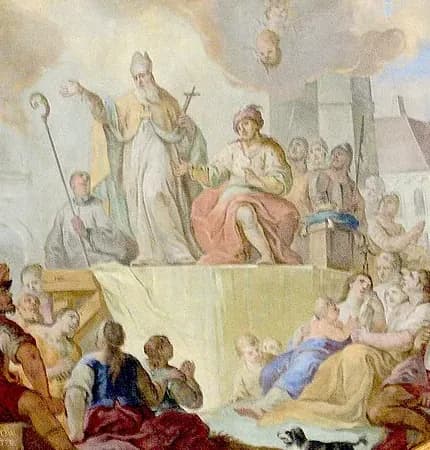
Aidan did not speak English. 15 Oswald had learned the Irish language in exile, and Bede describes the result: when the bishop preached, "it was most delightful to see the king himself interpreting the word of God to his commanders and ministers." 1 The Diocese of Hexham and Newcastle says the two often traveled together on missionary journeys in this way. 5
More Irish monks followed. Churches were built, the king gave land for monasteries, and people "joyfully flocked together to hear the word." 1 Aidan took twelve English boys to be taught at Lindisfarne; one of them, Eata, later became abbot of Melrose and bishop of Lindisfarne himself. 1
At an Easter dinner, when Oswald sent his own food out to the poor in the street and had the silver dish broken up for them, Aidan took his right hand and said, "May this hand never perish." 1
On foot, and nothing of his own
Bede's fifth chapter is a portrait. Aidan "neither sought nor loved any thing of this world," and gave away to the poor whatever kings or rich men gave him. 1 He traveled "both town and country on foot, never on horseback, unless compelled by some urgent necessity," and stopped whoever he met, rich or poor, to invite them to the faith or to strengthen them in it. 1 Everyone who walked with him read Scripture or learned psalms as they went. 1
When the rich gave him money, he used it to buy back people who had been sold as slaves, and many of those he ransomed became his disciples and were later ordained priests. 16
King Oswin of Deira once gave him a fine horse for crossing rivers. 1 Soon afterward a beggar asked Aidan for alms, and Aidan got down and gave him the horse with all its royal trappings. 1 When Oswin asked why he had given away the one horse chosen for him, Aidan answered, "Is that foal of a mare more dear to you than the Son of God?" 1 The king thought it over by the fire, then knelt at the bishop's feet and asked his pardon. 1 Aidan raised him up, and then, as the king grew cheerful, began to weep. When his priest asked him why, in their own language, he said he had never seen so humble a king, and did not think he would live long. 1
The storm, the fire, and Hilda
Bede gives three miracles "as a memorial." 1 Aidan gave a priest, Utta, a phial of holy oil before a sea voyage and told him to pour it on the water when the storm came; the storm came, and the sea grew calm. Bede had the story from a priest of his own church who had it from Utta. 1 On another occasion Penda of Mercia piled timber and thatch against the walls of Bamburgh and set it alight. Aidan, praying on the island of Farne about two miles away, saw the smoke and said, "Behold, Lord, how great mischief Penda does!" and the wind turned the flames back on those who had lit them. 1
He also encouraged women into the religious life. Bede records that Heiu, who is said to have been the first woman in Northumbria to take the habit of a nun, was consecrated by Aidan. 2 Hilda had spent a year intending to follow her sister into a monastery abroad; instead, Bede says, Aidan gave her the land of one family on the north side of the river Wear. 2 After she became abbess, he and other religious men "frequently visited and diligently instructed her." 2
Chad, later a bishop, preached on foot through towns and countryside as Aidan had, and Bede gives the reason: "he was one of the disciples of Aidan." 1
His death, and what Bede thought of him
Oswald was killed in 642, and Aidan found a friend in Oswin. 45 On August 20, 651, Oswin was murdered on the orders of Oswy, the king of Bernicia. 1 Bede says Aidan died "twelve days after the king he loved"; the Diocese of Hexham and Newcastle says he survived him only a fortnight, "dying it is said of a broken heart." 15
He was at a royal estate near Bamburgh where he kept a church and a room, and when he fell ill they put up a tent for him against the west wall of the church. 1 He died there on August 31, in the seventeenth year of his episcopate, leaning against a post that buttressed the wall. 14 Bede reports that the church later burned twice and the post did not. 1
That night a young shepherd in the hills, keeping watch while the others slept, saw a company of angels carrying a soul up to heaven. 3 In the morning he learned that Aidan had died at that hour, and he gave the sheep back to their owners and went to become a monk. 3 He was Cuthbert. 36
Aidan was buried on Lindisfarne, in the brothers' churchyard, and his bones were later moved inside the new church of Saint Peter and placed at the right of the altar. 1 When Bishop Colman went home after the Easter disputation of 664, he took part of them with him. 1
Bede would not let the Easter question go. Aidan kept Easter by the Irish reckoning, and Bede says plainly that he did not approve. 1 But he wrote that he praised "his love of peace and charity; his continence and humility; his mind superior to anger and avarice," his "authority becoming a priest in reproving the haughty and powerful, and at the same time his tenderness in comforting the afflicted." 1
What is Saint Aidan the patron saint of?
None of the sources used here names Aidan the patron of anything. 1456 The encyclopedia says he "in time became apostle of Northumbria," and Our Sunday Visitor calls him by the same title; that names the work he did rather than a patronage. 46 Popular lists sometimes give him firefighters. No source consulted for this page says so, and the page does not claim it.
Saint Aidan's feast day
Praying with Saint Aidan
The first thing Bede records Aidan saying is a criticism of a fellow monk, and it is a criticism about how to speak to people. 1 The first missionary had decided the English were stubborn and barbarous. Aidan thought he had asked too much of them too soon. 1 The council chose him for what Bede calls his "singular discretion," and Bede says time proved he had the other virtues as well. 1
For most of those years he could not make himself understood without help. 1 He preached, and a king repeated it in English. 1 Bede does not present this as an obstacle Aidan overcame. He presents it as something good to see. 1
Aidan gave things away quickly, money to the poor or to buy back slaves, and a king's horse to the first beggar who asked. 1 He was willing to tell a king that his horse mattered less than the poor man did, and then to weep when the king knelt to him. 1 Bede, who records his tears, does not explain them beyond Aidan's own words.
Bede disagreed with him on a question he thought important, and said so in the same chapter where he praised him. 1 He set down the disagreement and the admiration side by side and did not let one cancel the other. 1
Saint Aidan of Lindisfarne, pray for us.
Sources
- 1.Bede, The Ecclesiastical History of the English Nation, Book III (731), translation apparently L. C. Jane's (London: J. M. Dent, 1910), in the Internet Medieval Sourcebook (Fordham University).
- 2.Bede, The Ecclesiastical History of the English Nation, Book IV, chapter 23 (731), translation apparently L. C. Jane's (London: J. M. Dent, 1910), in the Internet Medieval Sourcebook (Fordham University).
- 3.Bede, The Life and Miracles of St. Cuthbert, Bishop of Lindisfarne (c. 721), chapter 4, translated by J. A. Giles, in the Internet Medieval Sourcebook (Fordham University).
- 4.William Grattan-Flood, "St. Aidan of Lindisfarne," The Catholic Encyclopedia, Vol. 1 (New York: Robert Appleton Company, 1907).
- 5."St Aidan," feast day page, August 31, Diocese of Hexham and Newcastle.
- 6.Maryella Hierholzer, "Meet the pioneering monk who introduced Christ to northern England," Our Sunday Visitor, August 31, 2025.
Saints to turn to next
Others in this collection who are turned to for some of the same things.
- Saint Charles de FoucauldSeptember 15, 1858 - December 1, 1916ConversionPrayerPoverty and simplicity
- Saint Francis of Assisic. 1181 - October 3, 1226Poverty and simplicityConversionPrayer
- Saint Nicholas of Tolentino1245 or c. 1246 - September 10, 1305 or 1306PrayerConversionPoverty and simplicity
- Saint Alphonsus LiguoriSeptember 27, 1696 - August 1, 1787PrayerConversion