Saint Bernard of Corleone
February 6, 1605 - January 12, 1667
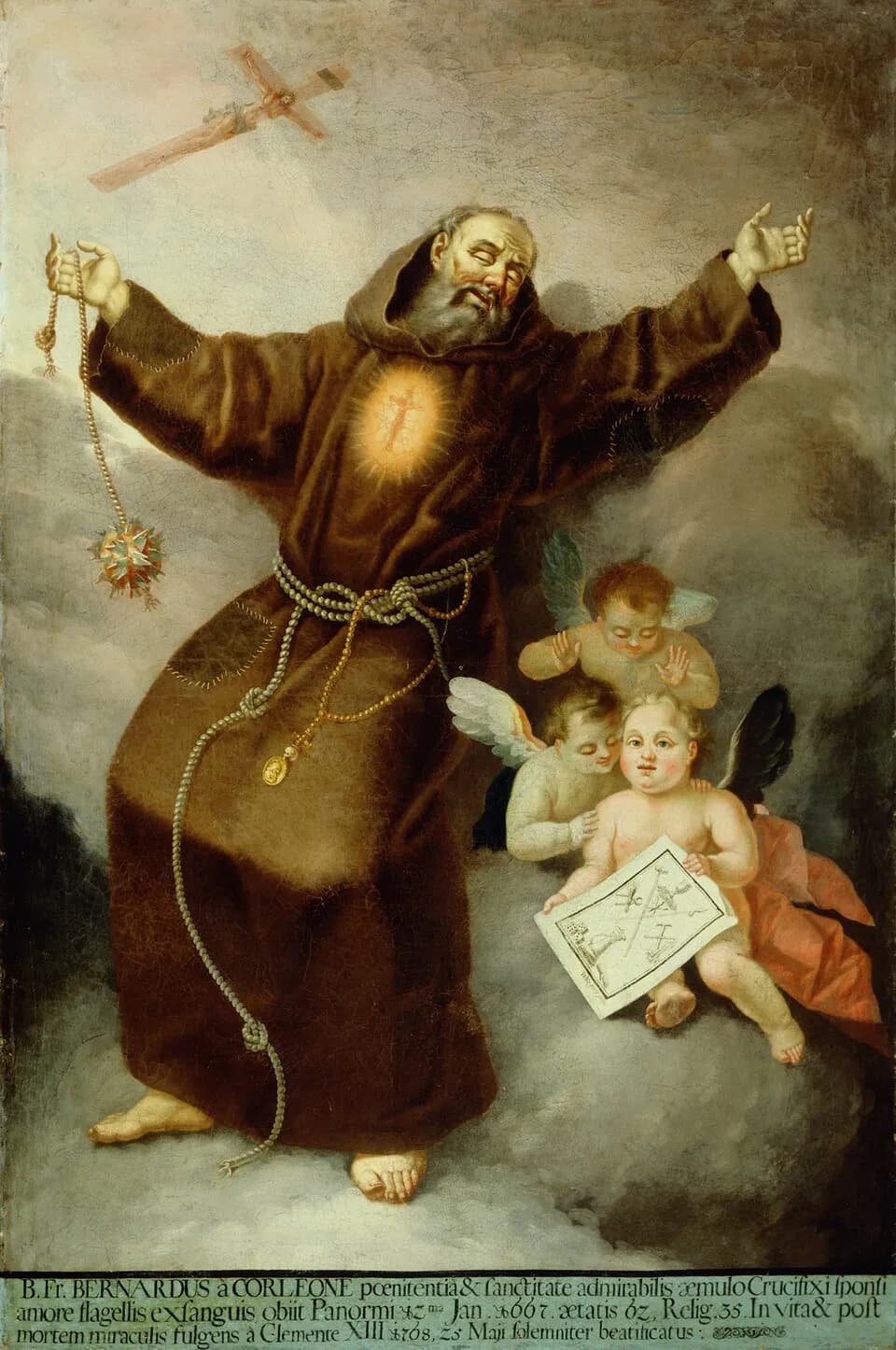
Saint Bernard of Corleone was a young Sicilian who ran a shoemaker's shop and was quick with a sword. At nineteen he fought a public duel that cost a hired killer his arm, and it shook him. 12 Seven years later he became a Capuchin lay brother, and he spent the next thirty-five years as a cook, nurse and launderer in the friaries of Sicily. 12 He died at Palermo on January 12, 1667, which is his feast, and John Paul II canonized him in 2001. 134
The house of saints
He was born Filippo Latino at Corleone, in Sicily, on February 6, 1605. 12 His father, Leonardo, was a shoemaker and leatherworker who used to bring the needy home to wash, clothe and feed them, and the family's house was known locally, in the Capuchin translation, as a "home of saints." 12 Filippo grew up devoted to Christ crucified and to the Virgin Mary. When he came to manage the shop he treated his workers well, and in winter he went through the town "begging alms for the poor prisoners." 1
Both of the main sources open by warning against the popular picture of him as a brawler in the piazza. The biography published by the Holy See calls that image "wide of the mark," and CapDox, the Australian Capuchins' archive, traces it to an old biography and to comparisons with the swordsman in Manzoni's novel. 12
The finest blade in Sicily
He did have one fault, and both sources take it from two witnesses at his beatification process: "he was quick to draw his sword at the slightest provocation." 1 CapDox adds that it was "especially in defence of his neighbour." 2
The two accounts tell what followed a little differently. CapDox has two fights. In the first he wounded the hand of a man who provoked him, which worried his parents. The second was the one that mattered, a public duel in 1624, when he was nineteen, with a hired killer whom CapDox names as Vito Canino. 2 The Vatican's English text runs the two together as a single incident. 1 They agree on the result. The killer lost an arm, Filippo was nicknamed "the finest blade in Sicily," and he "was shaken to the core." 1
He asked the wounded man's forgiveness, and the two later became friends. 12 Neither source says he ran to a friary. The Vatican text says that "his religious vocation matured," and CapDox speaks of a crisis that was resolved only when he took the habit, seven years after the duel. 12 On December 13, 1631, in the novitiate at Caltanissetta, he put on the Capuchin habit and took the name Bernard. 12 The Vatican text gives his age as 27 and CapDox says about twenty-seven, though by his birth date he was two months short of it. 12 He chose the Capuchins, both say, as the friars closest to ordinary people. 12
Cook and launderer
He was moved from friary to friary across the province: Bisacquino, Bivona, Castelvetrano, Burgio, Partinico, Agrigento, Chiusa, Caltabellotta, Polizzi, and perhaps Salemi and Monreale. The sources admit the order cannot be dated. What is known is that his last fifteen years were spent at Palermo. 12
His job was almost always cook or cook's helper. To that he added nursing the sick and whatever else needed doing, including washing the priests' clothes, until he was doing the laundry for nearly all his brothers. 12 CapDox notes that he is never found as porter or as questor, the brother who begs for the house. 2
He could not read. CapDox says a fellow friar tried to teach him from a primer and that he gave it up after a vision in which Christ told him, "Bernardo, don't look for what books contain because my wounds are enough for you." 2 His book was a small crucifix painted on a wooden cross. 2 He preferred friaries with a good crucifix in the church and told the others, "When you have a beautiful and devout Crucifix in the friary, there is nothing else you could desire." 2
Always at prayer
The witnesses at his process kept returning to his prayer. "He always exhorted us to love God and do penance for our sins," runs one testimony. 1 After the night office he stayed behind in church because, as he explained, "it wasn't good to leave the Blessed Sacrament alone and he would keep him company until the other friars arrived." 12 Against the custom of the time he received Communion every day. 12 When penance had worn him out, his superiors relieved him of every job but serving at the altar. 12
John Paul II built his remarks at the canonization on this testimony. Those who knew him, the Pope said, agreed that "he was always at prayer," "never ceased to pray," "prayed constantly," and people wondered how a simple lay brother could speak so well about the mystery of the Trinity. 3
CapDox describes the penance without softening it. He lived on burnt crusts and scraps of hard bread dipped in water, and ate them kneeling on the floor behind the refectory door. 2 It also insists on what went with it: he was never seen angry, never spoke ill of anyone, washed the feet of visiting friars, and was known for his ability to console the troubled. 2 His devotion to Mary was exuberant. He kept a little altar to her in the kitchen and dressed it with flowers and herbs every Saturday, and once, praying her litany in his cell, "he made sounds like fireworks, as if it were a great solemnity," to the amusement of the friars listening. 2
The poor, the sick and the animals
He hid from the curious, however important, and left a standing order with the porter: "When the poor come for me to see them, let me know straight away." 2 At Castronovo he went through the streets "with a large pot on his shoulders to give minestrone to the poor." 2
CapDox tells several stories from the process that the shorter Vatican text does not include. When an epidemic struck the whole friary at Bivona, Bernard nursed the brothers day and night until he collapsed himself, and the doctor gave him less than a day to live. He dragged himself to the church, took a small statue of Saint Francis, tucked it into his sleeve, and said, "Seraphic Father, I am letting you know that you will not leave my sleeve until you have healed me." The next day he was well. 2
People also brought him their sick animals, the mules, horses, cows and donkeys that the poor depended on for work, until the square in front of the Palermo friary looked on some days like a livestock market. He would say an Our Father, or lead the animal three times around the cross outside, and send it home cured. When the porter complained, he answered, "My dear porter, these poor creatures of God have neither doctor nor medicine available to them." 2
Both sources record his prayer when earthquakes and storms struck Palermo. He argued with God in front of the tabernacle, in the Vatican's English: "Easy Lord, be gentle with us! I want this grace, Lord, I want it!" 12
Death and canonization
He died at Palermo at two in the afternoon on Wednesday, January 12, 1667. After the last blessing he kept repeating, "Let's go, let's go." 12 A friar who had been close to him, Antonino of Partanna in the Vatican text and Antonio in CapDox, said he afterward saw him in spirit, radiant and crying out, "Paradise! Paradise! Paradise!" and blessing the disciplines, vigils and fasts of his life. 12
Pope John Paul II canonized him on June 10, 2001, the feast of the Blessed Trinity, with four others. 3 From his unbroken conversation with God, the Pope said, Bernard "drew the lifeblood for his courageous apostolate, responding to the social challenges of the time, with all their tensions and disquiet." 3
What is Saint Bernard of Corleone the patron saint of?
Saint Bernard of Corleone's feast day
Praying with Saint Bernard of Corleone
The sources take care over what kind of conversion this was. He was not a criminal who reformed. He was a devout young man who begged for prisoners and had one serious fault, and at nineteen the fault maimed somebody. 12 What the sources admire is what he did next: he asked the man's pardon, and then took seven years to work out what his life was for. 12
The temper did not vanish so much as find other uses. The man who had drawn steel in defense of his neighbor later bargained with God for Palermo during an earthquake and told Saint Francis he would stay up a sleeve until he cured him. 12 CapDox says that as a friar he was never seen angry with anyone. 2
His work was the kitchen and the laundry for thirty-five years, and he never learned to read. 12 The Pope who canonized him noted that people were astonished at how he talked about the Trinity, and gave the reason the witnesses gave: he never stopped praying. 3
His kindness reached unusually far down. Asked why he wasted time on mules and donkeys, he said that they had no doctor and could not say what was wrong with them, and that "compassion is needed." 2
Saint Bernard of Corleone, pray for us.
Sources
- 1."Bernardo da Corleone (1605-1667)," biography published by the Holy See for the canonization of June 10, 2001.
- 2."Saint Bernardo da Corleone," CapDox, Capuchin Friars of Australia; translation based on Costanzo Cargnoni in Sulle orme dei santi (Rome, 2000), 11-20.
- 3.John Paul II, Homily at the canonization of five Blesseds, Feast of the Blessed Trinity, June 10, 2001.
- 4."Liturgical Calendar of the Franciscan Breviary Supplement," CapDox, Capuchin Friars of Australia.
Saints to turn to next
Others in this collection who are turned to for some of the same things.
- Saint Aidan of Lindisfarnec. 590 - August 31, 651Poverty and simplicityPrayerConversion
- Saint Charles de FoucauldSeptember 15, 1858 - December 1, 1916ConversionPrayerPoverty and simplicity
- Saint Francis of Assisic. 1181 - October 3, 1226Poverty and simplicityConversionPrayer
- Saint Nicholas of Tolentino1245 or c. 1246 - September 10, 1305 or 1306PrayerConversionPoverty and simplicity