Saint Catherine of Bologna
September 8, 1413 - March 9, 1463
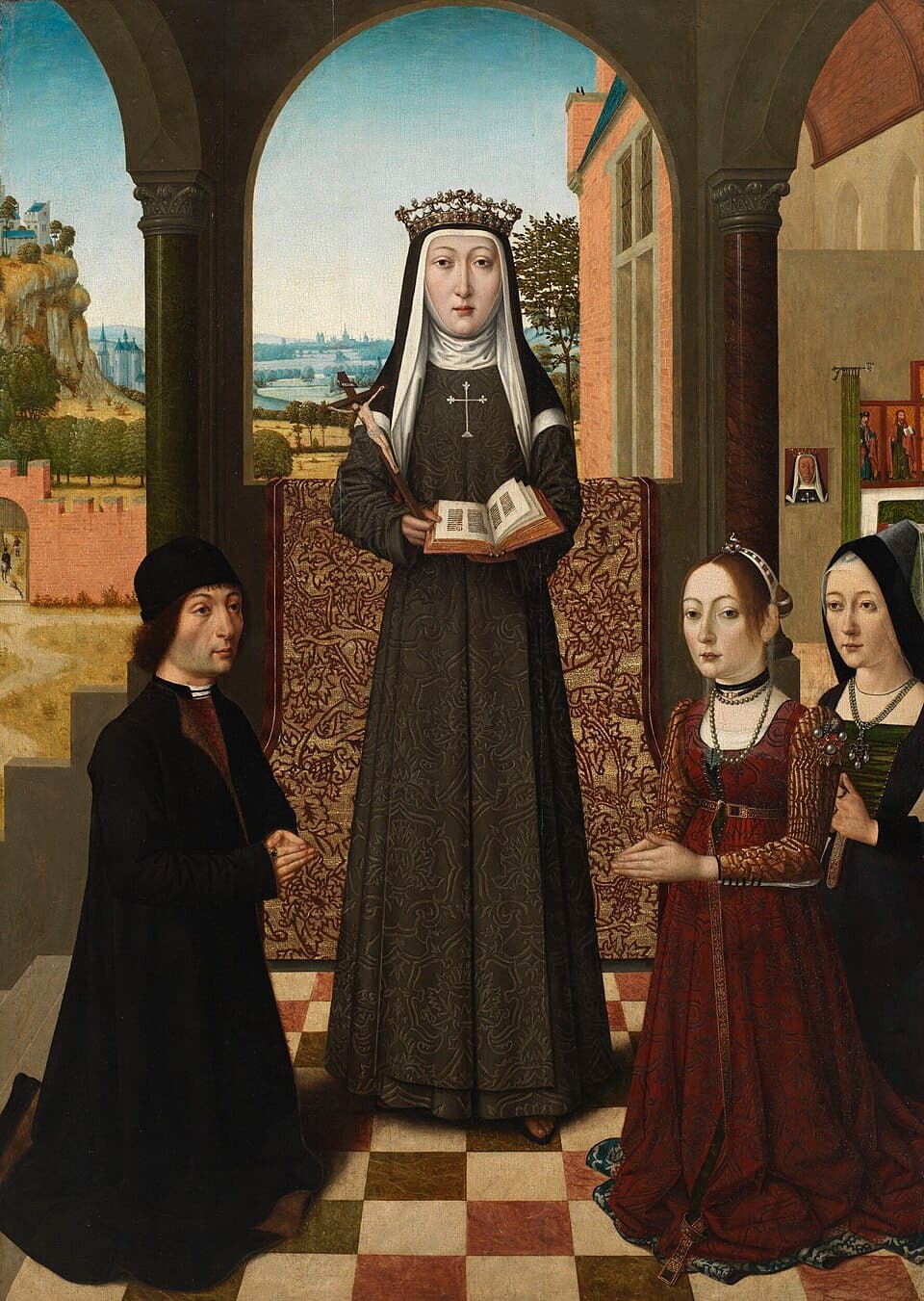
- Feast day
- March 9, kept throughout the Order of Friars Minor 1
Saint Catherine of Bologna wrote a book about fighting the devil and listed doubt about the Eucharist among the things she had personally had to fight. 2 She was a court-educated noblewoman who could paint, illuminate manuscripts, write verse and play the viola, and she spent her convent years doing the laundry, baking the bread and looking after the animals. 2 Her book is still read. One of the manuscripts she illuminated ended up among the treasures of Oxford. 1
The court at Ferrara
She was born in Bologna in 1413, the eldest child of a patrician of Ferrara who was a doctor in law and carried out diplomatic missions for the Marquis. 2 At about ten she went with her mother to Ferrara and entered the court of Nicholas III d'Este as lady-in-waiting to his daughter Margaret. 12
Benedict XVI is even-handed about the household she landed in. The Marquis was turning Ferrara into a fine city, summoning artists and scholars, and "although his private life was not exemplary, took great care of the spiritual good, moral conduct and education of his subjects." 2 Catherine, he says, "was unaware of the negative aspects that are often part and parcel of court life." 2
What she got there was an education. Music, painting, dancing, poetry, the viola, Latin, and the art of miniature-painting and copying. 2 Donovan notes the survival of the work: a manuscript she illuminated, once owned by Pius IX, "is at present reckoned among the treasures of Oxford." 1 Benedict adds the point that matters for what came later - in her monastic life "she was to put to good use the cultural and artistic heritage she had acquired in these years." 2
In 1427, aged fourteen, she left. Benedict says it followed "certain family events" and that her mother consented "in spite of having other plans for her daughter." 2 Donovan places the return home after Margaret's marriage to the Prince of Rimini. 1 She joined a small company of devout young women living in community.
The part she wrote down herself
What happened next is the reason her book exists, and she is the source for it. Benedict XVI does not soften the account: her trials and inner suffering "were great and terrible," she "passed through a profound spiritual crisis and came to the brink of despair," she lived in the night of the spirit, and she "was also deeply shaken by the temptation of disbelief in the Eucharist." 2
Donovan, writing a short encyclopedia notice, covers the same years in one clause - the "grievous and persistent temptations which in the early days of her religious life had tried her patience, humility, and faith, especially the latter virtue." 1 Especially the latter. A nun who had trouble believing.
Relief came as a vision giving her a clear awareness of the Real Presence, so dazzling, Benedict says, that she could not put it into words. 2 In 1429 she made a confession to a Friar Minor and prayed for forgiveness, and a vision told her she had it - an experience of divine mercy that "left an indelible mark upon her." 2 In 1431 she saw the Last Judgment, and the sight of the damned drove her to redouble her prayers for sinners. 2
She wrote The Seven Spiritual Weapons to instruct her sisters, and Benedict points out the tell in how she wrote it: she speaks of herself "in the third person in reporting the extraordinary graces which the Lord gives to her and in the first person in confessing her sins." 2 The seven are unglamorous. Strive to do good; believe you can do no good alone; trust God and do not fear the fight; meditate often on the life of Christ and above all his Passion; remember that you will die; keep your mind on the goods of heaven; know Scripture well enough that it directs your thoughts and actions. 2
Augustinian or Franciscan
The sources tell the community's change of rule differently, and the difference is worth seeing.
Donovan describes one body of women moving together: the community was following the Rule of the Third Order of Saint Augustine, and "later the community, yielding to the entreaties of Catherine, adopted the Rule of St. Clare," and in 1432 was clothed by the provincial of the Friars Minor. 1
Benedict XVI describes a split. "A sorrowful trial afflicted the community: tension arose between those who wished to follow the Augustinian spirituality and those who had more of an inclination for Franciscan spirituality." 2 Between 1429 and 1430, Lucia Mascheroni, who was in charge, founded an Augustinian monastery; Catherine and others bound themselves to the Rule of Saint Clare instead. 2
Benedict then calls the outcome a gift of Providence for a practical reason: the community they formed lived near a church annexed to a convent of Friars Minor, so they could take part in the liturgy, get spiritual assistance, and hear Bernardine of Siena preach. 2 Whichever account is right about the manner of it, the result is the same and neither source disputes the date range.
The laundry, and the office she did not want
The detail that makes her memorable is what a woman raised at the court of Ferrara actually did in the convent. Benedict lists it: she "served in the offices of laundress, dressmaker and breadmaker and even looked after the animals," and did the lowliest of it with love and ready obedience. 2 She regarded disobedience as spiritual pride, which she thought destroys every other virtue. 2
She took the office of novice mistress out of obedience while thinking herself unfit for it, and turned out to be good at it. 2 Given charge of the parlor, she found it hard to keep breaking off her prayers to answer the grill, and Benedict says the Lord did not fail to visit her there either. 2
When the abbess died and the superiors thought of her, she told them to send to the Poor Clares of Mantua instead, as better instructed in the Constitutions. 2 In 1456 she was asked to found a new house in Bologna. She would rather have ended her days in Ferrara, and went. 2 Donovan records that she was chosen abbess in her native town and held the office until she died. 1
The foundation was not a small undertaking. She traveled with eighteen sisters, and Benedict says that as superior "she set the example in prayer and in service" and lived in deep humility and poverty. 2 Donovan explains what was driving the expansion: vocations were arriving faster than one house could hold, so under a Brief of Callistus III convents were founded at Bologna and at Cremona. 1 The woman who had tried to send the job to somebody better qualified ended up running the order's growth in two cities.
At the end of her three-year term she was glad to be replaced, and had to take the office up again a year later when the new abbess went blind. 2 She was ill by then, and did it anyway. 2
What is Saint Catherine of Bologna the patron saint of?
Neither source used here states a patronage for Saint Catherine of Bologna, so this profile claims none. 12 She is often invoked by artists, which fits a woman who painted and illuminated manuscripts well enough that Oxford keeps one, but neither Donovan nor Benedict XVI says it, and this library does not supply what its sources will not. 1
Saint Catherine of Bologna's feast day
The feast of Saint Catherine of Bologna is March 9, the day she died. 12 Donovan states it is kept on that day "throughout the Order of Friars Minor," which is the older and narrower form. 1 On the canonization the two sources disagree outright: Donovan names Benedict XIII, and Benedict XVI names Clement XI and gives the date as 22 May 1712. 12 This page does not settle it.
Praying with Saint Catherine of Bologna
She is the saint for anyone who has found that belief comes and goes. The temptation she names is not a failure of nerve or of morals; it is disbelief in the Eucharist, arriving in a young woman who had already given up a court to enter religious life. 2 She did not leave. She wrote it down afterward so that her sisters would recognize it when it came for them.
Her seven weapons are worth reading for how ordinary they are. Nothing about visions, nothing requiring a particular temperament. Do good, expect to be unable to do it alone, do not be frightened, think about the life of Christ, remember you will die, keep heaven in mind, know Scripture. 2 Benedict calls it "a splendid programme of spiritual life, today too, for each one of us." 2
The convent years are the other half. A woman who read Latin and illuminated manuscripts spent decades baking, sewing, washing and minding animals, and Benedict says she did it in a way that gave her sisters "a luminous witness." 2 She also wanted to die in Ferrara and was sent to Bologna, wanted to stop being abbess and had to start again, and was in pain for the last year of it. 2 None of that is presented as having been made easy.
Benedict ends where the life ends. At the beginning of 1463 she called the sisters together to tell them she was dying, and through the terrible suffering of her last weeks "it was she who comforted her sisters." 2 She handed over the manuscript, said the name of Jesus three times, and died. 2 His summary is the useful one: even in the night of faith, "do not let go of the Lord's hand." 2
Saint Catherine of Bologna, pray for us.
Sources
Saints to turn to next
Others in this collection who are turned to for some of the same things.