Saint Francis de Sales
August 21, 1567 - December 28, 1622
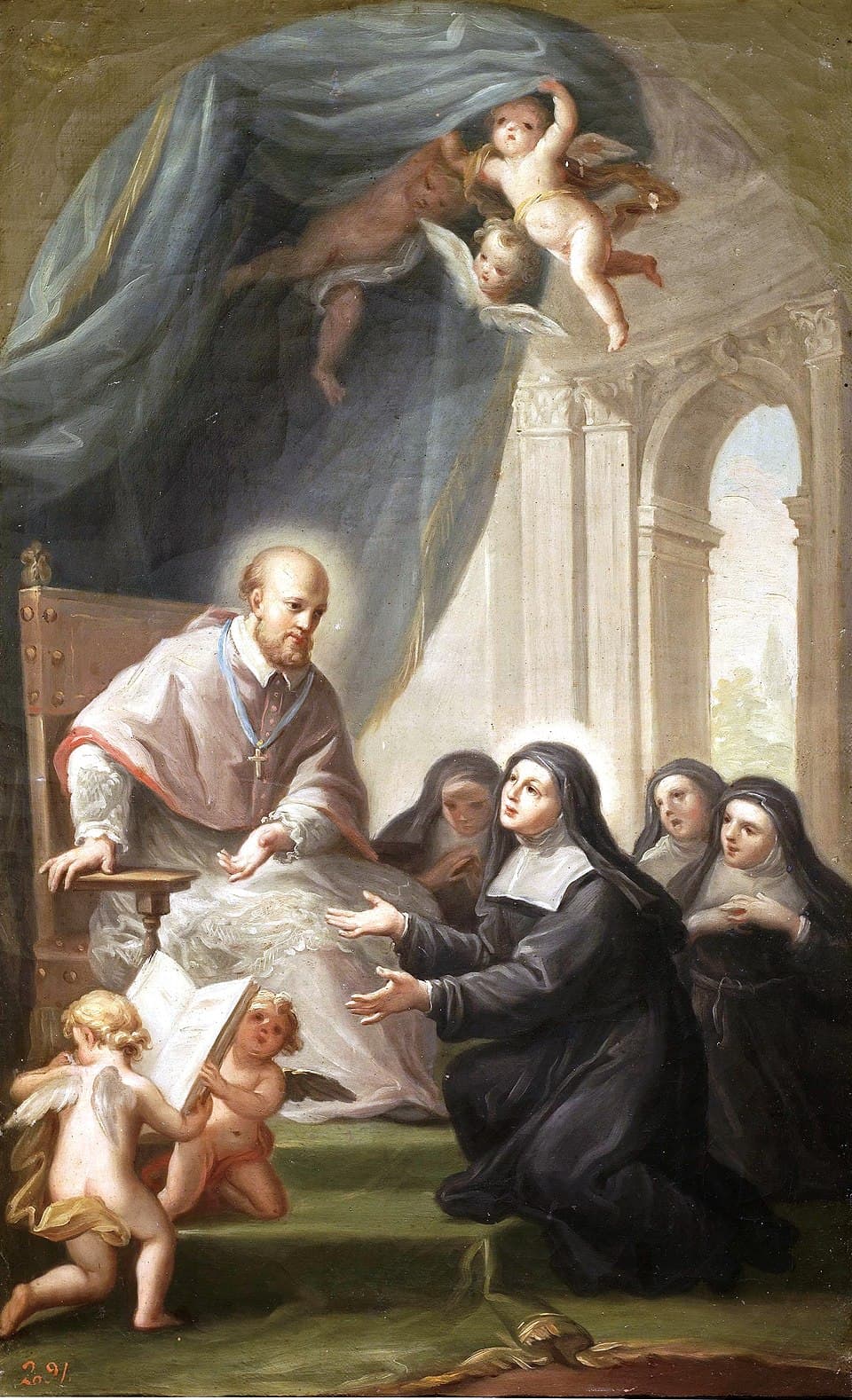
- Patron saint of
- Franciscan Media lists authors, journalists, writers, and deafness 3
- Feast day
- January 24 3. The 1909 encyclopedia article cites the Roman Breviary at 29 January, the date kept when it was written 1
- Born
- Thorens, in the Duchy of Savoy, August 21, 1567, eldest of six brothers 1
Saint Francis de Sales told a married laywoman that she could become a saint without leaving her house, and the book he wrote for her has not been out of print since 1607. 2 Before that he had a law degree, a father with a wedding arranged, and a spiritual crisis so severe he could barely eat or sleep for weeks. 12 He is the patron of writers, and the gentlest of the great directors of souls, and he was neither of those things at twenty. 23
The crisis, and how it ended
He was born at Thorens in Savoy in 1567, the eldest of six brothers in an old aristocratic family, and was educated with great care. 1 Benedict XVI notes the shape of the schooling: theology at Paris, and jurisprudence at Padua, where to satisfy his father he graduated brilliantly with degrees in utroque iure, in both canon and civil law. 2
At Paris, reflection on Augustine and Aquinas on predestination produced what Benedict calls a deep crisis. Francis became convinced he was damned. He "suffered as a true spiritual drama the principal theological issues of his time," prayed intensely, and was tormented by doubt so fiercely that for some weeks he could hardly eat or sleep. 2
The resolution is worth quoting in his own words, because it is the seed of everything he wrote afterward. In the Dominicans' church in Paris he prayed: "Whatever happens, Lord, you who hold all things in your hand and whose ways are justice and truth; whatever you have ordained for me... you who are ever a just judge and a merciful Father, I will love you Lord... I will love you here, O my God, and I will always hope in your mercy." 2
Benedict describes what changed: at twenty, Francis found peace "in the radical and liberating love of God: loving him without asking anything in return." 2 He stopped asking what God would do with him and simply loved God, regardless of what he might or might not receive. 2 The predestination question did not get answered. It stopped being the question.
His father had other plans - a senatorship, and one of the noblest heiresses in Savoy - and Pernin records that "a sharp struggle ensued." 1 It ended when the Bishop of Geneva, on his own initiative, obtained for Francis the post of Provost of the Chapter of Geneva, the highest office in the diocese. His father yielded, and Francis was ordained in 1593. 1 Benedict gives the date as 18 December. 2
Le Chablais
The following year he volunteered for a mission that could reasonably have killed him. Le Chablais had been made Protestant under Genevan rule and had just been returned to the Duchy of Savoy. 1 Francis made his headquarters in the fortress of Allinges and, in Pernin's phrase, "risking his life, he journeyed through the entire district, preaching constantly." 1
What Pernin says worked is not argument alone. "By dint of zeal, learning, kindness and holiness he at last obtained a hearing." 1 The kindness is listed among the methods, not as a temperamental footnote. He settled in Thonon, answered the preachers Geneva sent against him, and converted the syndic along with several prominent Calvinists; a large part of the population returned in 1597 and 1598. 1
Clement VIII sent him to Geneva to interview Theodore Beza, called the Patriarch of the Reformation, and Pernin's account of the meeting is honest about its outcome. Beza "received him kindly and seemed for a while shaken, but had not the courage to take the final steps." 1 The most famous conversation of his mission ended with nothing decided.
Benedict adds the note that makes sense of the whole period. Francis was involved in controversy and dialogue with Protestants, and experienced "increasingly, over and above the necessary theological confrontation, the effectiveness of personal relationship and of charity." 2 He did not conclude that the arguments were unimportant. He concluded that they were not sufficient.
The book for Philothea
He became Bishop of Geneva in 1602, at a time when the city was a stronghold of Calvinism and the see sat in exile at Annecy. 2 Pernin describes a bishop who kept his household simple, "completely dispensed with superfluities and lived with the greatest economy, in order to be able to provide more abundantly for the wants of the needy," and who heard confessions, gave advice and preached incessantly. 1
Out of his direction of a young woman, Madame de Charmoisy, came the "Introduction to the Devout Life," published in 1607 and addressed to a reader he called Philothea. 2 Benedict calls the invitation in it one that "might well have seemed revolutionary at the time": belong completely to God while living fully in the world and doing the work your state of life actually requires. 2 Francis states his intention in the preface without hedging - "My intention is to teach those who are living in towns, in the conjugal state, at court." 2
The document making him a Doctor of the Church insisted on exactly this expansion of the call to holiness, in a sentence Benedict quotes: true piety "shone its light everywhere and gained entrance to the thrones of kings, the tents of generals, the courts of judges, custom houses, workshops, and even the huts of herdsmen." 2 Benedict draws the line forward to the Second Vatican Council, which said the same thing about lay holiness three and a half centuries later. 2
With Jane Frances de Chantal, whom he first met preaching the Lent at Dijon in 1604, he founded the Institute of the Visitation in 1607 - conceived, Pernin says, for young girls and widows called to religious life who have not the strength or the inclination for the corporal austerities of the great orders. 1 Francis wanted it characterized by simplicity and humility, "doing ordinary things extraordinarily well." 2
The second great book, the "Treatise on the Love of God," is addressed to a more mature reader he calls Theotimus, and contains the sentence Benedict uses to sum him up: "man is the perfection of the universe; the spirit is the perfection of man; love, that of the spirit; and charity, that of love." 2 The union with God it describes is crowned not by ecstasy but by charitable action attentive to the needs of others, which Francis called "the ecstasy of action and life." 2
What is Saint Francis de Sales the patron saint of?
Saint Francis de Sales is the patron of writers. Franciscan Media lists him as patron of authors, journalists and writers, and also of deafness. 3 The fit is obvious from the output: two books that have stayed in print for four centuries and, in Pernin's words, "innumerable letters (mainly letters of direction)." 1 Neither the encyclopedia article nor Benedict XVI states a patronage, so Franciscan Media is the source for it here. 123
Saint Francis de Sales's feast day
The feast of Saint Francis de Sales is January 24. 3 He died on December 28, 1622, so the feast is not on the anniversary of his death. 1 The 1909 encyclopedia article quotes the Roman Breviary at 29 January, which is where his feast stood at the time it was written, and is another reminder that an old and reliable source reports its own calendar rather than the current one. 1 He was beatified in 1661 and canonized by Alexander VII in 1665. 1
On the doctorate, the sources disagree about who granted it. Pernin says he "was proclaimed Doctor of the Universal Church by Pope Pius IX, in 1877." 1 Benedict XVI attributes it to Leo XIII, citing a Brief of 16 November 1877. 2 The year is the same in both accounts and this page does not adjudicate the rest.
Praying with Saint Francis de Sales
The reason he is still read is that he wrote for people who were not going to become monks. Philothea is a married woman with a household and obligations at court, and the whole argument of the book is that this is a place where holiness happens rather than an obstacle to it. 2 Four hundred years later the claim is unremarkable, and it was not when he made it.
His rule for spiritual direction is one sentence long and he capitalized part of it. To Jane de Chantal: "this is the rule of our obedience, which I write for you in capital letters: do all through love, nothing through constraint; love obedience more than you fear disobedience." 2 He goes on to say he leaves her "the spirit of freedom" - not the freedom that excludes obedience, which he calls the freedom of the world, but the liberty "that excludes violence, anxiety and scruples." 2 That last word is the giveaway. He had been a scrupulous young man who could not eat.
The gentleness was never softness about the situation he was in. He ran a diocese whose cathedral city was held by people who regarded him as an enemy, lived on almost nothing so that more could go to the poor, and walked around a hostile district preaching until somebody listened. 1 Benedict's summary of the life is that it was relatively short and lived with great intensity, and marked "by the hardness of the times." 2
What he left, besides two books, is a way of describing God that people have found difficult to forget. Benedict lists the images: Father and Lord, husband and friend, with the characteristics of a mother and a nurse, and the sun of which even the night is a mysterious revelation. 2 And a sentence about what that God does to a person who is drawn: "love has neither convicts nor slaves, but brings all things under its obedience with a force so delightful, that as nothing is so strong as love nothing also is so sweet as its strength." 2
Saint Francis de Sales, pray for us.
Sources
Saints to turn to next
Others in this collection who are turned to for some of the same things.