Saint Bernard of Clairvaux
1090 - August 20, 1153
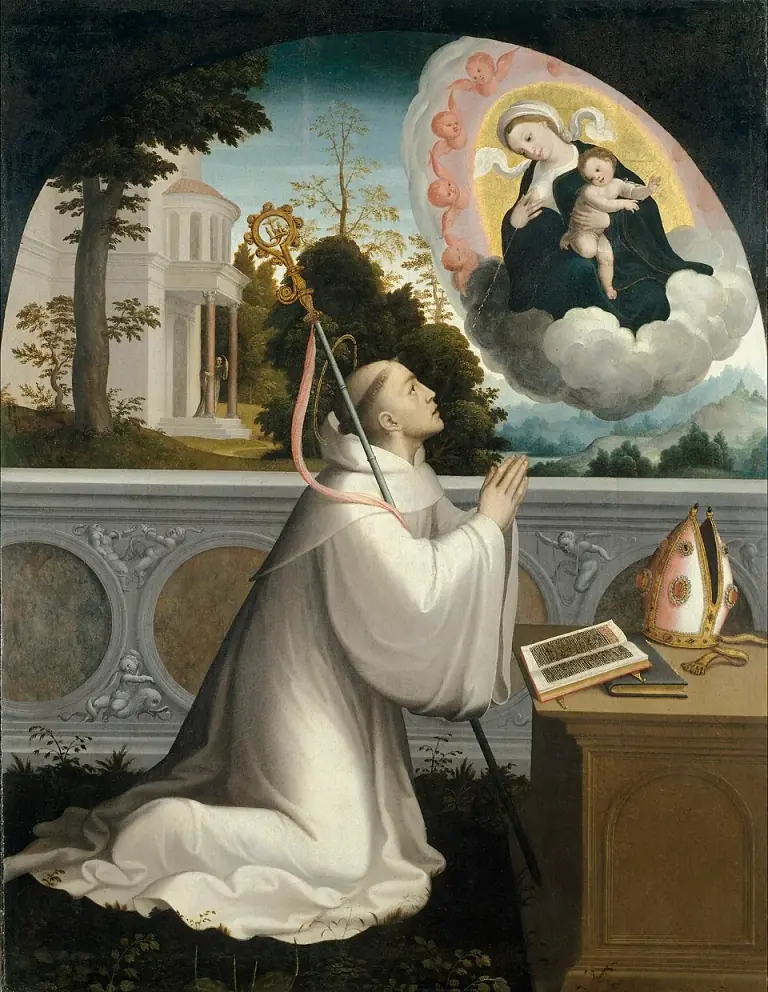
- Feast day
- August 20, the day he died in 1153 3
- Abbot of
- Clairvaux, from 1115, at the age of twenty-five 1
- Called
- The last of the Fathers of the Church, and Doctor Mellifluus - his praise of Christ "flowed like honey" 1
Saint Bernard entered a struggling new monastery at about twenty and brought thirty relatives and friends in with him. 13 Within five years he was sent out to found Clairvaux and was its abbot at twenty-five, and for the rest of his life the Church kept pulling him away from the silence he had joined it for - to settle a papal schism, to argue with Abelard, and to preach a crusade that failed catastrophically. 13 He is called the last of the Fathers of the Church. 1
The valley of Wormwoods
Bernard was born at Fontaines in 1090, the third of seven children of a family of the Burgundian nobility, and was sent at nine to the school of the canons of Saint-Vorles at Châtillon-sur-Seine. 12 He had a taste for literature and wrote poetry for a while; the encyclopedia says he wanted to excel at it chiefly in order to get at Scripture, which "later on became, as it were, his own tongue." 2 His mother died when he was nineteen. 2
At about twenty he entered Cîteaux, a new foundation stricter in the practice of the evangelical counsels than the older monasteries and more flexible in form. 1 He did not go alone. Franciscan Media counts five brothers, two uncles and some thirty young friends following him through the gate, and a dying community recovering enough vitality within four years to found a new house. 3
In 1115 Stephen Harding, the third Abbot of Cîteaux, sent Bernard to found a monastery in the valley of Wormwoods. He was twenty-five. 13 There he set out his idea of monastic life - sober and measured at table, in clothing and in building, with care of the poor written into it - and the valley was renamed Clairvaux, the valley of light. 13
The abbot who was never allowed to stay home
From 1130 onward Bernard was drawn into the serious business of the Holy See, and had to leave his monastery more and more often, sometimes going outside France altogether. 1 His skill as an arbitrator became too well known to be ignored. 3
He was not deferential about it. Franciscan Media records that when a letter of warning arrived from Rome, Bernard replied that the good fathers there had enough to do keeping the Church in one piece, and that if anything came up worth their attention he would be the first to tell them. 3 Shortly afterward he intervened in a full-blown schism and settled it in favor of the pope against the antipope. 3
He founded women's monasteries, kept up an enormous correspondence with people of every rank, and wrote steadily throughout. 1 In 1145 a former pupil of his was elected pope as Eugene III, and Bernard - his spiritual father - sent him a book on how to be a good pope, De Consideratione, which Benedict XVI calls "still appropriate reading for the Popes of all times." 1
Honey in the mouth
The title Doctor Mellifluus comes from the way he wrote about Christ: his praise "flowed like honey." 1 Against the elaborate dialectics of his century, Bernard kept returning to one name. "Jesus alone," he insisted, is "honey in the mouth, song to the ear, jubilation in the heart." 1
His test of any book was the same. "All food of the soul is dry," he wrote, "unless it is moistened with this oil; insipid, unless it is seasoned with this salt. What you write has no savour for me unless I have read Jesus in it." 1 He was arguing, in part, with Abelard, a genuinely great thinker who had introduced the dialectical and philosophical method into theology, and on another front with the Cathars, who despised matter and the body and so, Bernard held, despised the Creator. 1
Benedict XVI draws the conclusion carefully, and it is not anti-intellectual. Without a faith nourished by prayer and contemplation, he says, reflection on the divine mysteries "risk[s] becoming an empty intellectual exercise and losing their credibility"; theology has to keep referring back to "the knowledge of the Saints." With Bernard, "we too must recognize that man seeks God better and finds him more easily in prayer than in discussion." 1
He defended the Jews
In the middle of all this, Benedict XVI records something easily lost: Bernard "felt it was his duty to defend the Jews, and condemned the ever more widespread outbursts of anti-Semitism" in his own time. Several decades after his death, Rabbi Ephraim of Bonn paid him a vibrant tribute for it. 1
The twelfth century is not a period anyone should study for comfort on this point. That a Jewish writer went out of his way to praise a Christian abbot for it, a generation later, is the measure of how unusual the abbot was.
Mary
Bernard's Marian preaching is where he is most quoted. In a sermon for the Sunday in the octave of the Assumption he describes Mary's share in her Son's sacrifice in almost unbearable terms: "O Blessed Mother, a sword has truly pierced your soul!... So deeply has the violence of pain pierced your soul, that we may rightly call you more than a martyr for in you participation in the passion of the Son by far surpasses in intensity the physical sufferings of martyrdom." 1
His formula was per Mariam ad Iesum, through Mary to Jesus - and Benedict is careful to note that Bernard "testifies clearly to Mary's subordination to Jesus, in accordance with the foundation of traditional Mariology." 1 A century and a half later Dante gave the prayer to the Virgin in the last canto of the Paradiso to Bernard, of all the saints available to him. 1
The passage people carry around is from one of his homilies: "In danger, in distress, in uncertainty, think of Mary, call upon Mary. She never leaves your lips, she never departs from your heart... If you follow her, you cannot falter; if you pray to her, you cannot despair; if you think of her, you cannot err." 1
The Second Crusade
The Holy See prevailed on Bernard to preach the Second Crusade across Europe, and his preaching worked. Franciscan Media says his eloquence "was so overwhelming that a great army was assembled and the success of the crusade seemed assured." 3
The ideals of the men who went, and of the men who led them, were not his. The expedition "ended as a complete military and moral disaster." 3 Bernard held himself responsible in some way for what it became, and Franciscan Media judges that the weight of it possibly hastened his death, which came on August 20, 1153. 3
That is the end of the story and this page is not going to improve it. The most persuasive man in Europe used everything he had to send thousands of people somewhere, and it went wrong, and he carried it.
What is Saint Bernard the patron saint of?
Nothing that the sources cited here will state. Neither Benedict XVI's catechesis, nor the encyclopedia article, nor Franciscan Media's entry gives him an individual patronage, so this page leaves the question open rather than filling it from the lists that circulate. 123
What he is for is easier to answer: contemplative prayer, Marian devotion, and the particular problem of being good at public work you never asked for.
Saint Bernard of Clairvaux's feast day
The feast of Saint Bernard of Clairvaux is August 20, the day he died at Clairvaux in 1153. 3 He is honored as a Doctor of the Church, a title the encyclopedia connects to the works he wrote in the intervals when he managed to get back to his cloister - among them the sermons on the Song of Songs. 12
Praying with Saint Bernard
He wanted to be left alone in a monastery and was not. Benedict XVI's account is a list of departures: Rome's business from 1130, journeys outside France, a schism, a quarrel between a king and a duke, a crusade. 1 Bernard is the saint for people whose competence keeps costing them the life they actually chose.
The crusade is the part to sit with rather than skip. He preached it because he was asked to, he was overwhelmingly good at it, and what he raised turned into a moral catastrophe he then had to live with. 3 Sincerity and eloquence and papal backing were all present, and none of it made the outcome good. That is a real hazard of doing large things for God, and it is not usually mentioned.
His rule for reading was that nothing tasted of anything unless he could find Jesus in it. 1 Applied to Scripture it produced the sermons on the Song of Songs; applied to controversy it made him a difficult opponent. It is also a usable test for anyone whose prayer has become a matter of getting through material.
And in trouble, he said, think of Mary and call on her - if you follow her you cannot falter, if you pray to her you cannot despair. 1 He wrote that as an abbot who was regularly out of his depth in the politics of two kingdoms and a papal court, not as a man with nothing on his mind.
Saint Bernard of Clairvaux, pray for us.
Sources
Saints to turn to next
Others in this collection who are turned to for some of the same things.
- Saint AaronDied on Mount Hor, at the end of the years in the desertWork and vocationPrayer
- Saint Aelred of Rievaulx1109 - January 12, 1166 (or 1167)PrayerWork and vocation
- Saint Agnes of Montepulcianoc. 1268 - April 1317PrayerWork and vocation
- Saint Alphonsus Rodriguez1532 or 1533 - October 1617PrayerWork and vocation