Saint Aaron
Died on Mount Hor, at the end of the years in the desert
- Family
- Son of Amram and Jochabed; brother of Miriam and Moses; father of Nadab, Abihu, Eleazar and Ithamar 12
- Name means
- Unknown 1
- Feast day
- July 1 7
Saint Aaron was the elder brother of Moses, his spokesman before Pharaoh, and the first high priest of Israel. 12 He also made the golden calf at the foot of Sinai, and Scripture keeps both the calling and the sin. 13 The Roman Martyrology commemorates him on July 1. 7
The brother who could speak
According to the Book of Chronicles he was the great-grandson of Levi and the second child of Amram and Jochabed, after Miriam and before Moses; the meaning of his name is unknown. 1 Nothing is known of his life before his calling. 1
He first appears when Moses, at the burning bush, tried to refuse his mission because he was "slow of speech." God answered that Aaron the Levite, who could speak well, would be his spokesman. 1 Aaron went out to meet his brother, and together they gathered the elders of Israel and announced the coming freedom. 1
Before Pharaoh the two brothers stood side by side. The Catholic Encyclopedia notes that Aaron's part in the plagues was prominent, the first three and the sixth being worked at his command, and that both brothers took the people's complaints in the desert afterward. 1 When Israel fought Amalek, Aaron and Hur held up Moses's arms on the hilltop until the battle was won. 1
The golden calf
While Moses was on the mountain, the people grew afraid he would not come back. "Arise, make us gods, that may go before us," they said to Aaron, "for as to this Moses ... we know not what has befallen him." 3 He told them to bring their golden earrings, made a molten calf, built an altar before it, and proclaimed, "Tomorrow is the solemnity of the Lord." 3
What he meant by it has long been argued, the Catholic Encyclopedia says: either open idolatry, or an image of the God who had brought them out of Egypt. It thinks the text favors the second. 1
Moses came down, broke the tablets, and turned on his brother: "What has this people done to thee, that thou shouldst bring upon them a most heinous sin?" 3 Aaron's answer was weak. The people were "prone to evil," he said, and "I cast it into the fire, and this calf came out." 3 The Levites then killed the idolaters, three thousand by the best text, says the Catholic Encyclopedia, twenty-three thousand in the Latin Vulgate and the Douay-Rheims. 13 Aaron himself was spared because Moses prayed for him. 1
The first high priest
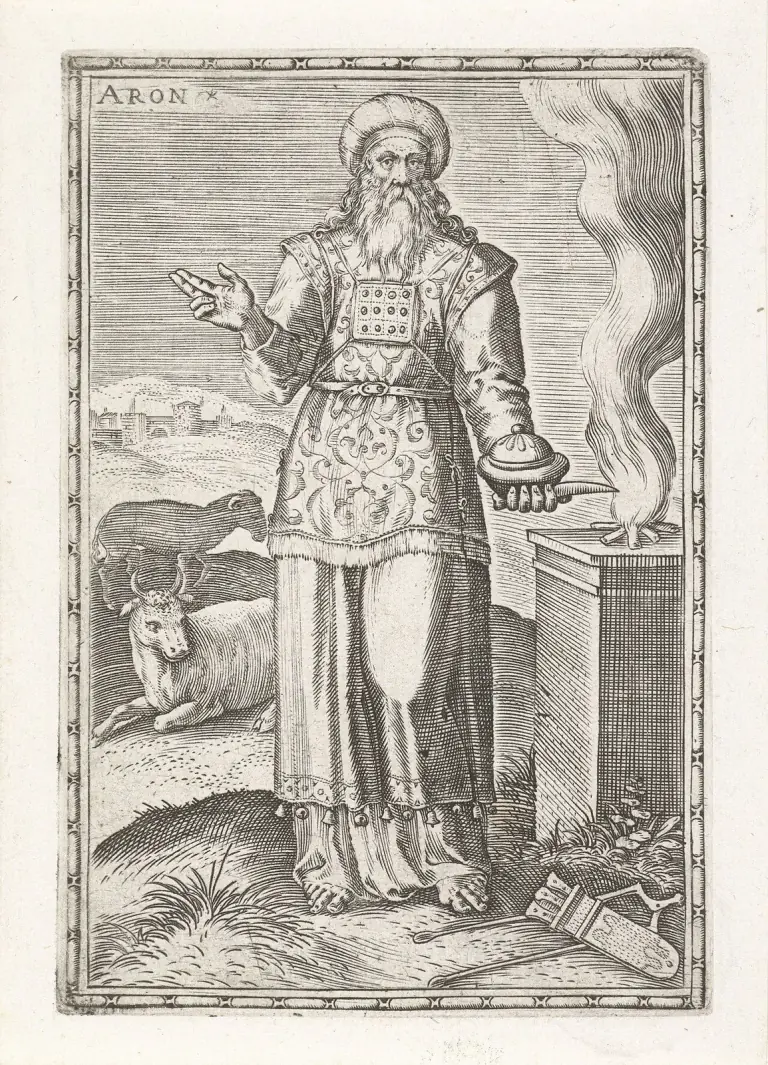
The sin did not undo his calling. 1 God told Moses to bring Aaron and his sons "that they may be my priests," and to make them sacred vestments. 2 On the shoulders of the ephod two onyx stones carried the names of the twelve tribes, and on the breastpiece over his heart he bore them again, "as a constant reminder before the LORD." 2 A gold plate on his turban was engraved "Sacred to the LORD." 2
Moses consecrated him over seven days, and on the eighth Aaron offered sacrifice and blessed the people. 1 On that same day two of his sons, Nadab and Abihu, offered "strange fire" and were struck dead; Aaron, in his grief, neglected part of the rite, and his excuse was accepted. 1
The Catholic Encyclopedia describes his office as unique: he alone entered the Holy of Holies, once a year on the Day of Atonement, and he alone stood answerable for the whole nation before God. 1
The staff that blossomed
His priesthood was not unchallenged. With Miriam he spoke against Moses, and was rebuked; later Korah and others rose against both brothers. 1 When a plague broke out among the people after that revolt, Aaron took his censer at Moses's word and "stood between the dead and the living," praying, and the plague stopped. 1
God then settled the question. Twelve staffs, one for each tribe, were laid in the tent of the covenant, with Aaron's name on the staff of Levi. 4 The next day Aaron's staff "had put forth sprouts, produced blossoms, and borne ripe almonds!" 4 It was put back before the covenant "as a sign to the rebellious." 4
Mount Hor
Near the end of the forty years, at Kadesh, the people had no water and turned on Moses and Aaron again. God told Moses to take the rod and speak to the rock; Moses struck it twice, and water came out. 5 Because of what happened there, God told the brothers they would not lead the people into the promised land. 5 What exactly their fault was is not clear: the Catholic Encyclopedia, following the Psalms, thinks Moses spoke rashly; Challoner's note calls it "a certain diffidence and weakness of faith." 15
Some months later, at Mount Hor on the border of Edom, God told Moses that Aaron's time had come. Moses took him and his son Eleazar up the mountain, stripped Aaron of his priestly vestments, and put them on Eleazar, "and Aaron being dead in the top of the mountain," Moses came down with his son. 5 "All the multitude seeing that Aaron was dead, mourned for him thirty days." 5 The Catholic Encyclopedia notes a monument on Jebel Nabi Harun shown as his tomb, but calls its authenticity "not altogether certain." 1
A figure of Christ
The Letter to the Hebrews was the first to compare Aaron with Christ, the Catholic Encyclopedia says, on two points. 1 The first is the call: "Neither doth any man take the honour to himself, but he that is called by God, as Aaron was. So Christ also did not glorify himself, that he might be made a high priest." 6 The second is that Aaron's priesthood could not make anyone perfect, and so gave way to Christ's. 1
The Catholic Encyclopedia sets out two ways of reading the sources for his life, the traditional one held by Catholics of its day and the critical one that sees his role enlarged by priestly writers, and notes that both agree he is the model of the Jewish high priest. 1 It adds that of all Aaron's descendants, none honored his blood as much as John the Baptist. 1
What is Saint Aaron the patron saint of?
Saint Aaron's feast day
Saint Aaron's feast day is July 1. The current Roman Martyrology commemorates him on that day as Aaron of the tribe of Levi, anointed with holy oil by his brother Moses as priest of the Old Testament, and buried on Mount Hor. 7
Praying with Saint Aaron
He was called to speak for someone else. His gift was eloquence, and it was given to serve his brother's mission. 1
He also gave the people what they asked for at Sinai, and then blamed them and the fire for it. 3 Scripture records the excuse without comment, and the Church still remembers him as a saint. 37
Hebrews makes one point from his life: no one takes the honor of priesthood for himself, but is called, "as Aaron was." 6
He carried the names of the tribes over his heart into the sanctuary, and when the plague came he stood between the dead and the living. 21
Saint Aaron, pray for us.
Sources
- 1.Charles L. Souvay, "Aaron," The Catholic Encyclopedia, vol. 1 (New York: Robert Appleton Company, 1907).
- 2.Exodus 28, with notes, New American Bible, Revised Edition, United States Conference of Catholic Bishops.
- 3.Exodus 32, with notes, Douay-Rheims Bible, Challoner revision, as hosted by drbo.org.
- 4.Numbers 17, with notes, New American Bible, Revised Edition, United States Conference of Catholic Bishops.
- 5.Numbers 20, with notes, Douay-Rheims Bible, Challoner revision, as hosted by drbo.org.
- 6.Hebrews 5, Douay-Rheims Bible, Challoner revision, as hosted by drbo.org.
- 7.Roman Martyrology, entry for July 1, "Sant'Aronne," Santo del giorno, Conferenza Episcopale Italiana (in Italian).
Saints to turn to next
Others in this collection who are turned to for some of the same things.