Saint Anacletus
Birth unknown - c. 88 or 91
- Years
- About 76 to about 88, says the 1908 Catholic Encyclopedia 2; about 80 to 92, says Vatican News 7; twelve years, says Eusebius 6
- Emblems
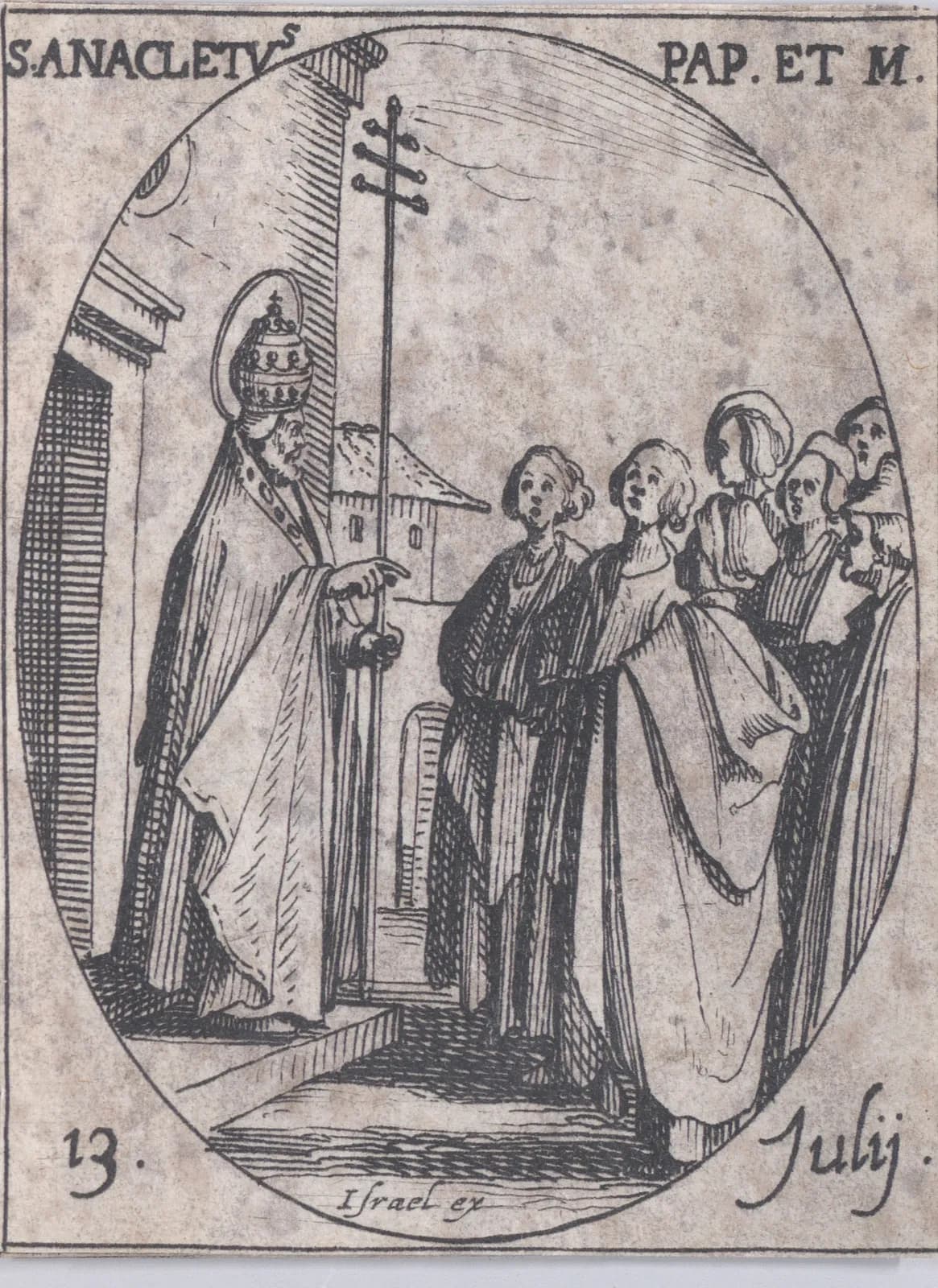
- A palm, a papal cross, and a coin he is breaking 3
Saint Anacletus, also called Cletus, was the second bishop of Rome after the apostle Peter, between Linus and Clement. 245 He is the pope with two names: the forms Cletus and Anacletus were taken by some early lists for two different men, and for centuries the Roman calendar kept two feasts for him. 123 The 1908 Catholic Encyclopedia says plainly that the name Cletus "is only another form for Anacletus." 2
One pope or two?
The oldest witnesses know one man. Irenaeus of Lyon, writing in the second century, says the apostles entrusted the Church in Rome to Linus, and "To him succeeded Anacletus; and after him, in the third place from the apostles, Clement was allotted the bishopric." 5 Eusebius calls him Anencletus. 6 Thomas Campbell, in the Catholic Encyclopedia, notes that Irenaeus, Eusebius, Augustine and Optatus "use both names indifferently as of one person." 1
Other lists disagree. The Liberian Catalog of the fourth century, the poem against Marcion and the Liber Pontificalis all make Cletus and Anacletus two different popes, and the Felician Catalog even makes Anacletus a Greek and Cletus a Roman. 1 The Liberian Catalog gives the order as Peter, Linus, Clement, Cletus, Anacletus. 2 Augustine and Optatus also put Clement before Anacletus, while Tertullian leaves him out altogether. 1 Campbell calls the question "the subject of endless discussion." 1
Johann Peter Kirsch, in the encyclopedia's article on Cletus, comes down firmly for one man. 2 The Liberian Catalog's two popes are an error, he says, "owing evidently to the existence of two forms of the same name, one an abbreviation of the other," and that catalog is the only authority before the sixth century for separating them. 2 The poem against Marcion, he adds, dates from the second half of the fourth century, and its list of popes probably depends on the Liberian Catalog, so it is not an independent witness. 2 The churches of Africa and of the East, on his account, held faithfully to the single succession. 2 Every other early list gives Linus, Anencletus, Clement, and "this succession is certainly the right one." 2 The Roman Canon of the Mass keeps the same order but uses the short form, Cletus, as do Epiphanius, Jerome and Rufinus. 2
Campbell lists the scholars who agree. Hergenröther and the Bollandist De Smedt held the two to be one, and Döllinger declared that "they are, without doubt, the same person" and that "the 'Catalogue of Liberius' merits little confidence before 230." 1 Duchesne took the same side; only Jungmann, Campbell says, left the question in doubt. 1 katolsk.no, the saints database of the Catholic Diocese of Oslo, treats him as one pope under two names, and so does the current Roman Martyrology, which commemorates "san Cleto" as the second to govern the Church of Rome after Peter. 34
The name
Anencletus is Greek and means blameless, katolsk.no explains. 3 Because Paul's Letter to Titus requires that a bishop be blameless, some have wondered whether a pope of this name ever existed at all; katolsk.no calls the doubt unnecessary. 3 Anencletus was not an unusual name for a slave, it adds, which may hint at where he came from. 3
The sources give different origins. The Liber Pontificalis says Cletus was a Roman by birth, from the quarter called the Vicus Patrici, and that his father was Emelianus. 2 The Felician Catalog, as Campbell notes, calls Anacletus a Greek. 1 Vatican News, recalling him today, calls him a Roman, but probably of Athenian origin. 7
What is known of his reign
Very little. "That he ordained a certain number of priests is nearly all we have of positive record about him," Campbell writes. 1 The Liber Pontificalis says he ordained twenty-five priests and was buried on the Vatican near the body of Saint Peter. 2 Kirsch says there is historical evidence "for only the last of these statements." 2 Vatican News adds that he built a small shrine over Peter's tomb on the Vatican hill, and notes that the Colosseum was inaugurated in his time. 7 katolsk.no reports the shrine among the traditions about him, with the division of Rome into twenty-five parishes and rules for consecrating bishops and for clerical dress, and says none of them has historical foundation. 3
His dates are uncertain. Kirsch places his reign from about 76 to about 88. 2 Eusebius dates his succession to the second year of the Emperor Titus, when Linus "delivered his office to Anencletus," and his end to the twelfth year of Domitian, when "Clement succeeded Anencletus after the latter had been bishop of the church of Rome for twelve years." 6 Vatican News gives about 80 to 92. 7
Campbell quotes Duchesne on how much any of this can bear: "we are far from the day when the years, months, and days of the Pontifical Catalogue can be given with any guarantee of exactness. But is it necessary to be exact about popes of whom we know so little?" 1 The list of Irenaeus, Duchesne concluded, can be accepted; the precise years cannot. 1
katolsk.no adds one more caution. Some lists of popes leave him out, regarding Linus and Cletus as Clement's deputies during a long absence of Clement's from Rome, rather than as bishops in their own right. 3
Was he a martyr?
The sources do not agree. Campbell ends his article, "we know he died a martyr, perhaps about 91." 1 Vatican News lists him as pope and martyr. 7 katolsk.no says the claim that he was martyred under the Emperor Domitian has no historical evidence, and that he perhaps died in 91. 3 Kirsch says nothing of martyrdom, and the current Roman Martyrology commemorates him as a pope, without the title of martyr. 24 Irenaeus, who lists the early bishops of Rome, calls only one of them a martyr: "Telephorus, who was gloriously martyred," as the New Advent translation spells his name. 5 Of the encyclopedia's two authors, writing a year apart, only Campbell affirms the martyrdom. 12
What is Saint Anacletus the patron saint of?
None of the sources consulted names a patronage for Saint Anacletus. 123 In art, katolsk.no says, he is shown with a palm, a papal cross, and a coin that he is breaking. 3 His name is heard at Mass, in the form Cletus, in the Roman Canon, the First Eucharistic Prayer, among the saints remembered before the consecration. 23
Saint Anacletus's feast day
Saint Anacletus's feast day is April 26, under the name Cletus. 247 The current Roman Martyrology commemorates him on that day. 4 Kirsch notes that his feast, which falls together with that of Saint Marcellinus, was already assigned to April 26 in the first edition of the Liber Pontificalis. 2 Because his two names were taken for two men, katolsk.no says, he also received a second day in the Roman calendar, July 13, as Anacletus. 3 Kirsch adds that the Martyrologium Hieronymianum names "Aninclitus" and "Clitus" on December 23 and 31, but only in lists of popes, so those days were not feasts of his. 2
Praying with Saint Anacletus
Anacletus was so little recorded that the Church was for a long time unsure whether he was one man or two. 123 Almost all that survives is his place in a list and the fact that he ordained priests. 12
Irenaeus did not need more. He named Anacletus to show that what was taught in Rome had been handed on from the apostles, one bishop after another, and Anacletus is the link between the man the apostles chose and Clement, who had known them. 5
His name may have meant blameless, and it may have been a slave's name. 3 Either way it is still said at the altar, in the shorter form, whenever the Roman Canon is prayed. 23
Saint Anacletus, pray for us.
Sources
- 1.Thomas Campbell, "Pope St. Anacletus," The Catholic Encyclopedia, Vol. 1 (New York: Robert Appleton Company, 1907).
- 2.Johann Peter Kirsch, "Pope St. Cletus," The Catholic Encyclopedia, Vol. 4 (New York: Robert Appleton Company, 1908).
- 3."Den hellige pave Kletus (Anakletus) ( - ~88)," Den katolske kirke (katolsk.no), Catholic Diocese of Oslo (in Norwegian).
- 4.Roman Martyrology, entry for April 26, "San Cleto, papa," as printed in "Santo del giorno," Conferenza Episcopale Italiana (in Italian).
- 5.Irenaeus of Lyon, Against Heresies, Book III, chapter 3, trans. Alexander Roberts and William Rambaut, Ante-Nicene Fathers, Vol. 1 (Buffalo: Christian Literature Publishing Co., 1885), at New Advent.
- 6.Eusebius of Caesarea, Church History, Book III, chapters 13 and 15, trans. Arthur Cushman McGiffert, Nicene and Post-Nicene Fathers, Second Series, Vol. 1 (Buffalo: Christian Literature Publishing Co., 1890), at New Advent.
- 7."St Cletus, Pope and Martyr," Saint of the Day, April 26, Vatican News.
Saints to turn to next
Others in this collection who are turned to for some of the same things.
- Saint Aelred of Rievaulx1109 - January 12, 1166 (or 1167)PrayerWork and vocation
- Saint Agnes of Montepulcianoc. 1268 - April 1317PrayerWork and vocation
- Saint Alphonsus Rodriguez1532 or 1533 - October 1617PrayerWork and vocation
- Saint André BessetteAugust 9, 1845 - January 6, 1937PrayerWork and vocation