Saint Rose of Lima
April 20, 1586 - August 1617
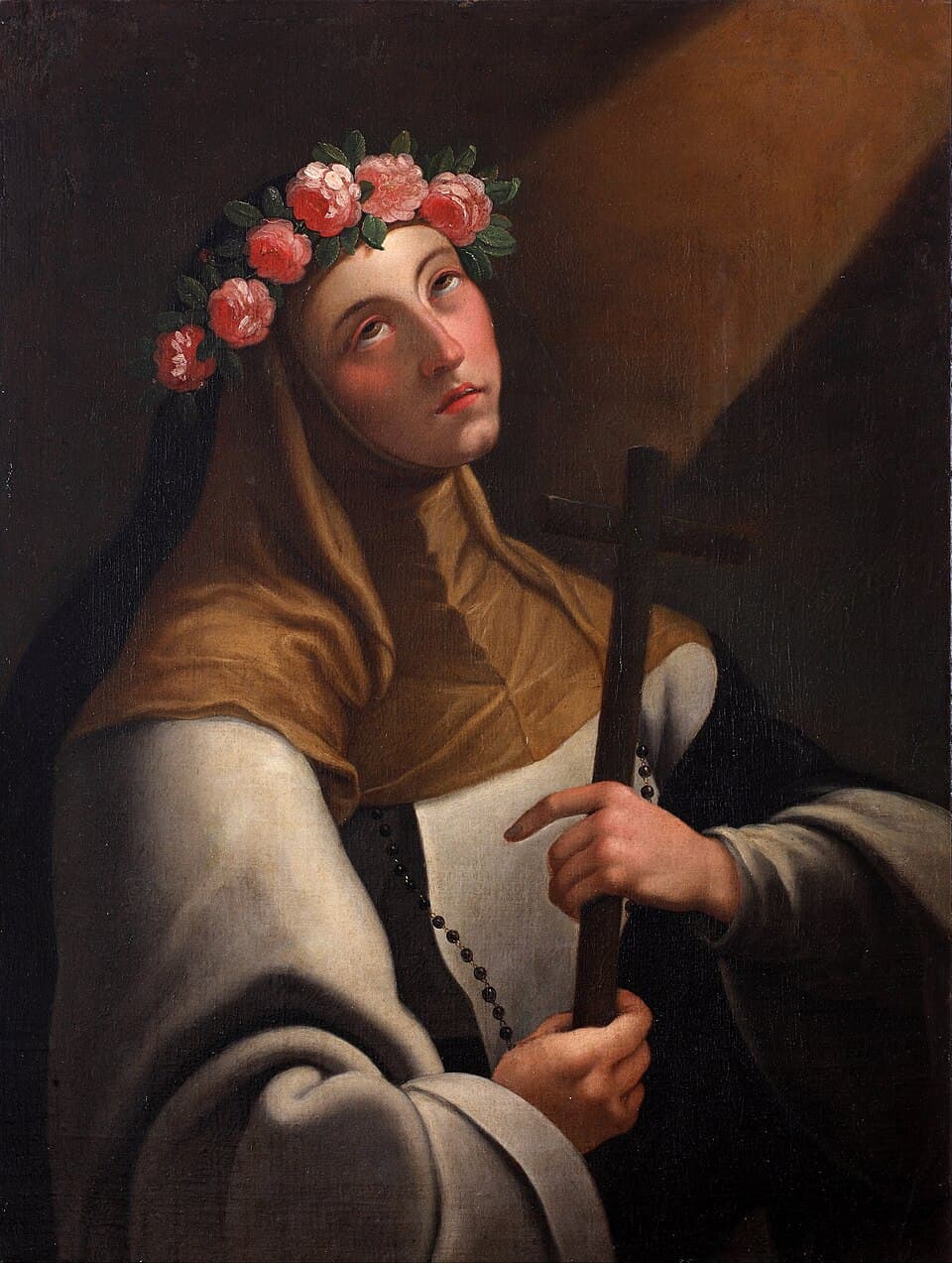
- Patron saint of
- The Americas, Peru, South America and the Philippines, and of florists, per Franciscan Media 2
- Her name
- Taken at confirmation in 1597, from a mystical rose said to have transfigured her face 1
- The first
- Canonized saint of the New World. She died at thirty-one 2
Saint Rose of Lima is the first canonized saint of the Americas, and the honest thing to say about her is what Franciscan Media says first: her penances are "more for admiration than for imitation." 2 She rubbed pepper into her face because people praised her beauty, wore a spiked silver band under a crown of roses, and slept on broken glass. 12 She also spent her last years nursing the sick and the homeless in a room of her parents' house. 2
A girl in a new country
She was born at Lima on 20 April 1586, to parents of Spanish descent, "at a time when South America was in its first century of evangelization." 12 At her confirmation in 1597 she took the name Rose, Ayme says, "because, when an infant, her face had been seen transformed by a mystical rose." 1
Ayme describes an unremarkable childhood of the devout kind - reverence, long hours before the altar of the Infant Jesus, obedience, and "untiring industry, making rapid progress by earnest attention to her parents' instruction, to her studies, and to her domestic work, especially with her needle." 1 The needle matters later; her embroidery helped keep the family.
Then she read about Catherine of Siena and decided to be her. 12 "She began by fasting three times a week, adding secret severe penances, and when her vanity was assailed, cutting off her beautiful hair, wearing coarse clothing, and roughening her hands with toil." 1
Franciscan Media gives the detail everyone remembers, and frames it: "because her beauty was so often admired, Rose used to rub her face with pepper to produce disfiguring blotches." 2 She was pretty, people said so, and she treated that as a danger to be destroyed.
Nobody around her approved. "All this time she had to struggle against the objections of her friends, the ridicule of her family, and the censure of her parents." 1 Franciscan Media: she took Catherine as a model "in spite of the objections and ridicule of parents and friends." 2
Ten years of saying no
The central conflict of her life was about marriage. Her parents wanted it; she had resolved on a vow of virginity. "For ten years the struggle continued before she won, by patience and prayer, their consent to continue her mission." 1
Ten years. Franciscan Media adds the other half of the deadlock: "They refused to let her enter a convent, and out of obedience she continued her life of penance and solitude at home as a member of the Third Order of Saint Dominic." 2 She was not allowed to marry, in her own conscience, and not allowed to leave, by her parents. So she built a religious life inside a family house.
She also worked. When her parents got into financial trouble "she worked in the garden all day and sewed at night", and Ayme notes that "her exquisite lace and embroidery helping to support her home" while her nights went to prayer. 12 She was keeping the household solvent throughout.
With her brother's help she built a small grotto in the garden, and eventually, with her confessor's permission, lived there as "practically a recluse in this cell, save for her visits to the Blessed Sacrament." 1 In her twentieth year she received the Dominican habit. 1
And it was not peaceful. "Great temptations assailed her purity, faith, and constance, causing her excruciating agony of mind and desolation of spirit." 1 Franciscan Media counts among the things she withstood "ridicule from without, violent temptation, and lengthy periods of sickness." 2 Whatever else the enclosure gave her, it did not give her calm.
What she did to herself
This section exists because leaving it out would be a lie, and it is written with Franciscan Media's warning standing over it: excessive, and "more for admiration than for imitation." 2
Ayme sets it down plainly. She wore "constantly a metal spiked crown, concealed by roses, and an iron chain about her waist." 1 Franciscan Media: "a thick circlet of silver on her head, studded on the inside, like a crown of thorns." 2 The roses in every painting of her are hiding it.
"Days passed without food, save a draught of gall mixed with bitter herbs." 1
And the bed. "When she could no longer stand, she sought repose on a bed constructed by herself, of broken glass, stone, potsherds, and thorns." 1 Then the sentence that makes her a person rather than an emblem: "She admitted that the thought of lying down on it made her tremble with dread." 1
She was frightened of her own bed and got into it anyway, for fourteen years. 1 A reader is entitled to find this disturbing rather than edifying. The Church has canonized her without ever proposing the bed as a model, and her own sympathetic biographers call the practice excessive. 2
Ayme also records what she thought she was doing it for: she offered it all "in expiation for offences against His Divine Majesty, for the idolatry of her country, for the conversion of sinners." 1 She believed she was paying something on behalf of other people.
The room at the back of the house
The last part of her life is the part that changes the shape of the rest, and Franciscan Media is the source for it.
"During the last few years of her life, Rose of Lima set up a room in the house where she cared for homeless children, the elderly, and the sick. This was a beginning of social services in Peru." 2
The recluse opened her door. The woman who had spent a decade negotiating for solitude used the solitude she had won to run an infirmary out of a spare room, and Franciscan Media credits it as the start of social care in the country.
The Inquisition looked into her - a laywoman with visions and extreme practices was exactly the sort of case it existed to examine - and Franciscan Media reports the finding: the interrogators "could only say that she was influenced by grace." 2
She died at thirty-one. Ayme dates it 30 August 1617; Franciscan Media's dates give August 24. 12 "When she died at 31, the city turned out for her funeral. Prominent men took turns carrying her coffin." 2 Lima buried her as a public figure.
What is Saint Rose of Lima the patron saint of?
Saint Rose of Lima is patroness of the Americas, of Peru, South America and Latin America, of the Philippines, and of florists. 2 Ayme calls her, in his first line, "patroness of America." 1
The continental patronage is a matter of being first: she is the first person canonized from the New World, and the Americas were given to her on that basis. 2 The florists follow from her name and from the roses in every image of her.
In practice she is also invoked by people in prolonged conflict with their own families over how they mean to live, and by those who suffer from scruples and religious anxiety. Her interior life was full of "excruciating agony of mind and desolation of spirit", and the honest reading of some of her penances is that they came out of that. 1
Saint Rose of Lima's feast day
The feast of Saint Rose of Lima is August 23. 2
Her death date is not settled between the sources. Ayme says she died at Lima on 30 August 1617; Franciscan Media's dates give August 24. 12 Neither acknowledges the other, and the feast sits on the 23rd, a day earlier than the earlier of the two. All three dates are recorded here rather than tidied into one.
In Peru and much of Latin America her day is a major civic occasion as well as a religious one, which follows from the funeral Franciscan Media describes - a whole city turning out, and prominent men taking turns to carry the coffin of a thirty-one-year-old woman who had almost never left her parents' garden. 2
Praying with Saint Rose
Take Franciscan Media's framing seriously, because it is unusually responsible for a devotional source. Her mortifications are named as excessive and set outside the range of what a reader should copy. 2 What is offered for imitation is something else: "a love of God so ardent that it withstood ridicule from without, violent temptation, and lengthy periods of sickness." 2 The endurance, not the glass.
The ten-year argument with her parents is the most ordinary thing about her and the most useful. She would not marry; they would not let her enter a convent; neither side gave way for a decade. 12 She did not run away and she did not submit. She kept working, kept the household afloat with her needle, and kept asking - and eventually they agreed. Most conflicts of conscience inside a family look more like that than like a clean break.
The bed is where a reader should be allowed to feel what they feel. Ayme records that she dreaded it. 1 There is a difference between a saint who is beyond fear and a saint who is frightened and proceeds, and Rose was the second. It is also fair to notice, as her own admirers do, that some of this was not health. Sanctity and suffering of mind can occupy the same person at once, and pretending otherwise helps nobody who is currently in both.
And then the room at the back of the house. 2 After everything - the pepper, the crown, the fourteen years - she spent her last strength on homeless children and sick old people, in her own home, and Peru dates its social services from it. The solitude she fought her parents for ten years to get, she gave away at the end.
Saint Rose of Lima, pray for us.
Sources
Saints to turn to next
Others in this collection who are turned to for some of the same things.
- Saint Catherine of Genoa1447 - September 15, 1510Anxiety and mental healthSuffering and illnessPrayer
- Saint Mary Magdalene de' PazziApril 2, 1566 - May 25, 1607PrayerAnxiety and mental healthSuffering and illness
- Saint Joachima de Vedruna1783 - 1854Suffering and illnessPrayer
- Saint John of GodMarch 8, 1495 - March 8, 1550Anxiety and mental healthSuffering and illness