Saint Paulinus of Nola
About 354 - June 22, 431
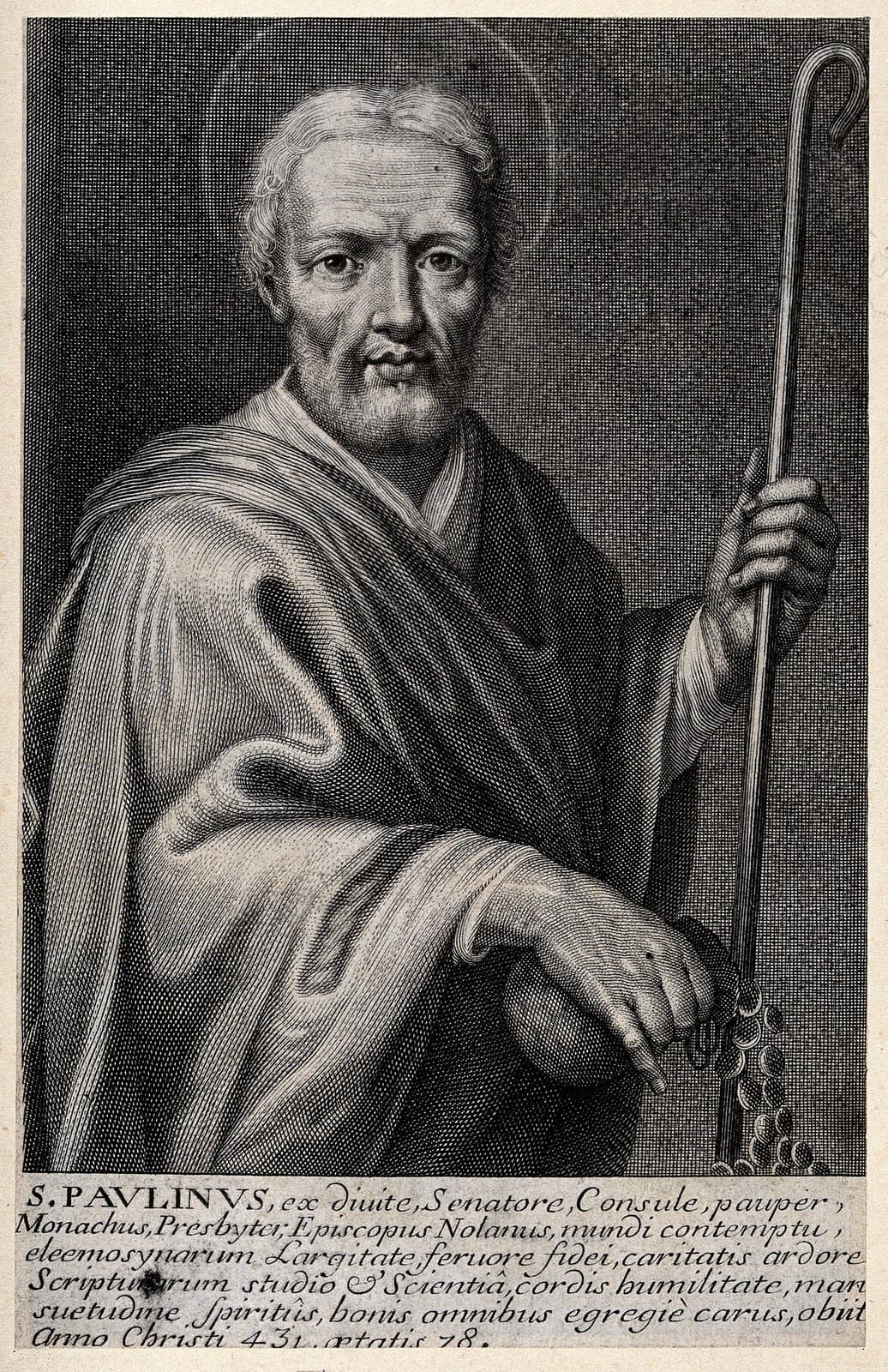
- Born
- At Bordeaux about 354, into a family of the Aquitanian nobility 1
- Was taught by
- The poet Ausonius, and governed the province of Campania 1
- Lost
- His only child eight days after birth, and was accused of murdering his brother 1
- Was ordained
- By a crowd at Barcelona, uncanonically, having received none of the lower orders 1
- Wrote
- The earliest surviving Christian wedding song 2
Saint Paulinus of Nola was a Roman governor, a poet's pupil and an heir to estates in two countries, and Franciscan Media's test of him is other people's letters: "Anyone who is praised in the letters of six or seven saints undoubtedly must be of extraordinary character." 2 He lost his only child at eight days old and was accused of murdering his brother, and he and his wife gave everything away. 1 A crowd at Barcelona then made him a priest on the spot, which his own encyclopedia notes was not legal. 1
Everything to lose
He was born at Bordeaux into "a distinguished family of Aquitania", and Franciscan Media names the position: "the son of the Roman prefect of Gaul, who had extensive property in both Gaul and Italy." 12 His education "was entrusted to the poet Ausonius" - one of the leading Latin poets of the century taught him personally, and they corresponded for the rest of Ausonius' life. 1
He became "a distinguished lawyer, holding several public offices in the Roman Empire", and governor of Campania. 12 And then, in Löffler's phrase, "he soon realized that he could not find in public life the happiness he sought." 1 He retired in his thirties to what Franciscan Media calls "a life of cultured leisure" with his Spanish wife Therasia. 2
Löffler lists the people he credited with his conversion, and it is a list rather than a moment: Therasia; Bishop Delphinus of Bordeaux and the presbyter Amandus; and Martin of Tours, "who had cured him of some disease of the eye." 1 He and his brother were baptized together by Delphinus. 1
Two things at once
The break with the world has two causes in the older source and one in the modern one.
Löffler: "When Paulinus lost his only child eight days after birth, and when he was threatened with the charge of having murdered his brother, he and his wife decided to withdraw from the world, and to enter the monastic life." 1
Franciscan Media has only the first: "After many childless years, they had a son who died a week after birth. This occasioned their beginning a life of great austerity and charity, giving away most of their Spanish property." 2 The accusation is absent from its account entirely.
Löffler gives no detail about the charge - not who made it, whether the brother died, or how it ended. It appears once, in a subordinate clause, as one of the two reasons a wealthy couple left public life. It is on this page because the source put it there.
They went to Spain about 390 and began giving the property away. 12
Made a priest by a crowd
At Christmas in 394 or 395, the people of Barcelona decided he should be their priest and did not take no for an answer. Löffler: "the inhabitants of Barcelona obliged him to be ordained, which was not canonical as he had not previously received the other orders." 1
That is an encyclopedia recording that a saint's ordination broke the rules - he went from layman to priest in a single step, without the intermediate orders, because a congregation insisted. Franciscan Media reports the same event without the irregularity: "Possibly as a result of this great example, Paulinus was rather unexpectedly ordained a priest at Christmas by the bishop of Barcelona." 2
He did not stay. He had a particular devotion to Felix, a saint buried at Nola in Campania - the province he had once governed - and in 395 he moved there for good. 12
What he built at Nola
He spent the money on the place. He "laid out a fine avenue leading to the church containing Felix's tomb, and beside it he erected a hospital", contributed to the aqueduct at Nola, and built basilicas at Nola and Fondi. 1
Löffler describes the basilica in unusual detail because Paulinus described it himself, in a letter that has become a source for historians of early Christian architecture: five naves, four chapels on each side, a clover-shaped apse, marble, silver lamps, paintings, statuary and inscriptions, and in the apse "a mosaic which represented the Blessed Trinity, and of which in 1512 some remnants were still found." 1 His letter thirty-two "has received special attention because in it he describes the basilica of Nola, which he built, and gives copious accounts of the existence, construction, and purpose of Christian monuments. From Paulinus too we have information concerning St. Peter's in Rome." 1
The rest went to people. Franciscan Media: he "gave away most of his remaining property - to the consternation of his relatives - and continued his work for the poor. Supporting a host of debtors, the homeless and other needy people, he lived a monastic life in another part of his home." 2 He kept a house and lived monastically in one wing of it while the rest supported whoever needed it.
About 409 he was made bishop, "by popular demand" again, and held the see for around twenty years. 12
The writing, and one criticism
Forty-nine letters and thirty-three poems survive, and a great deal does not - a panegyric on the Emperor Theodosius, a book of sacraments and hymns, letters to his sister, a book on penance, all lost. 1
Every year after 395 he wrote a hymn for the feast of Felix; thirteen survive and part of a fourteenth. 1 Löffler's assessment of the poetry is not merely polite: "The epic parts are very vivid, the lyrics full of real, unaffected enthusiasm and an ardent appreciation of nature." He adds the qualification too - "still he is not entirely free from the mannerisms and ornate culture of his period." 1
One poem has an odd distinction. The nuptial hymn for a friend's wedding "extols the dignity and sanctity of Christian marriage", and Franciscan Media identifies what it is: "the earliest extant Christian wedding song." 12 There is also a poem of comfort to a couple whose child had died, written by a man whose own son had lived eight days. 1
And there is a criticism, from a friend. "According to Augustine, he also had an exaggerated idea concerning the veneration of saints and relics." 1 Augustine thought he went too far about relics, and the encyclopedia prints it.
His last years were overshadowed by invasion: "Saint Paulinus of Nola's last years were saddened by the invasion of the Huns." 2 Löffler notes that "during his lifetime Paulinus was looked upon as saint." 1
What is Saint Paulinus of Nola the patron saint of?
Neither source cited here gives him a patronage. 12 Löffler ends with the travels of his body; Franciscan Media with the feast. Neither names a cause he is invoked for, and this page does not supply one.
His bones moved a great deal. Buried first in the cathedral at Nola, then at Benevento, then taken to Rome by the Emperor Otto III - and finally, by a decision of Pius X in 1908, sent back to Nola. 1 Löffler was writing three years after they got home.
Saint Paulinus of Nola's feast day
Praying with Saint Paulinus
He is the saint for a life that came apart at the top. He had everything the fourth century could give a man - money, a famous teacher, office, land in two provinces, a happy marriage - and what broke it open was a baby who lived eight days and an accusation of murdering his own brother. 1 Franciscan Media reports the first and omits the second; the older source gives them together as the reason he walked away.
What he did with the wreckage is oddly practical. He gave away the Spanish estates, then most of what was left, and used the rest on infrastructure: a road to a shrine, a hospital beside it, the town aqueduct, a basilica. 12 He kept the house and lived monastically in part of it while the rest paid the debts of people he did not know. 2 His relatives were appalled. 2
The wedding song is the detail to sit with. The earliest Christian marriage hymn that survives was written by a man who had buried his only child, in praise of the dignity of marriage - and he also wrote a poem to console another couple whose child had died. 12 He kept writing about the thing that had cost him most.
And Augustine, his friend, thought he was excessive about relics, and the encyclopedia prints the criticism next to the praise. 1 Being admired in the letters of six or seven saints did not mean they agreed with him about everything.
Saint Paulinus of Nola, pray for us.
Sources
Saints to turn to next
Others in this collection who are turned to for some of the same things.
- Saint Margaret of Scotlandc. 1045 - November 16, 1093Marriage and familyPrayerPoverty and simplicity
- Saint Anthony of Paduac. 1195 - June 13, 1231Poverty and simplicityPrayer
- Saint Basil the Greatc. 329 - January 1, 379Poverty and simplicityPrayer
- Saint Benedict Joseph Labre1748 - April 16, 1783Poverty and simplicityPrayer