Saint Basil the Great
c. 329 - January 1, 379
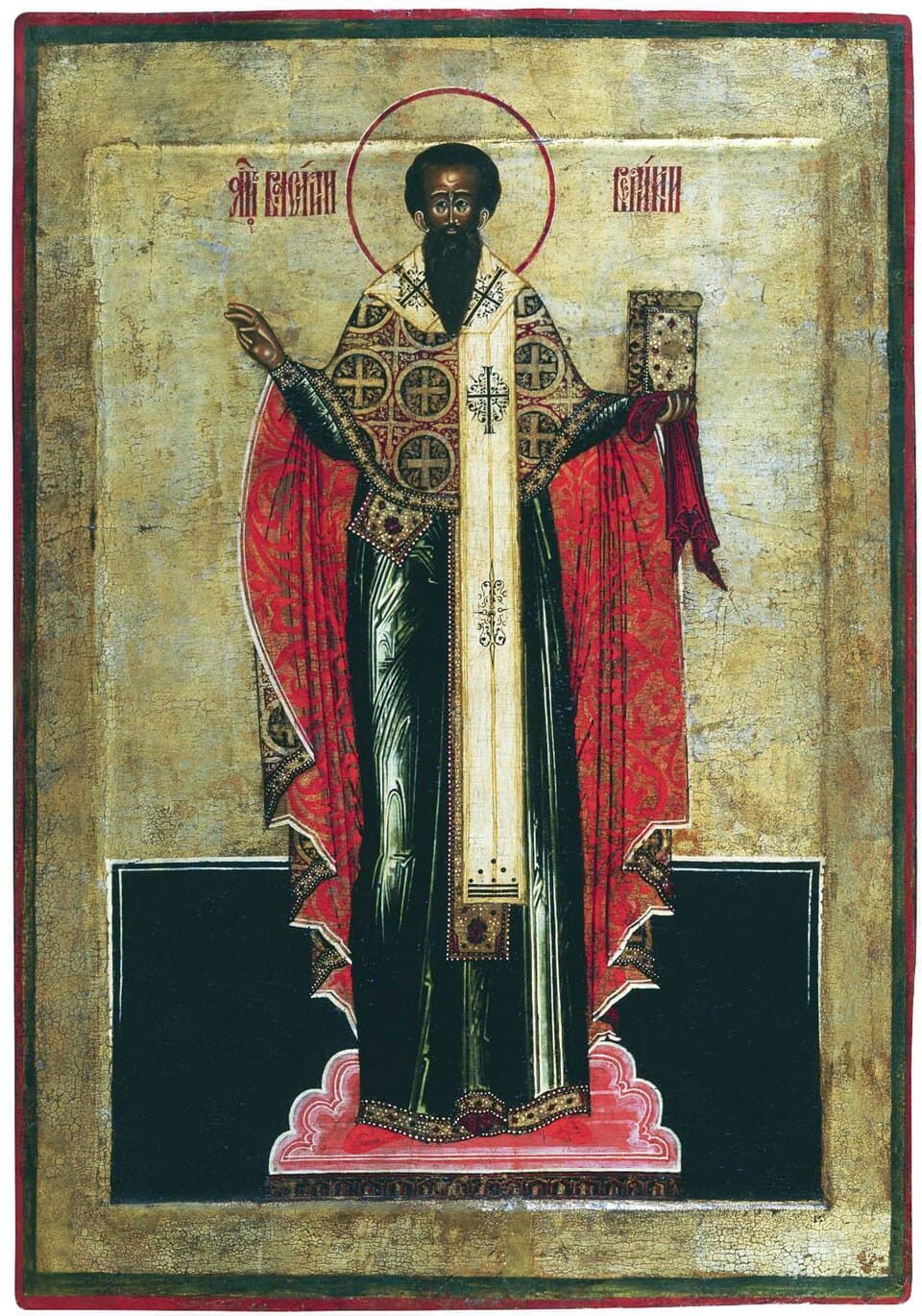
- Patron saint of
- Russia, which is the only patronage Franciscan Media lists for him 3
- Feast day
- January 2 3. The encyclopedia records three older reckonings: 14 June, 1 January, and a joint feast on 30 January from 1081 1
- Born
- Probably 329, into a family McSorley traces across three generations of saints; Benedict XVI says about 330 12
- Bishop of Caesarea
- From 370, consecrated according to tradition on 14 June, with eleven provinces under him 1
- Founded
- The Basiliade, a complex for the needy outside Caesarea that Benedict XVI calls the origin of the modern hospital 2
Saint Basil built what Benedict XVI calls the ancestor of the modern hospital, and named nothing after himself - the people of Caesarea called it the Basiliade anyway. 2 He is one of the Three Cappadocians, the man Benedict says gave monasticism in the East its shape, and the author of a Eucharistic Prayer still used. 12 He was also, by his own account, a young man badly impressed with his own education, who woke up out of it in tears. 2
A family of saints, and an expensive education
The household Basil came from is unusual enough to be worth stating plainly. His grandparents suffered for the faith under Maximinus Galerius and spent years of hardship in the mountains of Pontus. 1 His father, Basil the Elder, was a layman noted for virtue and a well-known teacher at Caesarea. 1 Of the ten children, three are honored as saints, and three of the sons became bishops. 1 Benedict's phrase for the house is "a true domestic Church." 2
He was schooled at Caesarea, then Constantinople, then Athens, where he became the inseparable companion of Gregory of Nazianzus. 1 Gregory's later panegyric describes a student already distinguished for brilliance and seriousness who kept company only with the most earnest, and who came away, in Gregory's phrase, "with all the learning attainable by the nature of man" - rhetoric, grammar, philosophy, astronomy, geometry and medicine. 1 Caesarea took him back gladly "as a founder and second patron," and he turned down a generous offer from Neo-Caesarea to run the education of their young. 1
What happened next he described himself, and both sources quote it. Gregory of Nyssa suggests the academic success had left traces of worldliness and self-sufficiency. 1 Basil's own account: "One day, like a man roused from deep sleep, I turned my eyes to the marvellous light of the truth of the Gospel..., and I wept many tears over my miserable life." 2 He read the Gospel and found there that the way to perfection ran through selling what he had, sharing it with the poor, and giving up care for this life. 1 Then he went and looked at how it was actually done, visiting the monasteries of Egypt, Palestine, Coele-Syria and Mesopotamia before founding one of his own in Pontus. 1
The monasticism he invented
Eustathius of Sebaste had already brought the hermit's life to Asia Minor. What Basil added was the cenobitic form, the common life, and McSorley says it was promptly imitated by many companies of men and women. 1 He became known as the father of Eastern monasticism and the forerunner of Benedict - and Benedict, in the Rule, calls Basil his teacher. 12
Benedict XVI puts his finger on what makes the Basilian version distinctive, and it is not austerity. "Basil created a very special monasticism: it was not closed to the community of the local Church but instead was open to it." 2 The monks belonged to the particular Church and were its life-giving nucleus. 2 They ran schools and hospitals, and were at the service of the poor. 2 John Paul II went so far as to write that many people think the essential structure of monastic life in the Church "was established, for all time, mainly by St Basil." 2
The practical consequence shows up when he became a public figure. As a priest in Caesarea he handled the support of the poor, the entertainment of strangers, the care of maidens, legislation for the monastic life, and the arrangement of the prayers. 1 McSorley summarizes his performance in a famine in six words: "he was the saviour of the poor." 1 In 370 he succeeded to the see of Caesarea, metropolitan of Cappadocia and exarch of Pontus, with more than half of Asia Minor under him. 1
The Basiliade, and what he said about money
The institution he built for the needy outside Caesarea was substantial enough that Sozomen describes it as a kind of city, and it was named after him by everyone else. 2 Benedict XVI's claim for it is not modest: "This was the origin of the modern hospital structures where the sick are admitted for treatment." 2
The preaching that went with it was sharper than the buildings. Benedict says Basil used "courageous, strong words" on the subject and quotes them. Anyone who wants to love his neighbor as himself, according to God's commandment, "must possess no more than his neighbour." 2 In times of famine he told his congregation "not to be more cruel than beasts... by taking over what people possess in common or by grabbing what belongs to all." 2 And the line Benedict singles out as the most evocative: "All the destitute look to our hands just as we look to those of God when we are in need." 2
Benedict's conclusion is flat and worth quoting because of who is saying it: "We see that St Basil is truly one of the Fathers of the Church's social doctrine." 2 The theological ground is stated too. Life is a stewardship of goods received from God, each person is responsible for the others, and whoever is rich must be, as it were, an "executor of the orders of God the Benefactor." 2
He was a liturgical reformer as well, which Gregory of Nazianzus noted. 2 The Eucharistic Prayer that carries his name is still in use, and he gave a fundamental order to prayer and psalmody - at his prompting, Benedict says, people learned to love the Psalms and went out to pray them at night. 2 He recommended frequent and even daily Communion in a letter. 2 Liturgy, prayer and charity are not separate programs in him; Benedict says they "go hand in hand and condition one another." 2
Bees, and what to do with pagan books
One of the more surprising things Basil left is a short address to young men on how to read pagan literature, and it is not what a reader braced for the fourth century might expect. He recognized, Benedict says, "with great balance and openness" that examples of virtue are to be found in classical Greek and Latin writing, and that such examples can help young Christians looking for the truth. 2
The image he used for the method is bees. Bees do not visit every flower without distinction, and they do not try to strip the ones they land on; they take what they need to make honey and leave the rest. 2 "And if we are wise, we will take from those writings what is appropriate for us, and conforms to the truth, ignoring the rest." 2 Benedict says the resulting habit is a question of true and proper "discernment," and that it is how young people grow in freedom. 2
What is Saint Basil the Great the patron saint of?
Franciscan Media lists Saint Basil as patron of Russia, and lists nothing else. 3 Neither the encyclopedia nor Benedict XVI states a patronage for him. 12 He is often associated with hospitals and those who run them, for the obvious reason of the Basiliade, but none of the three sources used here calls him their patron, so this profile does not either.
Saint Basil the Great's feast day
The feast of Saint Basil the Great is January 2, kept with his friend Gregory of Nazianzus. 3 The history behind that date is unusually tangled, and McSorley lays it out. The earlier Latin martyrologies, the Hieronymian and Bede's, make no mention of a feast of Basil at all; the first mention is in Usuard and Ado, who place it on 14 June, the supposed date of his consecration as bishop; the Greek Menaea commemorate him on 1 January, the day he died; and in 1081 John, Patriarch of Constantinople, established a joint feast of Basil, Gregory of Nazianzus and John Chrysostom on 30 January. 1 Four dates, three of them not the current one, and the day he actually died is not the day he is kept.
Praying with Saint Basil
Basil is the answer to a particular worry, which is that a serious interior life and a competent public one are in competition. He ran a diocese covering eleven provinces, built and staffed a complex for the sick and the destitute, wrote a monastic rule that shaped the East and reached Benedict in the West, revised the liturgy, and argued the Trinity against people with the emperor behind them. 12 Benedict describes him as combining, "with a wise balance," service to souls with dedication to prayer and meditation in solitude. 2
His account of his own conversion is the least flattering thing in either source, and he is the one who tells it. He had done extremely well and had wasted a great deal of time on vanities, and he wept over it. 2 Notably, what he did next was not to retreat into private improvement. He went and inspected monasteries in four countries to learn how the thing was actually done, and then built one. 1
On money he is harder to listen to than almost anyone the Church has canonized, and the sentence about possessing no more than your neighbor is not softened by either source. 2 It sits beside the fact that he spent the family fortune on the Basiliade and was, in a famine, the person the poor of Caesarea survived. 12 He is not making a rhetorical point from a comfortable distance.
The bees are the last thing, and the most usable. A Christian is not required to take everything in the culture or to refuse all of it, and Basil thought the work of sorting was itself formative - that a young person who learns to take what conforms to the truth and leave the rest is growing in freedom rather than losing it. 2 Gregory of Nazianzus, praising him after his death, said Basil convinces us that "since we are human beings, we must neither despise men nor offend Christ." 2 He died on the first day of 379, not yet fifty, and McSorley records that Jews, pagans and foreigners competed with his own flock to do him honor. 1
Saint Basil the Great, pray for us.
Sources
Saints to turn to next
Others in this collection who are turned to for some of the same things.