Saint Clare of Assisi
1194 - August 11, 1253
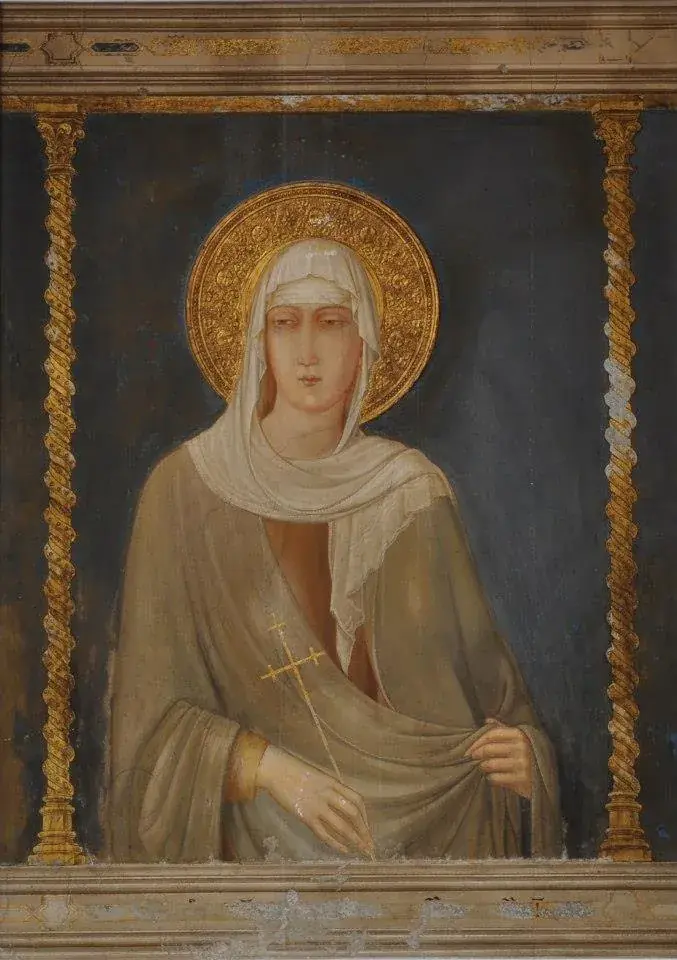
- Patron saint of
- Protection from eye disorders, and television 3
- Founded
- The Order of Poor Ladies, later the Poor Clares, at San Damiano 2
- Privilege of Poverty
- Granted by Gregory IX, September 17, 1228 2
Clare was eighteen, from a wealthy Assisi family, with a good marriage arranged for her. On the evening of Palm Sunday she walked out of the house and went to Francis, who cut off her hair and gave her a rough habit. She lived the next forty years at San Damiano and spent a good deal of that time fighting popes for the right to own nothing.
Leaving
She was born at Assisi in 1194, or 1193 depending on which source you take, into an aristocratic household with plans for her. 123 In 1211 she left in the night with her friend Bona di Guelfuccio and went to Francis at the Portiuncula, where he cut her hair and clothed her in penitential cloth. 1
After a short period with Benedictine communities, Francis obtained the chapel of San Damiano for her as a permanent home. 2 She stayed there for the rest of her life, more than forty years, and almost never left the enclosure.
The right to have nothing
Religious houses in the thirteenth century held property, because property was how a community survived. Clare wanted her sisters to hold none at all, and she had to get that in writing. Gregory IX granted the Privilegium Paupertatis on 17 September 1228, confirming that the community would have absolutely no possessions, in order to follow in all things the example of him who became poor. 2
Benedict XVI calls it a truly extraordinary exception to the canon law of the time. 1 She was not asking for permission to be poor. She was asking for protection against being made rich.
The first rule written by a woman
Clare wrote her own Rule and submitted it for papal approval, and Benedict XVI notes that she is the first woman in the history of the Church known to have done so. 1 It was approved days before she died.
She died at San Damiano on 11 August 1253 and was canonized just over two years later, on 26 September 1255, by Alexander IV. 12 The bull of canonization has a line about her that is hard to improve on: Clare lay hidden, but her life was revealed to all. 1
What is Saint Clare the patron saint of?
Franciscan Media lists her as patron of protection from eye disorders and of television. 3 The second sounds like a joke and is not one; it was given because of an account of her watching Mass on the wall of her cell when she was too sick to be carried to it.
Saint Clare's feast day
Praying with Saint Clare
She went out a door at eighteen and never really came back. 1 Whatever else is true of Clare, she is not a saint for people who want their vocation to be reversible.
The Privilege of Poverty is the strangest document in her story: a woman petitioning the pope for the right to own nothing, and having to argue for it. 2 Most people spend their energy in the opposite direction, and it is worth asking occasionally which way yours is going.
Forty years in one small place, and she wrote the first rule a woman ever gave the Church. 1 The enclosure did not make her smaller.
Clare lay hidden, her canonization bull says, but her life was revealed to all. 1 That is a fair description of most hidden lives, eventually.
Saint Clare of Assisi, pray for us.
Sources
Saints to turn to next
Others in this collection who are turned to for some of the same things.