Saint Judoc
c. 600 - c. 668
- Born
- About 600 1
Saint Judoc was a son of the king of Domnonée in Brittany who refused to rule, left his country, and spent his life as a priest and hermit in Ponthieu in northern France. 12 His hermitage at the mouth of the Canche became the abbey of Saint-Josse-sur-Mer, and his cult spread to England, Flanders, Germany and the Alps, where pilgrims took him as their patron. 13
The prince who would not be king
Judoc was born about 600. 1 The Norwegian bishops' saints database (katolsk.no) says that by tradition he was the son of Juthael, king of Domnonée in Armorica, and the younger brother of Saint Judicael, who took the throne about 607. 1 His name comes from the Old Breton Iudoc, and it has taken many forms: Judocus and Jodocus in Latin, Josse in French, Jost and Jodok in German, Joost in Flemish and Joyce in English. 13
The sources give three different reasons for his leaving. katolsk.no says he was educated at the monastery of Lammamiont, and that about 640, when Judicael abdicated and withdrew to a monastery, the rule of Brittany fell to Judoc. 1 He asked for eight days to consider, went back to Lammamiont, and spent them alone with God day and night, with many tears. 1 At the end he renounced the crown and set it down on the ground as a sign. 1 The Roman Martyrology, as the Italian bishops print it, says he left his country so as not to be forced to succeed his father. 2 Nominis, the French bishops' saints site, quotes the Diocese of Arras: it says he gave up the world when his wife died. 3
Priest and hermit in Ponthieu
He went to Ponthieu, on the coast of northern France, and there became chaplain to the local lord. 1 katolsk.no names him as Duke Haimo of Ponthieu, who would be Judoc's friend and protector for the rest of his life. 1 It gives two versions of this period. In one, he made a pilgrimage with eleven companions to Chartres, Paris and Amiens and a hard journey to Rome, became a hermit, was ordained, and served for seven years a church of Saint Martin that he had built with Haimo's help. 1 In the other, he studied in Paris, was sent by churchmen on a mission to Haimo, was ordained, and spent some years at Haimo's residence. 1
About 644 he withdrew with a single disciple, Wulmar, into the forest at Ray, where a small piece of land on the river Authie could be farmed. 1 The duke built them a chapel and cells. katolsk.no says the two hermits grew enough for their own meager needs and gave the surplus to the poor, and lived in strict penance, prayer and contemplation. 1
Visitors came because of his miracles, and after eight years he moved to Runiac, near the mouth of the Canche below Étaples. 1 Later, after Judoc had been bitten by a viper, they moved again, to a hermitage that Haimo built for them at a place called Schaderias, about seven kilometers west of Montreuil, with two wooden chapels, one to Saint Peter and one to Saint Paul. 1 katolsk.no's dates for these moves do not agree with one another, but the order is clear: Ray, then Runiac, then Schaderias, which in time took his name as Saint-Josse-sur-Mer. 1 Many small miracles were credited to him there, among them the discovery of a spring said to cure blindness and other illnesses. 1
Four beggars and four ships
katolsk.no says Judoc never refused the poor while he had a crumb of bread left in the hermitage. 1 One day, it says, four hungry men came to his door one after another. He halved his loaf three times, and when the last piece was too small to divide he gave it to the fourth man. 1 Wulmar, who had grown more and more anxious as their bread ran out, was much relieved to see four boats with provisions coming up the river, probably sent by Haimo. 1 The legend that grew from the story, katolsk.no adds, says the four men had been Christ himself, testing his servant's charity. 1
The two hermits kept strict enclosure, with one exception. katolsk.no says that out of devotion to the apostles and martyrs they made a penitential pilgrimage to Rome. 1 When they returned, they found that the duke had enlarged their hermitage and built a fine stone church dedicated to Saint Martin of Tours, and Haimo met them on the road himself and led them to their new home. 1
Judoc died some time after that pilgrimage. 1 The Martyrology in its French text dates his death about 668; Catholic.net's Spanish santoral says the same; Nominis gives 669 in its heading, and the Diocese of Arras says only that he died on a December 13 at the end of the seventh century. 34 katolsk.no gives about 668 or December 13, 675. 1 He was buried at his hermitage, and a monastery soon grew up there under his name. 13 Catholic.net says his body remained incorrupt; katolsk.no reports the same claim, and adds that two of his nephews, Winoc and Arnoc, inherited the hermitage. 14 The Arras notice instead names Winoc and Rodichael as his brothers. 3 katolsk.no says his Life was written about 710. 1
From Ponthieu to England and the Alps
katolsk.no says that in 792 Charlemagne gave Judoc's hermitage to Alcuin, to serve as a guesthouse for English travelers crossing the Channel. 1 About 902 refugees from Saint-Josse brought his relics to Winchester, where Saint Grimbald enshrined them in the New Minster, and feasts of high rank for Judoc were kept there and spread to many medieval English calendars. 1 By 977 relics were back at Saint-Josse-sur-Mer, either returned from Winchester or a rival set discovered in France. 1
His name traveled with the relics. katolsk.no points to the English name Joyce, used for men and women, and to Chaucer's Wife of Bath, who swears "by God and by Seint Joce." 1 From Saint-Josse the cult spread to Flanders, Germany, Alsace, Switzerland and Austria, where he is shown on the Emperor Maximilian's tomb at Innsbruck. 1 In Germany he ranked beside Saint James the Greater as a patron of pilgrims, and when German pilgrims to Compostela formed confraternities they chose Judoc as their patron and often named themselves for him. 1 Nominis notes that Saint-Josse is still a place of pilgrimage. 3
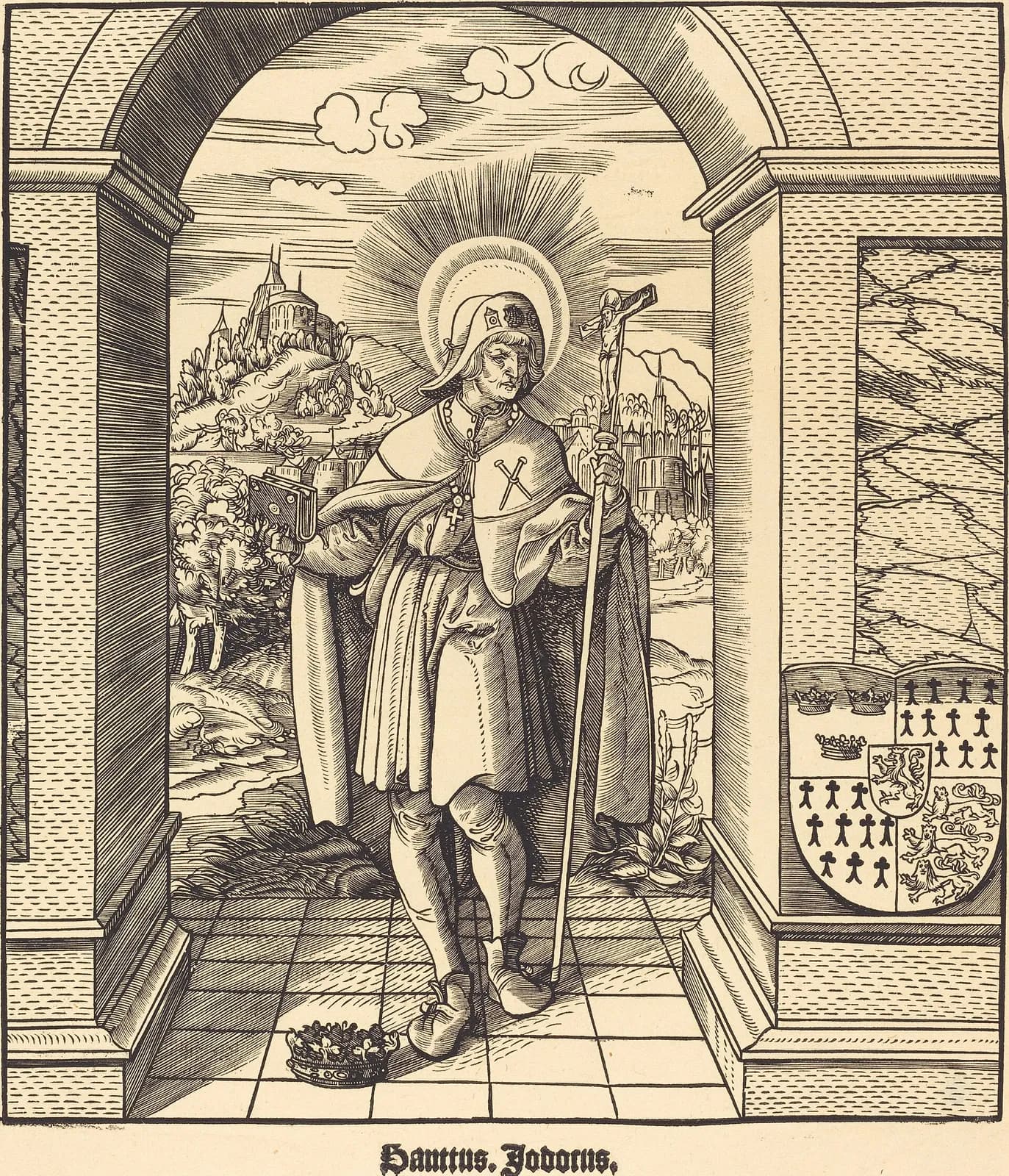
He is usually shown as a pilgrim or a hermit, often young, with a crown lying at his feet as the sign of the kingship he gave up. 14 katolsk.no says he is sometimes shown striking the crown into the ground with his staff so that a spring rises, and calls that a legend. 1
What is Saint Judoc the patron saint of?
katolsk.no names Saint Judoc as patron of pilgrims, sailors and bakers, of the blind and of hospitals, of good harvests and cattle, and as a protector against fire, storms, fever and plague. 1 Catholic.net calls him patron of seafarers and says he is invoked against fever, fire and shipwreck. 4 His role as a patron of pilgrims, katolsk.no says, was strongest in Germany, where confraternities of pilgrims to Compostela often named themselves for him. 1
Saint Judoc's feast day
Saint Judoc's feast day is December 13, the day of his death. 134 The Roman Martyrology enters him on that day as a priest and hermit in northern Neustria. 2 katolsk.no adds that Winchester kept the translation of his relics on January 9, and that Amiens keeps a feast of his translation on July 26. 1
Praying with Saint Judoc
The fullest account of his choice has him take eight days, alone and in tears, before he set the crown down. 1 Whichever reason the sources give for his leaving, all of them agree that he chose to be poor and far from home. 123
He did not live alone for long at a time. A duke befriended him, a disciple followed him, and crowds kept finding him, so that he moved from Ray to Runiac to the coast. 1 The story told of him most often is about bread: a loaf cut in half three times for strangers, while the man beside him watched the store run out. 1
His name went farther than he ever did. Pilgrims who never saw Ponthieu took a prince who had stayed a pilgrim all his life as their patron. 1
Saint Judoc, pray for us.
Sources
- 1."Den hellige Judoc av Bretagne (~600-~668)," Den katolske kirke (katolsk.no), Catholic Diocese of Oslo (in Norwegian).
- 2.Roman Martyrology, entry for December 13, "San Giudoco, sacerdote ed eremita," as printed in "Santo del giorno," Conferenza Episcopale Italiana (in Italian).
- 3."Saint Josse," Nominis, Conférence des évêques de France, quoting the Diocese of Arras and the Roman Martyrology (in French).
- 4."Judoco, Santo," Santoral, Catholic.net (in Spanish).
Saints to turn to next
Others in this collection who are turned to for some of the same things.
- Saint Benedict Joseph Labre1748 - April 16, 1783Poverty and simplicityPrayerDiscernment
- Saint Francis of PaolaMarch 27, 1416 - April 2, 1507PrayerPoverty and simplicityDiscernment
- Saint Agnes of Bohemiac. 1200-1205 - March 1281 or 1282Poverty and simplicityPrayerDiscernment
- Saint Celestine V1215 (or 1210) - May 19, 1296DiscernmentPrayerPoverty and simplicity