Saint Celestine V
1215 (or 1210) - May 19, 1296
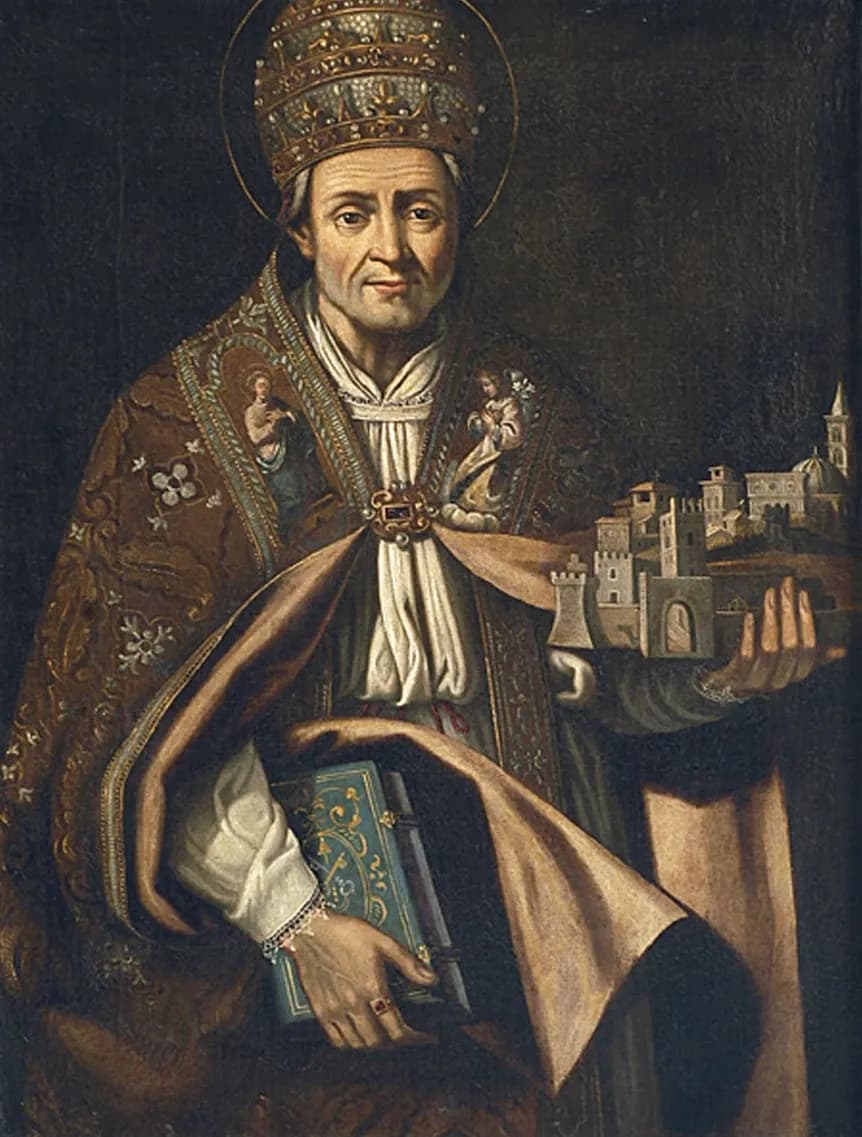
- Founded
- The Celestines, approved as a branch of the Benedictines by Urban IV in 1264 1
- Elected pope
- July 5, 1294, at Perugia, after a vacancy of more than two years 1
- Died
- May 19, 1296, in the castle of Fumone 1
- Canonized
- 1313, by Pope Clement V 1
- Patronage
- Aquila, Italy; bookbinders, as Catholic Culture lists it 4
Saint Celestine V was a mountain hermit named Peter of Morrone who was elected pope in July 1294, when he was an old man, by cardinals who had failed for more than two years to agree on anyone else. 1 He reigned five months, decided he was not fit for the office, and on December 13, 1294, resigned it. 14 He died a prisoner in the castle of Fumone on May 19, 1296, and May 19 is his feast. 15
The hermit of Morrone
The sources do not agree on when or where he was born. The 1908 Catholic Encyclopedia says 1215, in what it calls "the Neapolitan province of Moline." 1 Catholic Culture says 1210 and names Isneria, in the Abruzzi. 4 Benedict XVI, who calls him by his family name, Pietro Angelerio, visited Sulmona in July 2010 during a jubilee year the bishops of Abruzzo and Molise had proclaimed for the 800th anniversary of his birth. 2
The encyclopedia says only that he was of humble parentage. 1 The Life excerpted by Catholic Culture makes him the eleventh of twelve children of a poor farmer, and says his widowed mother sent him to school all the same. 4 He became a Benedictine at seventeen and was later ordained a priest in Rome. 1 The excerpted Life adds that he agreed to ordination in order "to find in the Holy Eucharist assistance against temptation." 4
What he wanted was solitude. He went first into the wilderness of Monte Morrone in the Abruzzi, which gave him his name, and afterward into the wilder country of the Majella. 1 The encyclopedia says he took John the Baptist for his model, and it lists what that meant: a hair shirt roughened with knots, an iron chain around his body, a fast every day except Sunday, and four Lents a year, three of them on bread and water. 1
He did not get the solitude. "Many kindred spirits gathered about him eager to imitate his rule of life," the encyclopedia says, and Pope Urban IV approved them as a branch of the Benedictines in 1264. 1 By the time he died there were thirty-six monasteries and six hundred religious, called Celestines after the name he took as pope. 1 In 1284, tired of governing them, he appointed a vicar named Robert and went back into the mountains. 1
An election nobody expected
Pope Nicholas IV died on April 4, 1292. Two years and three months later the conclave at Perugia had still not chosen a successor. 1 There were twelve cardinals, split between the parties of the Orsini and the Colonna, and neither side could outvote the other. 1 A visit from King Charles II of Naples in the spring of 1294 only made things worse. 1
Then Cardinal Latino Orsini told the others that God had revealed to a holy hermit that if they did not do their duty within four months, the Church would be severely punished. Everyone knew he meant Peter of Morrone. 1 The exhausted cardinals seized on the name and elected him unanimously, on July 5, 1294. 1
Three dignitaries and a great crowd climbed the mountain to tell him, a scene the encyclopedia calls "unparalleled in ecclesiastical history." 1 Benedict XVI names the place where he heard it as the hermitage of Sant'Onofrio. 2 Peter wept at the news, prayed briefly, and accepted. 1 He took the name Celestine, according to Catholic Culture's excerpt, "to remind him of the heaven he was leaving and for which he sighed." 4
Five months as pope
King Charles arrived at once with his son, in the encyclopedia's words "ostensibly to present his homage to the new pope, in reality to take the simple old man into honourable custody." 1 At the king's prompting Celestine refused to go to Perugia and summoned the cardinals to L'Aquila, inside the Kingdom of Naples. He rode there on a donkey whose rope was held by two kings. 1 The king had him crowned when only three cardinals had arrived, so the ceremony had to be repeated in traditional form some days later; the encyclopedia dates his consecration and coronation to August 29. 1 Benedict XVI places the coronation in the Basilica of Collemaggio. 2
The encyclopedia is blunt about what followed: "It is wonderful how many serious mistakes the simple old man crowded into five short months." 1 Again at the king's wish he moved the whole Curia to Naples. On September 18 he created twelve cardinals, seven of them French. He refused nobody, and was found to have granted the same office to three or four rival petitioners. 1 In Naples he lived in one room of the Castel Nuovo, and as Advent came on he had a small cell built there on the pattern of his hut in the Abruzzi. 1
One act of those months has lasted. Benedict XVI recalled that, once elected, "he chose to grant a special Indulgence," known as the Perdonanza, the Pardon. 2 L'Aquila has kept it for centuries as the Celestinian Forgiveness, and Pope Francis preached there on that day in 2022. 3
The resignation
He was not at peace. Business of state took the time he thought belonged to prayer, and he came to fear for his soul. 1 The idea of resigning seems to have occurred to him and to his discontented cardinals at about the same time. 1 It raised a real question, which the encyclopedia puts plainly: "Can a pope resign?" He has no superior on earth to accept a resignation. Cardinal Benedetto Gaetani, a trained canon lawyer, examined it and answered yes. 1
When the rumor spread, King Charles organized opposition, and a great procession of clergy and monks surrounded the castle begging Celestine to stay. He gave an evasive answer, and they sang the Te Deum and went home. 1 A week later, on December 13, 1294, he called the cardinals together, read a constitution declaring that a pope may freely resign, and resigned. 1 The cardinals then elected Gaetani, who took the name Boniface VIII. 1
Flight, capture and death
Boniface revoked many of his predecessor's acts and took him along on the road to Rome, now dressed as a hermit again, because he feared what enemies might do with "the simple old man." 1 Celestine slipped away at San Germano and reappeared among his monks at the Majella. Boniface ordered his arrest. For several months he kept ahead of the search in the woods and mountains, and at last he tried to cross the Adriatic to Greece. A storm drove the boat back, and he was caught at the foot of Monte Gargano. 1
Boniface shut him in a narrow room in the tower of the castle of Fumone, near Anagni. 1 The Life excerpted by Catholic Culture gives him a line there: "I desired nothing but a cell, and a cell they have given me." 4 The encyclopedia says he spent nine months in fasting and prayer, with two of his own monks to attend him, "though rudely treated by the guards." 1 It also says that the old charge against Boniface, that he had Celestine murdered, "is a calumny." 1
He died on May 19, 1296, in his eighty-first year by the encyclopedia's reckoning. 1 Catholic Culture's excerpt, which makes him seventy-two at his election, says that on Pentecost Sunday he told his guards he would die within the week, and that he died the following Saturday as he finished the last verse of Lauds. 4 Clement V canonized him in 1313, and some years later his body was moved from Ferentino to the church of his order at L'Aquila. 1
What is Saint Celestine V the patron saint of?
Catholic Culture lists his patronage as "Aquila, Italy; bookbinders." 4 The city is the one where he was crowned and where his relics lie in the Basilica of Santa Maria di Collemaggio. 24 None of the sources consulted explains the bookbinders. At Sulmona, Benedict XVI entrusted the young people of the diocese to Saint Peter Celestine among their patrons. 6
Saint Celestine V's feast day
Saint Celestine V's feast is May 19, the day he died in 1296. The Catholic Encyclopedia gives that date, Vatican News lists him on it as "St. Peter Celestine V, Pope," and Catholic Culture notes that the Roman Martyrology commemorates him then. 145 Catholic Culture files him under the day's other commemorations, taken from the Martyrology, and not as a memorial of the general calendar. 4
Praying with Saint Celestine V
Two popes have gone to the Abruzzo to talk about him, and neither spent long on the resignation. Benedict XVI, at Sulmona in 2010, started with the hermit. He called the young Pietro a "seeker of God" who went looking for the answers to the largest questions and found that he needed silence to hear them. 2 To the young people that afternoon he described him as "a man of listening, of inner silence, a man of prayer, a man of God." 6
Benedict also took up the obvious objection, that a hermit is running away from responsibility. He granted that the temptation exists, and answered that in the forms the Church approves, a life of solitary prayer is lived for other people. 6 Of the papacy itself he said that Celestine acted according to his conscience, "not fearing to lose his dignity but knowing that it consists in existing in truth." 6
Pope Francis, at L'Aquila in 2022, went straight at the phrase from Dante that is attached to Celestine, "the one who made a great refusal," and said that we remember him wrongly by it. Celestine, he said, was a man who said yes. 3 Francis called him "a courageous witness of the Gospel because there was no logic or power that was able to imprison or control him." 3
The encyclopedia, for its part, does not pretend the five months went well. 1 The man who appears in it was good at one kind of life and bad at another, was pushed into the second by a deadlocked conclave and a king, and came to see it. He asked whether he could lay the office down, was told he could, and did it in front of the cardinals. Then he tried to walk back to his cell. 1
Saint Celestine V, pray for us.
Sources
- 1.James F. Loughlin, "Pope St. Celestine V," The Catholic Encyclopedia, vol. 3 (New York: Robert Appleton Company, 1908).
- 2.Pope Benedict XVI, Homily at the Eucharistic Concelebration, Garibaldi Square, Sulmona, July 4, 2010.
- 3.Pope Francis, Homily at Holy Mass, Forecourt of the Basilica of Saint Mary in Collemaggio, L'Aquila, August 28, 2022.
- 4."St. Peter Celestine (Pope Celestine V)," Liturgical Year calendar for May 19, Catholic Culture; biography excerpted from The Lives of the Saints.
- 5."St. Peter Celestine V, Pope (Pietro del Morrone)," Saint of the Day, 19 May, Vatican News.
- 6.Pope Benedict XVI, Meeting with Young People, Cathedral of Sulmona, July 4, 2010.
Saints to turn to next
Others in this collection who are turned to for some of the same things.
- Saint Agnes of Bohemiac. 1200-1205 - March 1281 or 1282Poverty and simplicityPrayerDiscernment
- Saint Benedict Joseph Labre1748 - April 16, 1783Poverty and simplicityPrayerDiscernment
- Saint ChadBirth date unknown - March 2, 672PrayerDiscernmentPoverty and simplicity
- Saint ColetteJanuary 13, 1381 - March 6, 1447Poverty and simplicityPrayerDiscernment